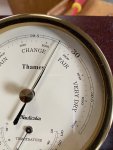
Why are these barometer scales different?

MattS

Well-Known Member
Joined
7 Sep 2020
Messages
570
Location
Kent
Visit site
Help, what am I missing... have got a replacement clock and barometer for the boat, but I've noticed that the new barometer has a different scale to the old one. New reckons 30 inHg = 1031mbar, whereas old reckons 30 inHg = 1016mbar...

Photos attached - I'm sure I'm missing something key!
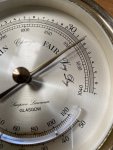
IMG_4119.JPG
IMG_4120.JPG
 
I am tempted to say that the answer is in the name. One made by a reputable marine company and another by a company famous for producing toys that should never go anywhere near a boat. For the avoidance of doubt 30inHg = 1016 mbar
 
To be fair, most baro's are a bit vague with their scales, it's the movement of the needle which counts really.
Just looked, my new Plastimo one says 1007 today, the old Simpson-Lawrence says 1009, surprisingly close.
 
I think you've all confirmed what I suspected, which incidentally is what I have just said to Nauticalia on the phone... I think you had a dodgy batch of barometers made up!

Can you guess which ones are now going on Ebay...
 
I think you've all confirmed what I suspected, which incidentally is what I have just said to Nauticalia on the phone... I think you had a dodgy batch of barometers made up!

Can you guess which ones are now going on Ebay...
Why not send it back?

I can't see how they can refuse to refund / replace
 
Before throwing one away, why not test them both ?
Pick up an airport near you, find its ICAO code (example Heathrow --> EGLL), then search "metar EGLL": it will bring you several sites with the hourly official pressure recordings for that airport (already reduced to sea level, no corrections necessary).
First calibrate your two barometers (there is usually a tiny screw that can move the needle) to show the same pressure value reported by the Metar, then wait for a significant movement in pressure (say a low coming through with a following building ridge) and note as many as you can of the three pressure values, METAR - #1 baro - #2 baro.
Compare the data and keep the one which seems to behave best :)
 
Does anyone still use inches of mercury? I thought that went out with the dinosaurs! Even millibars are deprecated; we should use Pascals. As millibars are hectoPascals (I think) there's an easy conversion.

Yes!
Our council offices have a beautiful old Mercury barometer in a special window visible from the street, this goes back to when Aberaeron was an active seaport, of course the graduations are in inches, but as it is only about 8 ft above sea level it’s a great way of checking ones boat barometer, so please keel the inches on a modern instrument.
 
In the US is still mostly mm Hg, although the NOAA reports both side by side.

Although I find it funny that 1 standard atmosphere is not 1000 mbar.
That's because Pascals are defined in terms of more basic units (ultimately metres, kilograms and seconds), not in terms of atmospheric pressure. It's a convenient coincidence that atmospheric pressure usually falls somewhere near 1000 HPa, but it is no more by design than that atmospheric pressure is usually around 30" of mercury.
 
Historically, not sure they were inches of mercury: Evangelista Torricelli in the 1600ish (then Galileo disciple) invented the mercury barometer and most likely did not know about inches.
As for the 1013.xx hPa, in Torricelli tube the atmospheric pressure is equal to mercury saturated vapour pressure minus mercury density x gravity acceleration x height (Stevin's law)
Mercury density is 13.6 x 10^3, g=9.81 m/s^2, at sea level and standard atmosphere the mercury column height is 7.6 m^-1; hence:
1 Atm = 13.6 × 9.81 × 7.6 x 10^(something) = 1013 hPa

That's where 1013 hectoPascal come from :)
 
All this aside, I feel like I'm going to struggle with the idea of having a barometer mounted on my bulkhead that is fundamentally incorrect - even if it technically reads accurately, it can only be accurate on one of the scales at any one time!

I think I'll just find a local clock repairer and get them to restore the original Simpson Lawrence units!
 
That's because Pascals are defined in terms of more basic units (ultimately metres, kilograms and seconds), not in terms of atmospheric pressure. It's a convenient coincidence that atmospheric pressure usually falls somewhere near 1000 HPa, but it is no more by design than that atmospheric pressure is usually around 30" of mercury.

Yup, I got that. I knew the base units of PA, I just never thought about the coincidence.

That is startling that the barometer could be produced with such a blatant error.
 
All this aside, I feel like I'm going to struggle with the idea of having a barometer mounted on my bulkhead that is fundamentally incorrect - even if it technically reads accurately, it can only be accurate on one of the scales at any one time!

Most of us are prepared to live with a compass that requires a deviation card for accuracy, having calibrated the barometer, why not have a correction card mounted alongside?!
 
Top