
Why are these barometer scales different?

Before throwing one away, why not test them both ?
Pick up an airport near you, find its ICAO code (example Heathrow --> EGLL), then search "metar EGLL": it will bring you several sites with the hourly official pressure recordings for that airport (already reduced to sea level, no corrections necessary).
First calibrate your two barometers (there is usually a tiny screw that can move the needle) to show the same pressure value reported by the Metar, then wait for a significant movement in pressure (say a low coming through with a following building ridge) and note as many as you can of the three pressure values, METAR - #1 baro - #2 baro.
Compare the data and keep the one which seems to behave best :)
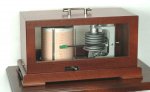
That’s very similar to what we do. Simple barometers can be surprisingly accurate. However we also have one of these screwed to a specially made bracket/shelf on a bulkhead:
E34C50B6-1580-4CA2-B9CD-BE6F65E1EFE0.jpeg
You can see what’s happening to the pressure at a glance.
 
A barometer graduated in arbitrary units, eg 0-177 Gerbils per Square Furlong, would be just as useful because it's the pressure trend, and the position and movement of the needle, which matter.
It depends on what you ask from a barometer. Example: there is a low which is forecast to pass over your position, models are not sure about its evolution, the lowest forecast pressure for the following day is say 990 at 1200utc: if by 0800 you read 980 and the barometer has just shown a tiny variation, I would deem it a (very) important information about what is going to happen during the day. :)
 
It depends on what you ask from a barometer. Example: there is a low which is forecast to pass over your position, models are not sure about its evolution, the lowest forecast pressure for the following day is say 990 at 1200utc: if by 0800 you read 980 and the barometer has just shown a tiny variation, I would deem it a (very) important information about what is going to happen during the day. :)
I am keen to learn from the experts, but I don't quite understand the example given; when you say, 'if by 0800 you read 980..', do you mean read it in the updated weather forecast? Cheers.
 
I am keen to learn from the experts, but I don't quite understand the example given; when you say, 'if by 0800 you read 980..', do you mean read it in the updated weather forecast? Cheers.
Sorry I should have been clearer: if in the morning you read 980hPa from your calibrated barometer, and pressure has just begun to decrease, that means the actual pressure movement is very different from the forecast which said it will be 990 and a few hours later, the low will be (is already) deeper than forecast and probably nastier. An uncalibrated barometer does not allow this comparison, one would just read the small drop.
I just queried the table below but values are not very significant as nothing strange is happening weatherwise, but you can get pressure forecasts at various synoptic times, then check during the day how/if the forecast fits actual spot values, not only variations

Forecast for 47°30N 003°30W
Date Time WIND DIR GUST PRESS HTSGW DIRPW PERPW CAPE
utc kts deg kts hPa mtrs deg sec
----------- ----- --- ---- ------ ----- ----- ----- ----
04-27 06:00 22.3 072 29.1 1018.5 1.2 82 4.4 0.0
04-27 09:00 22.1 074 27.5 1019.7 1.2 87 4.5 0.0
04-27 12:00 18.3 080 23.9 1019.7 1.0 84 4.4 0.0
04-27 15:00 16.0 081 22.5 1019.1 0.9 85 4.1 0.5
04-27 18:00 13.7 075 20.8 1019.5 0.8 244 7.9 5.6
04-27 21:00 14.0 047 22.3 1021.5 0.7 242 7.8 0.0

Nothing is strictly necessary of course, but comparing actual values with forecasts made for that specific time can give more insight into what is really happening wrt forecasts; pretty much like wind shifts, etc.
 
Sorry I should have been clearer: if in the morning you read 980hPa from your calibrated barometer, and pressure has just begun to decrease, that means the actual pressure movement is very different from the forecast which said it will be 990 and a few hours later, the low will be (is already) deeper than forecast and probably nastier. An uncalibrated barometer does not allow this comparison, one would just read the small drop.
I just queried the table below but values are not very significant as nothing strange is happening weatherwise, but you can get pressure forecasts at various synoptic times, then check during the day how/if the forecast fits actual spot values, not only variations

Forecast for 47°30N 003°30W
Date Time WIND DIR GUST PRESS HTSGW DIRPW PERPW CAPE
utc kts deg kts hPa mtrs deg sec
----------- ----- --- ---- ------ ----- ----- ----- ----
04-27 06:00 22.3 072 29.1 1018.5 1.2 82 4.4 0.0
04-27 09:00 22.1 074 27.5 1019.7 1.2 87 4.5 0.0
04-27 12:00 18.3 080 23.9 1019.7 1.0 84 4.4 0.0
04-27 15:00 16.0 081 22.5 1019.1 0.9 85 4.1 0.5
04-27 18:00 13.7 075 20.8 1019.5 0.8 244 7.9 5.6
04-27 21:00 14.0 047 22.3 1021.5 0.7 242 7.8 0.0

Nothing is strictly necessary of course, but comparing actual values with forecasts made for that specific time can give more insight into what is really happening wrt forecasts; pretty much like wind shifts, etc.
Amazing, cheers for the lesson !
 
Before throwing one away, why not test them both ?
Pick up an airport near you, find its ICAO code (example Heathrow --> EGLL), then search "metar EGLL": it will bring you several sites with the hourly official pressure recordings for that airport (already reduced to sea level, no corrections necessary).
First calibrate your two barometers (there is usually a tiny screw that can move the needle) to show the same pressure value reported by the Metar, then wait for a significant movement in pressure (say a low coming through with a following building ridge) and note as many as you can of the three pressure values, METAR - #1 baro - #2 baro.
Compare the data and keep the one which seems to behave best :)
That's a good plan for 'road-testing' the two instruments, but for calibrating the one the OP will put into use, he will need to have it at sea level reasonably near an airport and use the pressure value reported by its METAR.
I am fortunate in that my boat is within earshot of Dublin Airport.
In Ireland, Met Eireann's website contains nationwide weather station reports, with pressure reduced to QNH:
Dublin Airport Observations - Met Éireann Observations for Dublin Airport, Ireland - The Irish Meteorological Service
I couldn't find similar on the menu of the metoffice.gov.uk website, but entered "marine" in the search box and found this result four lines down:
Marine observations
 
Last edited:
Surely you will only need to know the pressure in the metric units of your choice, and calibrate the instrument correctly in those, while regarding the imperial units as irrelevant.

Technically yes you're right :) I will never need the incorrect scale...

But on principle I don't now want to replace a well made instrument with something that was clearly made very cheaply...!
 
Does anyone still use inches of mercury? I thought that went out with the dinosaurs! Even millibars are deprecated; we should use Pascals. As millibars are hectoPascals (I think) there's an easy conversion.
Why 'should'? As it happens, I continue to use mm Hg, but my old hall barometer reads in inches and I am not aware of any law that forbids its use. I can't get used to names such as pascals, or even newtons for that matter, so for my remaining decade or so I shall ignore the thought police and use whatever suits me at the time.
 
Historically, not sure they were inches of mercury: Evangelista Torricelli in the 1600ish (then Galileo disciple) invented the mercury barometer and most likely did not know about inches.
:)
Old Italian measurements. (generally)
1 Oncia
12 Oncia = 1 Piede liprando
4 Piedi liprando = 1 Canna
note 1 Piede liprando = 0.51377 m so 513.77mm / 12 = 42mm so one italian inch = 1.69 Imperial inches.
However different Italian states had different versions so your Italian inch could be as high as just over 2 imperial inches or about 3/4 of a imperial inch..

As Roberto says, there should be an adjustment on the back, it might be both are out of adjustment. Get the correct value for the day for where you are and a small screwdriver..

1 atmosphere? isn't that 14.2 pounds?
 
Top