Who said this aabout modern yacht designs?

.....That's a 308 mile race that they did that year in 30 hours. Average over 10 knots.

And here's another one. a 1250 did the 2015 Transatlantic race from Newport to Cowes. They did the 2800 mile course in just over 13 days. Average speed about 9 knots. Not at all bad considering that year also had some pretty light patches....


Two fun vids to watch as the UK slowly grinds to a halt ?

I'd jump on one of those in a heartbeat!
 
You must excuse my lack of knowledge about yacht racing. After spending most of my life racing motorbikes I have lost interest in any kind of racing.

It was the boat he cruised in with the family every summer, took most of the gear out and emptied the tanks and entered his clubs regular races with his mates at the weekends.

I will admit he was not very successful - whether it was the boat or him we shall never know. But it was clear that when loaded with all the cruising gear plus fuel and water he was disappointed with its performance from what he said while I was on board. I suspect it was purely subjective, not accurately measured.

FYI, the Evans Bay club here in Wellington has a regular Saturday afternoon race for cruisers. Proper cruisers - lightweight racers are not allowed to enter. Very popular, usually about 15 taking part, even Bob in his 32 foot steel gaff rigged cutter with a particularly small rig - he often races single handed.

The keen ones do leave their anchors at home and empty the water tanks.........................

That is a race for cruisers then! Malo have always been on the heavy side of the scale...
 
Just to correct a couple of things here.


No, it didn't. It started with whether a racing Designer was a better person to be drawing cruising boats. It's drifted all sorts of places, but the original quote was about designers, not designs.


Relative is basically meaningless unless you are going to apply it as some sort of handicap to decide who the better crew was... Is the new boat of the same size faster or slower?


Absolute nonsense. 6.5kts in long distance racing for Pogo type boats? Where did you get that? Complete and utter rubbish. For evidence...


That's a 308 mile race that they did that year in 30 hours. Average over 10 knots.

And here's another one. a 1250 did the 2015 Transatlantic race from Newport to Cowes. They did the 2800 mile course in just over 13 days. Average speed about 9 knots. Not at all bad considering that year also had some pretty light patches....

In cruising mode they obviously wouldn't push as hard. But to deny the speed potential of the boat for offwind passage making is total rubbish.
The number of 6.5 for 40 class boats average is from the Route du Rhum. The one for Bolero is from Bermuda races.

There is no doubt that a Pogo can chase across an ocean on a downhill run with lots of coloured sail and at high (planing) speeds. When winds are light, the runs are not all to leeward or the boat is carrying cruising gear, speeds are not much higher than other displacement craft.
 
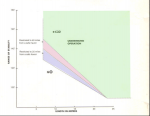
Interesting stability graph, posted on the boat design.net


UK commercial sailing vessels
1584377152236.png

The two indicators are for Grimalkin (IOR half ton) and Contessa 32.

The chart shows the relationship between boat size and AVS (angle of vanishing stability)
The larger the boat, the more able it is to resist capsize and hence the lower the AVS can be.
Smaller boats require a greater range of positive stability.1584377152236.png

c32-g-jpg.94536
<
 
The number of 6.5 for 40 class boats average is from the Route du Rhum. The one for Bolero is from Bermuda races.

RdR average of 6.5 knots? You are full of it!

The latest RDR had 6 Class 40s arriving in less than 18 days. 18 days to cover the 3542 miles is an average of 8.2 knots. 6 boats were faster than that. The winner averaged over 9 knots. And that's average VMG, not average boatspeed. Since all of them sailed considerably more miles than the rhum line, average boat speed would be considerably higher still.
One boat (the multihull line honours winner) covered 4367 miles. If you look at the tracker you will see that the class 40s sailed a very similar track. In fact, a bit longer as they were forced further south. 4367 miles in 18 days is an average boatspeed of over 10 knots.
And you should bear in mind that they spent the first 3 days or so going upwind in heavy airs....

An average VMG of 6.5 knots, would be, by my maths, 22.7 days.
21 out of the 34 finishers were faster than that. Most of the latter finishers had damage of some sort or made pit stops.

You could also look at the TJV. The last edition, sailed at the end of last year featured the latest generation of class 40s. It's a longer race, to Brazil, and it also crosses the doldrums. By my calculations the top 7 Class 40s averaged over 9.5 knots VMG. Again the start of the race was heavy airs upwind. And they also had to cross the doldrums. Yet the winners averaged over 10 knots VMG. VMG! Again average boatspeed would be considerably quicker.

Hull speed for a traditional 40 foot boat is about 8 knots. These boats are crossing oceans averaging over hull speed.... But you think they're not quick...?

Your "facts" are not stacking up. These are seriously quick 40 footers.

There is no doubt that a Pogo can chase across an ocean on a downhill run with lots of coloured sail and at high (planing) speeds. When winds are light, the runs are not all to leeward or the boat is carrying cruising gear, speeds are not much higher than other displacement craft.

Well knock me down with a feather.... Planing boat "not massively quicker than other boats when not planing..." Who'd have thought it.... That point is so obvious it really doesn't need stating.

The point is that an awful lot of cruising passages are done downwind in medium to fresh conditions. So why not do them in a boat designed to sail fast downwind? If you want to talk about high latitude sailing, it's a totally different kettle of fish. But for predominantly tradewinds, warm weather cruising, there is a different option to the traditional heavy boat now.

For all your talk of seaworthiness, there is a safety factor in speed that you are overlooking. And that is simply that the ability to do consistent double digit speeds makes routing the boat around bad weather a lot more feasible than at 5-6 knots. And avoiding bad weather is a better option than having a great strategy to deal with it....
For example, see the different experiences when the GGR raced through the southern ocean in their traditional boats, vs when the class 40s did.
 
Interesting stability graph, posted on the boat design.net


UK commercial sailing vessels
View attachment 86429

The two indicators are for Grimalkin (IOR half ton) and Contessa 32.

The chart shows the relationship between boat size and AVS (angle of vanishing stability)
The larger the boat, the more able it is to resist capsize and hence the lower the AVS can be.
Smaller boats require a greater range of positive stability.View attachment 86429

c32-g-jpg.94536
<

Oh honestly. If you're going to talk about the seaworthiness of modern boats, it's best not to use as an example of a "bad" boat one from 1979....
 
Oh honestly. If you're going to talk about the seaworthiness of modern boats, it's best not to use as an example of a "bad" boat one from 1979....

The "bad boat" from 1979 shares all the same features as the "bad boats" that turtled during the 1998 S-Hobart or any of the slew of Open 50ies that capsized and failed to right themselves and many contemporary designs as well: light displacement, wide beam, comparatively modest AVS and super-light and consequently, low inertia rigs.
stat-stability-vo-jpg.94601

A depression travels at between 20 and 30kts. Perhaps a racing boat might, with careful routing be able to skirt it, but not actually outrun it.
Most cruisers don't have the same kind of routing capability as far as I know and, as you have pointed out, not the speed to evade. Current weather patterns are becoming less predictable.

The current crop of light flyers need to actively contribute to their survival by maintaining speed in rough conditions. Modern autopilots can do that in absence of a helmsman, but it requires considerable reliance on technology and at no time is such reliance, or not being on watch, if short-handed, consistent with good seamanship.

Racing requires a completely different mind set than cruising and a greater preparedness to accept risk. Anyone who has done ocean racing knows that, but to consider speed a substitute for passive seaworthiness, when the chips are down, the crew is exhausted, injured or seasick, is simply playing lottery with your life or worse, the lives of your crew. Sooner or later things will catch up, not just statistically speaking.

Perhaps the parametres for seaworthiness have changed. If so, someone should really let the sea know that.
 
A depression travels at between 20 and 30kts. Perhaps a racing boat might, with careful routing be able to skirt it, but not actually outrun it.
Most cruisers don't have the same kind of routing capability as far as I know and, as you have pointed out, not the speed to evade. Current weather patterns are becoming less predictable.

Clearly you do not understand weather routing. Or what is available at extremely reasonable cost to cruisers now. If you consider that forecasters can reasonably predict the path of a depression 4 days into the future, a boat capable of averaging 10 knots can be nearly 1000 miles away when it arrives. That's more than enough to avoid the worst weather. Have a look at what La Vagabonde did during their recent transatlantic with Greta on board. That is an absolute case study in good cruising routing on a relatively fast boat. At one point they slowed to let a rough patch pass in front of them. At one point they dived 200 miles south to avoid 40 knot winds and at one point they put the hammer down to ensure they stayed in front of something. All done on board with basic routing software on what is clearly a cruising boat. As a result they safely crossed the Atlantic without seeing more than 30 knots at any point. A slower boat without routing would have seen multiple occasions of 40+ knots on the same crossing.

The current crop of light flyers need to actively contribute to their survival by maintaining speed in rough conditions. Modern autopilots can do that in absence of a helmsman, but it requires considerable reliance on technology and at no time is such reliance, or not being on watch, if short-handed, consistent with good seamanship.

Again, the point with fast boats is not to be in very rough conditions. But yes, when you are in them you are best served by running fast. And yes, you are absolutely right that modern autopilots are more than capable of this. And again, I suggest you look at the comparative performances of the supposedly very seaworthy Golden Globe boats, and the performances of the class 40s etc when they have been in the Southern ocean. Or even some of the rough Atlantic crossings the Class 40s have done. Your view of the seaworthiness of older boats vs newer boats is steadily being challenged by real world observations.

Racing requires a completely different mind set than cruising and a greater preparedness to accept risk. Anyone who has done ocean racing knows that, but to consider speed a substitute for passive seaworthiness, when the chips are down, the crew is exhausted, injured or seasick, is simply playing lottery with your life or worse, the lives of your crew. Sooner or later things will catch up, not just statistically speaking.

Perhaps the parametres for seaworthiness have changed. If so, someone should really let the sea know that.

You are again simply seeing cruising through only your eyes. There are 2 points to this. Firstly that the speed of a Pogo etc gives you the option to get out of the way that something averaging 5 knots does not have. You could just as easily argue that going to sea in a boat that does not have the ability to clear out of the way of a big weather system is statistically more dangerous. It's not as if traditional boats have anything close to a 100% record when in bad weather. Remember that the worst case in the 1998 Hobart was the Winston Churchill. A very traditional boat that was overwhelmed and sank. Time and time again, after big storms hitting fleets of boats we see the simple truth that not being in the worst of the weather is by far and away the best survival mechanism. In the past that has been a large slice of luck. Fastnet 79 for example. Boats like Grimalkin were in the absolute worst of the weather, whilst their design didn't help it's also worth remembering that more traditional boats also fared badly in that storm. Sydney 98 as well, WC was in the very worst part of the storm. But weather forecasting, and crucially getting good forecasts to boats at sea has changed a massive amount. Note, for example, that in the 2017 OSTAR, the faster boats were able to route around the storm and saw only "quite rough" conditions whilst the more traditional boats got hammered.

Secondly, as discussed up the thread, the AVS of the Pogo is not really any worse than other contemporary cruisers. And whilst the tactics used by lighter more modern boats will be different than those preferred by more traditional boats, there is no evidence that they are less successful. Again, Golden Globe vs Class 40s in the Southern Ocean....
 
Top