Who said this aabout modern yacht designs?

If that was the basis of their argument, then you would have a point. But it wasn't. They were bemoaning the new boats for not behaving like the old boats, without stopping to consider if the way they were sailing the boat was in any way influencing the boat's behaviour.
As regards the 2" dropping of the car (not traveller, jib car) back. To be honest I wouldn't expect most cruisers to have bothered bringing it forward in the light. It's just that the rounding up is not being caused by the main, as they will have been conditioned to expect, so they're reacting with traveller and main sheet and getting annoyed when the boat doesn't behave as their old one did, when it would probably be prevented in the first place with jib car. (Although obviously a wildly over trimmed main, or one that is far too big for the conditions, will also cause broaching.)

Approach is not constant moving of cars, it's more " if my boat is rounding up all the time, bring the jib car back a bit. If I'm not bothered about top speed in the light, leave it back. Problem solved, go back to reading book."

An excellent summary (when read in conjunction with previous post) of some useful techniques that lots of cruisers can put into practice right away.

Flaming's other point re there never being such a big difference between racing and cruising boats. This is manifestly correct. Witness the collapse of the cruiser racer segment. The market is now dominated by racing boats, cruising boats, with a few pricey sports cruisers thrown in. This latter segment will beat the pants off older cruising boats and modern charter tubs alike. But as mentioned earlier, there is something for everyone.

The other contention here is that older boats are somehow more seaworthy and faster than modern equivalents. This is manifestly false. Just look at weapons routinely scorching through the roaring forties, furious fifties, and sometimes even skimming the screaming sixties. Pull back to very fast from outright race mode and these boats are unbelievably powerful and safe.

I'm still at a loss to understand why those with a penchant for older boats are getting so worked-up about this :)
 
Anyone who likes may look back in this thread to see that it was stated, right at the beginning, that the gulf between racing boats and cruising boats has never been greater. That was never disputed.
What was said, was that new (cruising) designs that "mimic" racing designs (for reasons of interior volume and layout) are less suitable for their purpose. A boat with an SA/D ratio of around 16 is simply not a racer no matter how wedgy they look. The current crop of "sport cruisers/racers" (Pogo/JBK) have SA/D ratios between 28 and 40. The fact that Flaming races his, successfully, by his own account, would demonstrate that the breed of cruiser/racer is not dead.

It is also a fact that, generally speaking, ballast ratios have been dropping and in some cases well below 3o%. A while back, that would have been considered marginal. It has been assumed that most things put onboard would be below the CG. That is not true. Most designers are really cadgey about revealing where that centre is, but for most modern boats it is at or near the waterline.
The assumption that tanks, engines, batteries and ship's systems are all below CG is not correct.
The ID 40, a relatively modern design, LOA 12.05, 3.71 beam, with a half-load displacement of 8.12 tons, Ballast ratio 45%, has a CG exactly at the DWL. The canoe body has a depth of 0.57 cm (half-load).
Deduct 15cm for the floors & stringers and everything added to the boat above the seats is above the CG. Total CG for ship's systems (see above) is actually above CG. AVS ( angle of vanishing stability) is 129 degr.

Let's compare her with a Pogo 12.50:

Length 12.50m, beam 4.50m, displacement 5.5 tons, ballast ratio 35.5
Assuming a prismatic coefficient of 0.65, we can calculate her canoe body of having a depth of around 20cm. We can safely assume the CG to also be at or near DWL. No matter how carefully the tanks are molded into the hull, most of any gear or supplies loaded will be above the CG and detract from stability at higher angles of heel. AVS will be lower than that of the ID 40.

Hydrostatic stability
GZ is the couple between CG and CB. Wide beam can provide high initial stability, but this decreases rapidly at higher angles of heel.

Dynamic stability
Asymmetric hull forms, wide beam and light displacement pose an increased risk of capsize in large seas (Marchaj, Seaworthiness, the Forgotten Factor).
 
The fact that Flaming races his, successfully, by his own account, would demonstrate that the breed of cruiser/racer is not dead.

Dunno how it does that, seeing as how it's not doing any cruising... It's really a weekender at best. Though still with more space than a Contessa!

I still have no idea who you actually think you're really arguing with... It's been made absolutely clear that the current crop of AWB cruisers are nothing like as fast as the current crop of race boats. We agree here...
What we now have is the Pogo etc breed. Boats designed specifically for live aboard sailing. But to do so in a way that is quite different from your "load using a forklift" approach...
As has been quite clearly stated several times now, you cannot load these boats in the same way as you can load a heavy displacement cruiser without severely impacting the performance. Again, we are very much in agreement.
That doesn't make them better., It doesn't make them worse. It makes the whole approach to going cruising in them different.

You seem to be struggling with the concept that some people want to go cruising without loading the boat heavily, and that as such a Pogo etc is a very good choice of boat. Couple the boat's speed potential with some decent weather routing and the chances of getting caught out in anything particularly nasty seem pretty slim.
 
I know it's only my account too, but I've seen 'im do it. He's quick.

ps. What's an ID 40?
Sorry it's YD 40. The YD 40 is the boat featured as a calculation example used in Larson & Eliason, Principles of Yacht Design, 1994. Excellent book and a much more up-date version to Kinney's, Skene's Elements of Yacht Design. I believe the boat was built in Sweden, possibly under a different name. Looks suspiciously like a new(ish) Najad.
 
Wide beam can provide high initial stability, but this decreases rapidly at higher angles of heel
This is true, and initial stability is, along with ultimate stability, part of the "defence" against a large breaking wave. It's not just a question of "what's the angle of vanishing stability" it's also a question of how much energy it takes to get there, which is indicated by the area under the stability curve.
 
Dunno how it does that, seeing as how it's not doing any cruising... It's really a weekender at best. Though still with more space than a Contessa!

I still have no idea who you actually think you're really arguing with... It's been made absolutely clear that the current crop of AWB cruisers are nothing like as fast as the current crop of race boats. We agree here...
What we now have is the Pogo etc breed. Boats designed specifically for live aboard sailing. But to do so in a way that is quite different from your "load using a forklift" approach...
As has been quite clearly stated several times now, you cannot load these boats in the same way as you can load a heavy displacement cruiser without severely impacting the performance. Again, we are very much in agreement.
That doesn't make them better., It doesn't make them worse. It makes the whole approach to going cruising in them different.

You seem to be struggling with the concept that some people want to go cruising without loading the boat heavily, and that as such a Pogo etc is a very good choice of boat. Couple the boat's speed potential with some decent weather routing and the chances of getting caught out in anything particularly nasty seem pretty slim.
I dont disagree with this. I think anybody who chooses to cruise a Pogo understands the kind of boat it is and its limitations as a load lugger. The issue I have and probably didnt make very well, is that the current crop of ‘normal’ production boats that in the mind of the designers, were intended to replace the older cruising boats like mine, dont really fill the roll very well. The kind of cruising most people are doing here the Caribbean is carrying there shell on their back. Their boat is their home if not full time then at least 6 months of the the year. Just about all of our cruising friends have boats that are full to the brim. Spare bunks become storage spaces. Us cruisers tend to fill the boat up regardless of size. You expand to fill the space available. We are pretty ruthless at auditing the stuff we have onboard. We carry no more fuel than we need or water. We have a watermaker so we routinely only have 200 litres in the 800 litre tank. Several groups of friends dont have a watermaker so they fill their tanks to the brim. This is the cruising life over here. Overloaded or at least fully loaded.
My observation is that the modern 40-50 ft cruisers doesnt take this weight well. When they load up they are slower or at least as slow as the same older generation of boat that is also loaded up. Instead of modern cruising boats being a major step forward from those of the past, I see a number of negative aspeçts to these new designs.
 
I dont disagree with this. I think anybody who chooses to cruise a Pogo understands the kind of boat it is and its limitations as a load lugger. The issue I have and probably didnt make very well, is that the current crop of ‘normal’ production boats that in the mind of the designers, were intended to replace the older cruising boats like mine, dont really fill the roll very well. The kind of cruising most people are doing here the Caribbean is carrying there shell on their back. Their boat is their home if not full time then at least 6 months of the the year. Just about all of our cruising friends have boats that are full to the brim. Spare bunks become storage spaces. Us cruisers tend to fill the boat up regardless of size. You expand to fill the space available. We are pretty ruthless at auditing the stuff we have onboard. We carry no more fuel than we need or water. We have a watermaker so we routinely only have 200 litres in the 800 litre tank. Several groups of friends dont have a watermaker so they fill their tanks to the brim. This is the cruising life over here. Overloaded or at least fully loaded.
My observation is that the modern 40-50 ft cruisers doesnt take this weight well. When they load up they are slower or at least as slow as the same older generation of boat that is also loaded up. Instead of modern cruising boats being a major step forward from those of the past, I see a number of negative aspeçts to these new designs.
geem
I certainly agree with you that liveaboard cruisers add add add and add some more. To a lesser extent, as a three months a year cruiser, we have done much the same. I am sure the process of accumulation of gear is similar whether you have an old yacht or a brand new one. But I remain unconvinced that last century designs can cope with the extra weight any better than current ones. Which bit of Archimedes law has been changed?
You say that "When they load up they are slower or at least as slow as the same older generation of boat". Can you support that assertion with any hard data? I very much doubt it.

Following this thread has accentuated the differences in view between the generation owning their own , older yachts and defending them blindly. I think we have to face up to it, the vast majority of today's new boat purchasers want bigger, cleaner, faster yachts. Look at the Dufour 53 where production is aimed at selling 60 plus boats in a year. Look at all the Ben/Jen/Bav/Hanses that do the ARC each year. There is plenty of real sailing going on in these modern designs.
 
Now that is my major complaint about modern manufacturers. In their race to sell for the lowest price they have somehow managed to convince a lot of people that towable cars etc are "racy" and not suitable for a cruising boat. Which is a total nonsense.


No argument at all with your description of modern cruising sailors. But not sure how that's an argument in this debate? If they're only pootling along under headsail at circa 50% of the boat's potential, then they are not going to be spinning out like the boat testers in the Practical sailor article...


Nobody is claiming that there is no such thing as a bad boat... And that Hunter does sound like one...

As for your cruising boat requirements. It's a sensible list, but it won't be universal. I, for example, wouldn't be so bothered about transom slap or ability to take the ground, but would want decent performance and a really good comfortable helming position. Which is often hideously overlooked.
Its interesting how people requirements can be so different. Having just sailed a typical 125 nm over night in 20kts on the beam down the Windward side of the islands here with a 2m sea. A comfortable helm position isn't high on my list. Part of the trip was under Windpilot and the other part under autopilot. We have decent performance, no problem there, a none slapping transom would be high on my priority list as we spend at least 9 months of the year at anchor. A comfortable cockpit is very high on my list. It should have excellent shelter from wind, sun, rain and spray. I want to be able to see the sails without looking around a bimini. Lots of boats here have terrible view of the sails from the cockpit. A sea kindly motion is important as one of us will be asleep half the time when on night passages. Easy handled good performance sails. We have a solent rig, fully battened main and mizzen. Lots of sail options. Going to windward with more than 20 kts over the deck we use our working jib on the inner furler. Huge performance advantage over a furled 130% genoa that we see so often. A tall rig that allows us to set large sail area in light winds. Stumpy little masthead rigs dont work. Deep draft. Nothing beats a deep keel if you want to make progress to windward. There is lots more but you get the picture. Ones requirements are often born out of your experience and the way you use your boat.
 
This is true, and initial stability is, along with ultimate stability, part of the "defence" against a large breaking wave. It's not just a question of "what's the angle of vanishing stability" it's also a question of how much energy it takes to get there, which is indicated by the area under the stability curve.
The upper area of the stability curve indicates the amount of energy necessary to effect a capsize; that is the safe zone. The lower area should, ideally, be as small and shallow as possible. The steeper the angle at the transition, the more energy is needed to right the boat from an inverted position.
Boats with an AVS of 150 degr (or greater) will, according to Marchaj, self-right very quickly as long as there is no serious down flooding. AVS is a hydro-static calulation, i.e. for flat water.

Older designs tended to have higher ballast/displ. ratios, newer designs frequently have ratios well under 30% to save weight. To make up for righting moment and to carry the larger sail areas the boats are made beamier. The problem is that the centre of gravity has risen over the years and at higher angles of heel GM is getting smaller and because the boats are significantly lighter, righting moments are getting smaller. Beamy, light boats tend to readily follow the inclination of a wave and quickly find themselves on the diminishing reverse slope of the stability curve. The dynamic impact of a wave is provided with a larger turning lever and area as the deck edge finds a grip in the water. The remaining righting force is quickly overcome. Marchaj.

For a number of years I noticed that yachting mags would post stability curves when introducing new designs. This seems to have gone out of fashion. To be honest, a lot of this was bollocks, since the numbers were mostly based on empty displacements. Designers often massaged the numbers to meet minimum stability requirements, ignoring simple "options" like furlers, radars, arches etc, etc. Does that really matter?
A few years ago an Oceanis 390 capsized in the Biskay in F8-9 of wind and someone drowned. The board of inquiry found that the boat had an AVS of only 109.37 degr., too little to cope with the dynamically reduced stability conditions.
From the report: "Ocean Madam was a production Beneteau Oceanis 390 yacht. The class is typical of its type with a high volume, low ballast ratio, light displacement and shallow hull form." and "The class is typical of its type with a high volume, low ballast ratio, light displacement and shallow hull form. It is highly suitable for most activities including charter work and has a good safety record. It is not a suitable craft for crossing oceans in bad weather."

S.A./Disp.:
17.17

Bal./Disp.:
36.22

Disp./Len.:
173.67

Capsize Screening Formula:
2.12
 
geem
I certainly agree with you that liveaboard cruisers add add add and add some more. To a lesser extent, as a three months a year cruiser, we have done much the same. I am sure the process of accumulation of gear is similar whether you have an old yacht or a brand new one. But I remain unconvinced that last century designs can cope with the extra weight any better than current ones. Which bit of Archimedes law has been changed?
You say that "When they load up they are slower or at least as slow as the same older generation of boat". Can you support that assertion with any hard data? I very much doubt it.

Following this thread has accentuated the differences in view between the generation owning their own , older yachts and defending them blindly. I think we have to face up to it, the vast majority of today's new boat purchasers want bigger, cleaner, faster yachts. Look at the Dufour 53 where production is aimed at selling 60 plus boats in a year. Look at all the Ben/Jen/Bav/Hanses that do the ARC each year. There is plenty of real sailing going on in these modern designs.
I'm not sure you have ever sailed E to W across the Atlantic. The route taken by the ARC from the Canaries to the Caribbean is not exactly the "Eiger North Face" of sailing; people have done it in a folding kayak and all sorts of other unsuitable craft and if one had to, you could probably drift across in a garbage can.
 
The upper area of the stability curve indicates the amount of energy necessary to effect a capsize; that is the safe zone. The lower area should, ideally, be as small and shallow as possible. The steeper the angle at the transition, the more energy is needed to right the boat from an inverted position.
Boats with an AVS of 150 degr (or greater) will, according to Marchaj, self-right very quickly as long as there is no serious down flooding. AVS is a hydro-static calulation, i.e. for flat water.

Older designs tended to have higher ballast/displ. ratios, newer designs frequently have ratios well under 30% to save weight. To make up for righting moment and to carry the larger sail areas the boats are made beamier. The problem is that the centre of gravity has risen over the years and at higher angles of heel GM is getting smaller and because the boats are significantly lighter, righting moments are getting smaller. Beamy, light boats tend to readily follow the inclination of a wave and quickly find themselves on the diminishing reverse slope of the stability curve. The dynamic impact of a wave is provided with a larger turning lever and area as the deck edge finds a grip in the water. The remaining righting force is quickly overcome. Marchaj.

For a number of years I noticed that yachting mags would post stability curves when introducing new designs. This seems to have gone out of fashion. To be honest, a lot of this was bollocks, since the numbers were mostly based on empty displacements. Designers often massaged the numbers to meet minimum stability requirements, ignoring simple "options" like furlers, radars, arches etc, etc. Does that really matter?
A few years ago an Oceanis 390 capsized in the Biskay in F8-9 of wind and someone drowned. The board of inquiry found that the boat had an AVS of only 109.37 degr., too little to cope with the dynamically reduced stability conditions.
From the report: "Ocean Madam was a production Beneteau Oceanis 390 yacht. The class is typical of its type with a high volume, low ballast ratio, light displacement and shallow hull form." and "The class is typical of its type with a high volume, low ballast ratio, light displacement and shallow hull form. It is highly suitable for most activities including charter work and has a good safety record. It is not a suitable craft for crossing oceans in bad weather."

S.A./Disp.:
17.17

Bal./Disp.:
36.22

Disp./Len.:
173.67

Capsize Screening Formula:
2.12

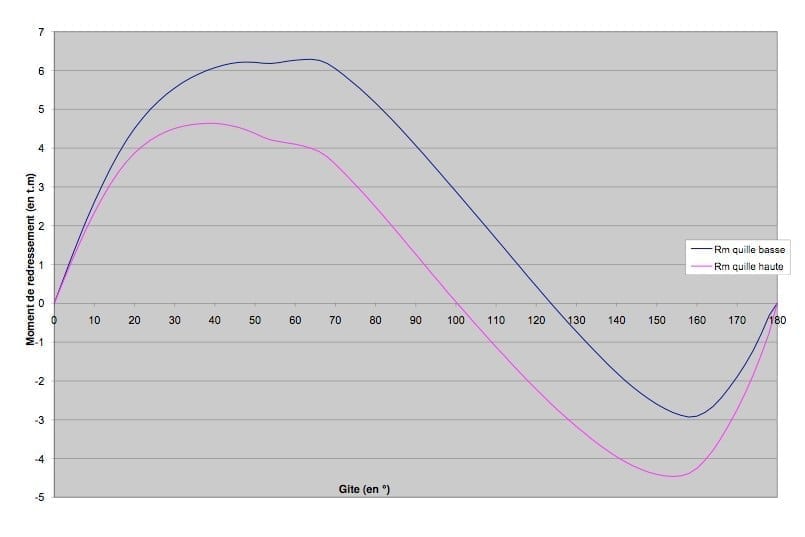
For reference here is the POGO 12.50 stability curve. The blue line is with the keel down, the pink line is with the keel up.

a_148.jpg


Here is the curve for the current HR 44.

HR44-GZ-Curve.jpg
 
You say that "When they load up they are slower or at least as slow as the same older generation of boat". Can you support that assertion with any hard data? I very much doubt it.
Ok, from my experience of cruising up and down the windward and leeward islands I see the evidence before my eyes. Unless you were here you wouldnt see it. Do you have any evidence that these modern Jen, Bav, Ben loaded up in cruising trim are faster than their 1980/90 comparable boat? Lets say we take a 40 ft boat and add two tonnes of gear.
 
You say that "When they load up they are slower or at least as slow as the same older generation of boat". Can you support that assertion with any hard data? I very much doubt it.
Ok, from my experience of cruising up and down the windward and leeward islands I see the evidence before my eyes. Unless you were here you wouldnt see it. Do you have any evidence that these modern Jen, Bav, Ben loaded up in cruising trim are faster than their 1980/90 comparable boat? Lets say we take a 40 ft boat and add two tonnes of gear.


You're not saying that you have no evidence to support this monthly attack on modern boats other than personal prejudice ?

Backed up by stories along the lines of, "Old Lewis Hamilton was at the lights in his F1 car; you want to see his face when my E-Type left him for dead!" :)

On the flipside, there is a vast body of hard evidence including polar diagrams, IRC and other ratings, alongside the witness of any sailor who chooses to look at the two vessels sailing side by side.

As Flaming said, time for some hard data from the MAB corner.
 
For reference here is the POGO 12.50 stability curve. The blue line is with the keel down, the pink line is with the keel up.

a_148.jpg


Here is the curve for the current HR 44.

HR44-GZ-Curve.jpg
Thank you for that, Flaming. The curves show that it roughly takes 40% less energy to capsize the Pogo compared to the HR. 6300kg/m versus 10800kg/m.

Pogo 12.50, SA/D 35.02 , Ballast/Displ. 36%, Beam 4.70m, L/Displ 78.48,
Capsize screening factor 2.57
HR 44, SA/D 19.90, Ballast/Displ. 40%, Beam 4.20m, L/Displ. 173.48, Capsize screening factor 1.79
HR 43 SA/D 17.41, Ballast/Displ. 35.43%, Beam 4.08m, L/Displ. 218,
Capsize screening factor 1.77
 
Top