Which are the best yacht knives?

+1 to diving knives, they are exactly for this purpose. I don't have personal experience to share but I keep IST K11.

 
I have a cheap (but still sharp) bread knife in the bag with mask and snorkel etc for underwater work. Also a suction-cup handle (designed to stick to tile and provide a hand-rail for old people in the bath...) which can stick to the hull to provide something to hold onto while working.

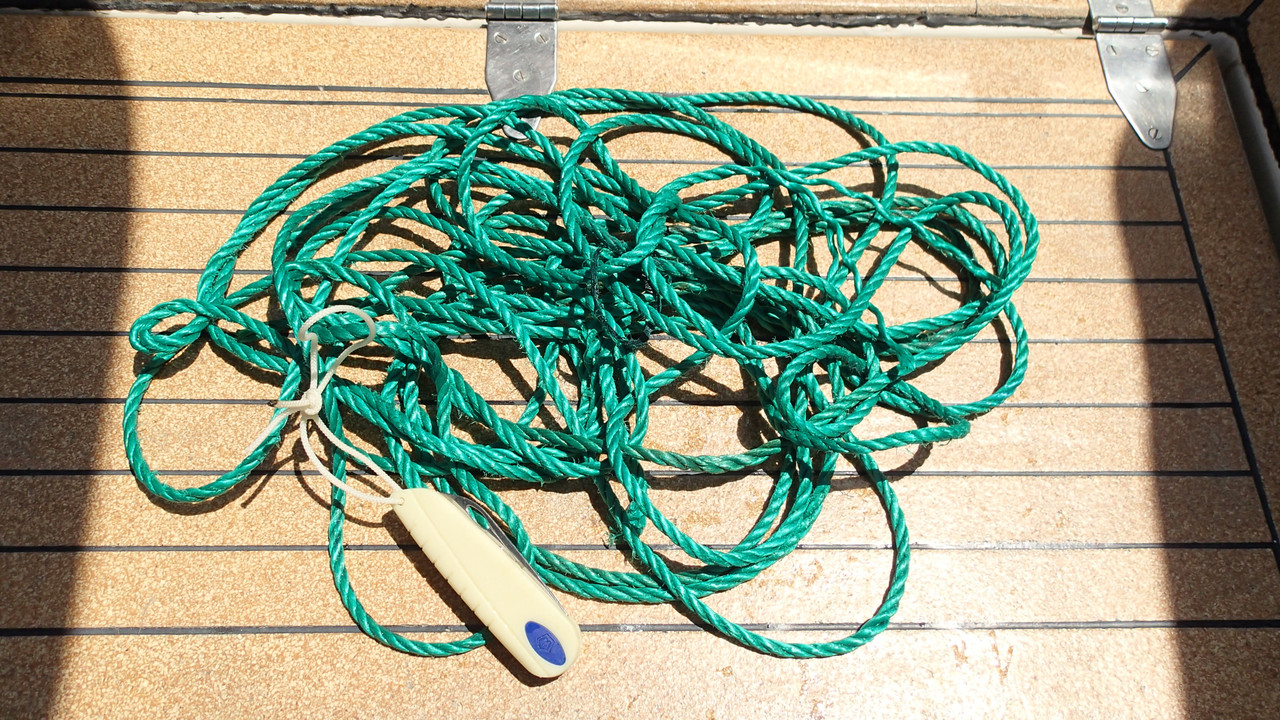
For non-urgent rigging work I have one of the Currey knife/spike/pliers sets on a belt. I take the knife home to sharpen from time to time.

For emergency rope-cutting I have a pair of rescue knives with serrated blade and hooked end, in flat clip-in plastic sheaths screwed to the binnacle and the mast. The original mast one went rusty after a few years in salt spray (they're stainless, but presumably a grade optimised for edge retention rather than rust prevention) so I replaced it, and both are now heavily greased inside their sheaths.

Pete
 
To me the bread knife underwater is a very last resource, one has to hold things (and himself) with one hand and use the knife with the other, a lot of risk of slicing own hand.
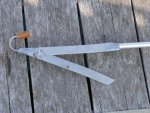
I much prefer this type of thing, they are available in different shapes and cost 10-20-30e; the advantage is one cuts while pulling it, not pushing; I once had a big piece of fishing net like a ball around the prop, I took one of those and pull after pull I eventually shredded it into pieces. A normal knife means one must hold himself say with one hand around the shaft, while pushing the knife in the same direction, one false movement and it s blood everywhere

mesh_cutter.jpg

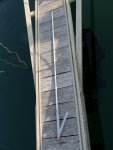
These are bread knives in a "distant pulling" configuration, slice through ropes (and jellyfish) like a charm :)
P1050996.JPG
P1050997.JPG
 
This morning I was servicing moorings, on the beach, prior to placing.
I had to remove some old ropes, hardened with age, around thimbles & by far the best thing was a hacksaw.
When splicing new rope such as 25mm multiplait ( I do quite a lot each year for moorings) in my shed, I use decorators scissors or electricians scissors
I believe that a 25 mm wide machine hacksaw blade ground down as a blade & tape applied over 2 pieces of thin lathes one end as a handle works well
 
P5160057.jpg


"Call that a knife? Now THIS is a knife...."

32601652967_fb12417307_z.jpg


One the other hand, a most effective cutting tool for emergencies is the gardener's serrated-edge pruning saw. This makes very short work of rope entanglements.

32601724747_7264148c7e.jpg


These widely-available tools come in both rigid and folding versions. I far prefer the folding version with the fingers guard....

32601723847_83f333c291_z.jpg


Cold water immersion - not often a problem in Oz, I understand - swiftly numbs the digits, such that one wouldn't be aware of serial amputation of fingers until the water changed colour. For that reason, kevlar gloves are indicated for rope-cutting and for anchor chain work.
 
At that price no wonder! Still it has a tool for removing stones from horses hooves!

I carry a very cheap, £10, knife from the local army surplus - serrated blade, marlin spike and shackle key. I'd still use the bread knife for some rope round the prop.

But some pay over £100 for a Leatherman tool-my Victorinox is 10 years old and is a real comfort to have aboard. It cost half of a Leatherman and I find it far more usefull.
 
Nice one Zioberg ! I wondered about taking my made in Birmingham - Jamaican supplied - machete to a knife sharpening course in case my intentions were misunderstood but who buys a zombie killer knife for sensible reasons !!
 
I've found that almost any old bread knife, as long as it's sharp, is good for cutting rope off prop. I have found that clasp knives don't give you a long enough draw. A hacksaw also does a good job.
Clasp knives with a wavey blade rather than serrated are good for cutting webbing.

I also found that clasp knives did not give a long enough draw and you need to get up close (and personal) with the rope with the short draw. Which means as you are deeper it all takes longer.

This is the trouble with the fancy serrated or scalloped 'sailing' knives - the blades are too short.

Jonathan
 
With no disrespect to the many answers, for which thanks, it seems that the humble bread knife is a success. Its long, serrated and can be sharpened (and most seem to be made from some sort of stainless steel (as mentioned steel that takes an edge that lasts rather then chosen for being the best stainless). A hole at the end seems a good idea for a lanyard.

Any of the newer clasp knives with serrated cutting edges appear to find favour - and I will be retiring the Currey deck hand - once I find out which clasp knife has decently long blade (and a shackle key).

We too have some of those suction cup devices, used for carrying sheet glass by glaziers, - but in the rush to free up the prop I completely for got about them. We have them to clean the hull - great for 'making' a sensible hand hold - which is what you need when cutting rope round a prop or locked into the rudder.

I do also like the idea of decent gloves - its not only the knife that is sharp but the occasional shell cannot be ignored. I was using leather gloves, the sort you might see being used on a budding site - but they are bit clumsy - I need to find something robust that offers tactility.

Thanks to all for the replies

Jonathan
 
I do also like the idea of decent gloves - its not only the knife that is sharp but the occasional shell cannot be ignored.

Yes - in the same bag as my bread knife, mask, and snorkel is a pair of industrial worker's "cut resistant gloves". There's a european standard for this which specifies different levels of cut and puncture resistance; I got ones with the highest cut rating short of metal mesh or chain mail. As industrial safety equipment they weren't expensive (around £10, I think) and they've come in handy for handling a variety of rough and potentially sharp things.

Pete
 
For emergency use a small and sharp axe is the only real option if you have to cut quickly through a rope that isn't under tension I reckon.

Bread knife or hacksaw for ropes round props, etc. though I always worry a bit about the prop and shaft etc.

I have a Gerber Race Rescue Knife on me as well that I will one day attach to my LJ somehow (along with the light, PLB/AIS and handheld DSC ...). It's the hook end version so I have less chance of stabbing to death the poor soul (probably me) whose LJ I'm trying cut free. It even gives me a fighting chance of slipping the blade between a limb and a rope wrapped tight around it without amputation. It's VERY sharp though...

I used to carry a Captain Currey style knife but now I just have a shackle key. I regard any fold-out knives, especially multi-tools, as ideal for use under oak trees but just a quick way of losing fingers on a small boat.
 
The Leatherman is the go to knife for deckhands. Not the cheapest tool out there but has never let me down. Had one for 5 years now. From what I remember they come with a lifetime warranty.
 
(A). Leatherman Skeletool CX [ https://www.amazon.co.uk/Leatherman-Skeletool-Multi-Tool-Nylon-Smooth/dp/B0015RYLM0 ] for general stuff. Awesome, one-handed operation, unobtrusive, and not trying to be a toolkit in your pocket. Specifically for me, because I wear a lumbar brace following a spinal injury, I can’t wear a belt so something that clips inside a pocket is useful to me; something that requires a belt pouch isn’t.

(B). Cheap Amazon plastic-handled sheath knife for cockpit pescicide. I guess I just don’t want the blood and slime on (A) when it clips back in to my trouser pocket.

(C). Boat's breadknife for cutting underwater rope. It’s long, serrated and reasonably safe for the purpose.

(D). Round-headed, serrated Gerber sheathed safety knife given to me for, um, the OP's purpose, lashed into my life-jacket belt. I don’t think it’s ever been used, and underwater, the longer pull of (C) saves me time I prefer to spend breathing.

(E). Razor-sharp wit sees far more action than any of the above.*

* I can only furnish evidence for 80% of these statements.
 
I think that no matter the type, it has to be sharp and immediately available.

I have a small sabatier kitchen knife in a holder in the galley (close to the entrance) of which I tell my crew that it is illegal to put down. It is either in your hand or in the holder.

I've only had to use it once for a very mild emergency, but it was good to have it at hand immediately.
 
Top