Whats a fair price for replacing the PSS shaft seal wear parts on my boat?

  • Thread starter Thread starter Deleted User YDKXO
  • Start date Start date
Leave it Mike for another season .
That could be the life of the boat very easily .
Wipe it off and use something like oil to coat or a smear of grease.It will take another decade to re accumulate .

One of mine did that , a clean up and a good run out it never returned .

You ( royal you Mike ) can dive in , snorkel and test the cutlass bearings in situ .
Turn both props by hand compare stiffness and eyeball the black rubber , try and shake them to test play .You ( get someone ) can do it in the water .
Its not commercial, you are not doing 1000 s of hrs a year .
 
Leave it Mike for another season .
That could be the life of the boat very easily .
Wipe it off and use something like oil to coat or a smear of grease.It will take another decade to re accumulate .

One of mine did that , a clean up and a good run out it never returned .

You ( royal you Mike ) can dive in , snorkel and test the cutlass bearings in situ .
Turn both props by hand compare stiffness and eyeball the black rubber , try and shake them to test play .You ( get someone ) can do it in the water .
Its not commercial, you are not doing 1000 s of hrs a year .
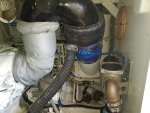
I would tend to agree with the leave it for another time approach. That leak could just as easily be from the lubrication/cooling water pipe. The bellows in your pic look in pretty good nick. How long has it been since they were last replaced?
 
I would tend to agree with the leave it for another time approach. That leak could just as easily be from the lubrication/cooling water pipe. The bellows in your pic look in pretty good nick. How long has it been since they were last replaced?

My guess is that the bellows are original (ie 14yrs old) and the leak cannot be from the lubrication pipe because its clearly saltwater
 
It might be worth the risk, Mike.
But the way that you do your boating, you want the boat to be 100% fit when you get there.
In your position, I would probably leave it for a more convenient time.

But, as I said above we HAVE had one go (a Tides seal) whilst we were away.
It was worrying at the time because we hadn't experienced anything like that before.
Ours leaked about a bucket full every 2 hours.
We were in Cala Portals/Vells at the time so we spent one night emptying the bilge every two hours.
The Princess engineers were only 4 miles away so in the morning we went into Portals and they fixed it for me on the spot (replaced the leaking seal with one of the spares on the shaft).
It only took a couple of hours and we were on our way again - in fact we were due to go to Palmanova that day anyway.
But I put that all down to luck.
If yours started to leak badly, whist you were on your holiday, you would kick yourself for not doing it earlier.

As I say, I would probably risk it.
Tricky decision.
 
Another question
Do you have a decent pump on board?
Or maybe a wet vac?
Something that would make bailing water easy.
That way, if you do get a small leak, you can still enjoy your holiday.

I've only just discovered wet vacs - they are BRILLIANT.
There is always somewhere that needs to have water removed.
I've spent all these years on my knees with a sponge - now 15 seconds from a wet vac and it has all gone..
 
It might be worth the risk, Mike.
But the way that you do your boating, you want the boat to be 100% fit when you get there.

Youre right Mike especially this year. It looks like this year will be another year of limited boating and for what time I'm going to get I dont want the hassle of worrying about something going wrong. Yes we've got a wet vax on board and it is very good
 
I’d be amazed if they have tapped into your precious fresh water system when sea water is in unlimited supply.
Other thing is there are many reasons the fresh water supply can be interrupted .Not many for the seawater if the engines are running and a decent seawater pump pressure which is monitored with his MANs .
Aside I do not think PSS s actually piss leak .They gradually weep over a very long time frame .It could be a year or 100 s of hrs to get from that pic ( assuming it’s not 14 yrs of crud ? ) to even a bucket full after a 10 hr long day running .

The boat just needs a dam good seeing to , thrashing . .Problem is as we all know they do not like sitting un used .

€9 K for that is extreme in anyone’s book .
 
I agree with Hurricane, will likely not be an immediate problem.

Just make sure on two points. Ask the yard to (Assuming you are afloat):

- check there is flow out of that inlet pipe. It will be saltwater, probably the same stuff that is fed to the engine injection bend. No flow can lead to squealing, overheating and the seal flicking off centre and consequent leaks. I can't see that the inlet pipe itself is leaking.

- Check the engine alignment. If it has gone out of line this obviously put an unfair load on the seal.

- Clean the mating faces with rag, as demonstrated in the video you posted. At the same time check the bellows compression is correct.

Someone suggested grease - never use it on this type of seal it depends on a thin layer of water between the faces.

.
 
I agree with Hurricane, will likely not be an immediate problem.

Just make sure on two points. Ask the yard to (Assuming you are afloat):

- check there is flow out of that inlet pipe. It will be saltwater, probably the same stuff that is fed to the engine injection bend. No flow can lead to squealing, overheating and the seal flicking off centre and consequent leaks. I can't see that the inlet pipe itself is leaking.

- Check the engine alignment. If it has gone out of line this obviously put an unfair load on the seal.

- Clean the mating faces with rag, as demonstrated in the video you posted. At the same time check the bellows compression is correct.

Someone suggested grease - never use it on this type of seal it depends on a thin layer of water between the faces.

.
Grease it was me ,Not on the face obviously.I said after cleaning up the salt crud .Rather than just leave the dry graphite if you carefully coat the outer ring only , shoe polish will do it never crud’s up again .Stays black and shiny .
Like shoe polish don’t cake it on so it runs all over the place .
Tyre wall black that you use pretty up car tyres that kinda thing ......carefully applied on the rubber only wipe excess , not blather up the disks etc .
 
I'm sure it will be pumped raw water.
Ours are "taken off" the raw water at the point the raw water enters the exhaust silencers.

The blue pipe here:-
20180421_120526.resized.jpg

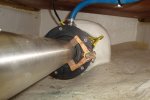
And the other end on our Tides seal - this is the one that had the seal replaced at sea about 5 years ago .
DSC07151.resized.JPG

I think the idea is that there is a negative pressure behind the props in the water and this draws the cooling water continually through the seal.
If it were fresh water, it would get through loads of water.
 
defo seawater!
cannot be anything else, fullstop.
if you trace the pipe it would take you to the end of the seawater path passing through all the heat exchangers and just before it goes to the mixer.
just wipe and leave as is.
BTW, is the other one like that as well?
and is there any water in the bilge or because of the deposits they assume there's a leak?

and btw, if you read the installation instructions, it's v.clear:
IF you keep your speed under 12kn, you can just have this pipe going way above waterline and keep it open (to vent air) So cooling happens from the sea side.
If it's a planning hull, only then you need to connect them to the seawater cooling pipe before the mixing elbow
 
Yes my F43 were sea-water fed and when I first moved the boat from Gib (Hurric will remember) the face had similar deposits which I cleaned off. We did 500nm in 3 days which seated and polished them up, I never had any trouble with them at all. And we did a long trip to Mallorca too, I reckon if surfaces are cleaned and the boat taken for a decent run, they should be fine, just lift inspect and adjust compression of bellows I reckon.
 
75388DFB-9D98-4885-B93A-16719803FDDC%5B2%5D.jpg
M, did they possibly send you any higher resolution pic?
In this one, it looks like the border of the s/steel rotor is pitted all around its border.
And if it is, it's legitimate to expect that also along the contact surface.
But that's something that should never happen, and makes me suspect either poor rotor material, or bonding problems, or both.
 
Last edited:
M, did they possibly send you any higher resolution pic?
In this one, it looks like the border of the s/steel rotor is pitted all around its border.
And if it is, it's legitimate to expect that also along the contact surface.
But that's something that should never happen, and makes me suspect either poor rotor material, or bonding problems, or both.
Sticking up , it’s just salt .
A better Q for Mike is , have you ever cleaned them and checked the tension ?
 

Other threads that may be of interest

Top