
What type of rope is this ?

tsekul

Well-Known Member
Joined
24 Aug 2012
Messages
191
Visit site
Hi There,

what type of rope is this ? It seems to have an outer braid cover, an inner braid and a core that is also braid. I want to put an eye splice in it but can’t find anything like triple braid. Presently I am struggling to get core out of the outer cover.

thanks in advance
T
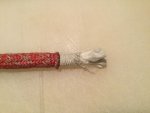
0B6E7F39-1136-4CA7-B027-624C33929AB8.jpeg
 
I've an idea it's a fairly old type of cruising dyneema cored rope, English Braids?
The middle braid does't really contribute strength.
 
Last edited:
The thin middle layer is probably just to prevent slippage of core against cover. Teufelberger makes something like this (named "Str8 Jacket"). So it's designed to resist extracting the core. They don't have splicing instructions for it and it's probably not meant to be spliced. And if it's used, it gets even more difficult! :cool:
 
Liros cruising dyneema has a ‘ middle‘ core similar to that in your picture. They give splicing instructions but I found it impossible on new rope, so you have little hope on old.
 
A small question: why splice dyneema? TBH I think it an anachronism:

1. use dyneema for lack of stretch not for strength (all synthetic ropes are way stronger than need be, so a knot is 'only' 60% of a strength 3x what it need be; big deal).
2. splices thicken and stiffen the rope so it won't pass over pulleys. This is really, really bad for masthead sheeves so never splice a main halliard (or accept broken pulleys for zero gain).
3. You can't inspect a splice, and how many of us have reasonable QA of the splice, gathered by years of careful attention to methodology, documentation and destructive testing? You can't really trust it.

What ever is the advantage? Always happy to learn 'tho.
 
These are my Genoa sheets.

I want a eye in one end so I can attach to the clew with a soft shackle. This is for two reasons 1. As there are not two large bowlines, when tacking it is less likely to snag on the shrouds and 2. I want to be able to ease sheets to an exact position that is always a constant, tying a bowline is not accurate enough.

looks like if I want to do this I’m going to need new sheets.
 
A small question: why splice dyneema? TBH I think it an anachronism:

1. use dyneema for lack of stretch not for strength (all synthetic ropes are way stronger than need be, so a knot is 'only' 60% of a strength 3x what it need be; big deal).
2. splices thicken and stiffen the rope so it won't pass over pulleys. This is really, really bad for masthead sheeves so never splice a main halliard (or accept broken pulleys for zero gain).
3. You can't inspect a splice, and how many of us have reasonable QA of the splice, gathered by years of careful attention to methodology, documentation and destructive testing? You can't really trust it.

What ever is the advantage? Always happy to learn 'tho.
One advantage of splicing is that the eye is nice and smooth, so less likely to snag (think Genoa sheets passing over an inner forestay when tacking for example)
Some dyneema/aramid type ropes are very easy to splice - our tug mooring and towing lines are all spliced but they are uncored& unsheathed so it's basically a "Chinese finger trap" affair - very strong and simple.

Our splices are done by our rigger though, but we stitch a witness line through it to indicate if it has pulled through - counterintuitively this happens at very low loads, if the rope has been freshly spliced and not pulled tight on a bollard.

It really is magic stuff, very light, strong and excellent for tow lines.
 
Top