
What NASA say about installing their paddle wheel through-hull

So is glassing it in with Isopon P40 asking for trouble? NASA appear to be recommending a product like this.


- W
I agree, that seems to be what NASA are implying…

That said, I would argue that epoxy is the most benign. Especially if mixing your own thickened epoxy from laminating resin.

Some ready mixed fillers do have a small solvent content. And a quick search for MEK (the catalyst) suggests one of its uses is melting plastic for welding!

If we follow the paranoia through to its logical conclusion, I’d avoid polyester resins and fillers too!
 
I agree, that seems to be what NASA are implying…

That said, I would argue that epoxy is the most benign. Especially if mixing your own thickened epoxy from laminating resin.

Some ready mixed fillers do have a small solvent content. And a quick search for MEK (the catalyst) suggests one of its uses is melting plastic for welding!

If we follow the paranoia through to its logical conclusion, I’d avoid polyester resins and fillers too!

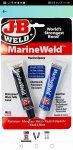
Would this stuff be suitable?

Screenshot_20210903_110836_com.amazon.mShop.android.shopping.jpg

- W
 
I agree, that seems to be what NASA are implying…

That said, I would argue that epoxy is the most benign. Especially if mixing your own thickened epoxy from laminating resin.

Some ready mixed fillers do have a small solvent content. And a quick search for MEK (the catalyst) suggests one of its uses is melting plastic for welding!

If we follow the paranoia through to its logical conclusion, I’d avoid polyester resins and fillers too!
The catalyst is likely to be Methyl ethyl ketone peroxide, not MEK itself.

I used to make DIY plastic glues for odd bits in the lab. by dissolving clear plastic containers in either acetone or butanone (aka MEK). It worked pretty well on rigid plastic items.
 
~~~~~~~~~~~~~~~~~~~~~~
" We don’t know about CT1 but if it isn’t silicone based we would not recommend using it. We had specialist advice and have used silicone sealant since the early 80’s. It will not damage the fittings or hull.

You can use a proprietary body filler to glass the skin fitting in afterwards."
~~~~~~~~~~~~~~~~~~~~~~~~~

- W

"proprietary body filler" isn't likely to be epoxy, almost certainly going to be polyester, NASA supply P38 with their in hull transducer tubes, although they are likely a different type of plastic.
 
What is the difference between P38 and P40, Paul?

- W

P38 is the stuff for filling dents in cars, P40 is a mix of glass strands and polyester resin.

P40 would be super strong, double check with NASA to make sure it's OK and if so, i'd go with that. If you key the hull and p40 it in, even if the flange fell off (shouldn't if fitted correctly) you still shouldn't get any water ingress.
 
P38 is the stuff for filling dents in cars, P40 is a mix of glass strands and polyester resin.

P40 would be super strong, double check with NASA to make sure it's OK and if so, i'd go with that. If you key the hull and p40 it in, even if the flange fell off (shouldn't if fitted correctly) you still shouldn't get any water ingress.
I’ve used both (on cars!) and can affirm the difference as Paul says.

I find P40 quite hard to work with/fair, because of the very ‘glassy’ consistency. It really is formulated for filling (bodging?!) rust holes etc.

If you have, or get hold of, both - you might want to fair the P40 over with P38, for neatness. But that’s all getting rather complicated…!

I’ll be fitting mine in a couple of weeks and will happily share my epoxy method then. I’m not advocating against the polyester - but presumably many of us have epoxy lying around. It is the most harmless thing I know of for plastics, for the strength offered.
 
The catalyst is likely to be Methyl ethyl ketone peroxide, not MEK itself.

I used to make DIY plastic glues for odd bits in the lab. by dissolving clear plastic containers in either acetone or butanone (aka MEK). It worked pretty well on rigid plastic items.

mmmmmm .... MEK .. is NOT Acetone or Butanone .....

Methyl ethyl ketone (MEK) is a colorless liquid that has a sweet odor and is soluble in water. It is a highly volatile chemical and is frequently used as a commercial cleaner and solvent for glues, paints, coatings, and printing inks.

I owned - created - ran PetroChem labs for over 30 years .............

I also have MEK here on my bench for 'welding' plastic kit parts together - if close good fit by MEK alone .. or if small gaps missing - melting plastics in a small amount of MEK to create a paste.
 
PLEASE PLEASE if you are going to glass in ... USE EPOXY based not Polyester .....................

Epoxy is a safe formulation that literally has no ill effects on any plastic. But Polyester can eat some plastics .................
 
mmmmmm .... MEK .. is NOT Acetone or Butanone .....


I owned - created - ran PetroChem labs for over 30 years .............

I also have MEK here on my bench for 'welding' plastic kit parts together - if close good fit by MEK alone .. or if small gaps missing - melting plastics in a small amount of MEK to create a paste.
I know MEK is not acetone and did not mean to imply that and thought it was clear I meant either acetone or butanone. I said butanone (aka MEK).

I bow to your superior knowledge as an expert in PetroChems. Could you please tell me how butanone and MEK differ (apart from more archaic nomenclature)? I've been under the impression for more than 50 years that they were the same thing.
 
Last edited:
I reckon they are the same thing, despite Refueler's claim.

Butanone - Wikipedia
I was attempting some weak humour when asking him to explain the difference. I was a research and development chemist in a previous career. Aqueous reactions and I've never worked in petro-chem area. Ketones are basic schoolboy stuff though, not complicated. Having said that, it was almost alchemy when I started with aqua regia, oleum, oil of vitriol, spirit of salts etc. (well not quite but it seems like it :D).
 
Last edited:
I was attempting some weak humour. I was a research and development chemist in a previous career. Aqueous reactions and I've never worked in petro-chem area. Basic schoolboy stuff though, not complicated. Having said that, it was almost alchemy with aqua regia, oleum, oil of vitriol, spirit of salts etc. (well not quite but it seems like it :D).

So is butanone the same as MEK, or not? Refueler says it's not.
 
mmmmmm .... MEK .. is NOT Acetone or Butanone .....


I owned - created - ran PetroChem labs for over 30 years .............

I also have MEK here on my bench for 'welding' plastic kit parts together - if close good fit by MEK alone .. or if small gaps missing - melting plastics in a small amount of MEK to create a paste.

Methyl ethyl ketone ( MEK ) is the common name for butanone. CH3.CO.CH2.CH3
Acetone is the common name for propanone. CH3.CO.CH3

I am an honorary life member of The Royal Society of Chemistry.

.
 
Methyl ethyl ketone ( MEK ) is the common name for butanone. CH3.CO.CH2.CH3
Acetone is the common name for propanone. CH3.CO.CH3

I am an honorary life member of the Royal Society of Chemistry.

Thanks for that. It seems Refueler is confused.
 
Methyl ethyl ketone ( MEK ) is the common name for butanone. CH3.CO.CH2.CH3
Acetone is the common name for propanone. CH3.CO.CH3

I am an honorary life member of The Royal Society of Chemistry.

.

I have to say that in all the years - I have never seen the name Butanone used for MEK ...........

I appreciate the correction.
 
What is epoxy based? What do you suggest?

- W

I have good success with the Epoxy 'Sticks' you can buy for exhaust / metal repairs .....

A tube of the two components that you break of what you need ... kneed it till the two parts have blended and then you apply ...

If you want to go the resin and matt route - then a trip to local shop and buy light matt and epoxy resin such as West Systems ........... when I was living in UK - my local supply was Strand Glass .. no idea if they still exist in UK now,
 
I have good success with the Epoxy 'Sticks' you can buy for exhaust / metal repairs .....

A tube of the two components that you break of what you need ... kneed it till the two parts have blended and then you apply ...

If you want to go the resin and matt route - then a trip to local shop and buy light matt and epoxy resin such as West Systems ........... when I was living in UK - my local supply was Strand Glass .. no idea if they still exist in UK now,

So JB Water Weld would be good?

Do you think one stick would be enough?

- W
 
Top