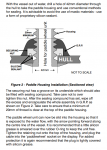
What NASA say about installing their paddle wheel through-hull

I've fitted a couple of these and also reinforced one with epoxy and glass fibre mat. The latter was after a talk given by a club member about a cruise he undertook to the inner Hebrides in his Drascombe when his log tube flange became detached and water rushed in through the inch and a half hole. I and several others examined ours and carried out remedial strengthening. I thought I would share my knowledge not get into a bad tempered argument about alternatives to the published method of installation.

Thank you. It is interesting that you chose to reinforce with glass fibre mat and epoxy rather than glassfibre mat and polyester resin.

I have a friend who works professionally with glass fibre. He says you cannot use ordinary chopped strand mat with epoxy, so I am curious as to what mat you used?

- W
 
Thank you. It is interesting that you chose to reinforce with glass fibre mat and epoxy rather than glassfibre mat and polyester resin.

I have a friend who works professionally with glass fibre. He says you cannot use ordinary chopped strand mat with epoxy, so I am curious as to what mat you used?

- W
The mat used for polyester is not suitable,for use with epoxy because the binder does not dissolve in epoxy.
There is however a mat, with a different binder, which is suitable.
My understanding is that compared with the mat for polyester it is difficult to work with. Thai why I would use cloth or tape.
..
 
When I posted the installation instructions it was #63 which now seems to have been renumbered or deleted (although it is so numbered when I search in my 'recent posts'.


You are right . Post #63, posted last Saturday at 12:20 and still there ( if you know where to look) ;)
here
NASA log paddle wheel installation

FWIW NASA's instructions can always be found via their website where people will find

1631113434215.png

1631113380020.png
 
Last edited:
Four years later, with the boat in the water for three and a half of those and not sinking, I am finally getting round to fitting a new through-hull but still don't know the best way to glass it in as per Nasa's recommendations.

I have sent another email to Nasa, viz:

"Hi,

I had a small leak round the log through-hull, which I largely stopped using an epoxy putty stick - though it did not stop it completely due to the water pressure. It allowed me to complete the season without lifting out.

I now intend to remove the epoxy putty,remove the through-hull and fit a new one.

You recommend glassing/reinforcing the tube onto the hull on the inside. I was planing to use a polyester resin filler like Isopon P40 to do this, as my skill at working with GRP is minimal. However, someone told me that polyester resins as used in P40 and conventional resin and mat repairs can damage some plastics.

Would P40 be a suitable material to use for the recommended GRP encapsulation process?

If not, if epoxy GRP is the recommendation, then what epoxy-based encapsulation method would you suggest? My understanding is that normalk chopped strand mat cannot be used with epoxy resin.

Many thanks for your advice,"


I will let you know what they say this time. However, it seems it might be easier to just use matting and resin. I am useless with fibreglass, but for this application it seems it might be easy enough to cut suitably sized circles of mat and place them over the tube and nut one at a time, wet out thoroughly with the resin then repeat. ??

(Obviously I couldn't use a roller, but could probably get all the air out by vigourous dabbing with a brush. I have ordered some fibreglass cloth and some epoxy resin/hardener and will give it a go. If I have any left over the hard dinghy could do with a wee repair to replace the duct tape that has been on it for years.)

- W
 
I went through this last year when fitting an NASA EML transducer. I queried their instructions and got the curt reply "Silicone is advised to use". When I replied that the only available marine silicone sealant was Geocel, which is not specified for underwater use the reply was "Anything apart from silicone may compromise the plastic moulding.". I replied that I will instruct my engineer to use Geocel unless they respond otherwise, no response was forthcoming. So we fitted the transducer to the letter of NASA instructions, using Geocel, not overtightening the nut and glassing in with resin and mat.

BTW the EML 3 works wonderfully with my old ST60 sustem. Always have water speed even after being sat on mooring for winter months.
 
Does anyone know precisely what type of plastic this irritating through-hull is made of?

— W
It will be interesting to find out. I assume it's cheap and widely available or they'd use something better.

Perhaps it's a variant of LDPC.


Low density polymerised cardboard. Slight improvement over Papier mache.:D

Actually, PVC or polycarbonate based materials are candidates. More likely the former if the material doesn't feel particularly hard.
 
Last edited:
Does anyone know precisely what type of plastic this irritating through-hull is made of?

— W
As far as the EML goes the NASA through hull looked very similar to the removed Raymarine/Airmar one in terms of material and flange thickness when I compared them. Obviously that does not mean the same type of plastic or if the older paddlewheel through hulls are the same.
 
As far as the EML goes the NASA through hull looked very similar to the removed Raymarine/Airmar one in terms of material and flange thickness when I compared them. Obviously that does not mean the same type of plastic or if the older paddlewheel through hulls are the same.

Got a reply from Nasa:

P40 is suitable, it is a styrene based product. The skin fitting is manufactured in high grade ABS (Acrylonitrile Butadiene Styrene)

- W
 
Top