What NASA say about installing their paddle wheel through-hull

webcraft

Well-Known Member
Joined
8 Jul 2001
Messages
40,410
Location
Cyberspace
www.bluemoment.com
~~~~~~~~~~~~~~~~~~~~~~
" We don’t know about CT1 but if it isn’t silicone based we would not recommend using it. We had specialist advice and have used silicone sealant since the early 80’s. It will not damage the fittings or hull.

You can use a proprietary body filler to glass the skin fitting in afterwards."
~~~~~~~~~~~~~~~~~~~~~~~~~

So this is advice going back nearly four decades...

CT1 is only 18 years old, contains no solvents or isocyanates and is specifically recommended for bonding plastics. My understanding is it is not PU, it is a 'hybrid polymer', but I am prepared to be corrected on that.

With all due respect to NASA and being fully aware that I am going against their advice, I will be using CT1 to install the new through-hull, whether it is done on the hard or between tides unless someone can give me a more compelling reason not to.

- W
 
I'm fairly sure it has been established that...
CT1 has recently been reformulated with 'Tribrid technology'.
The original CT1 formulation is now sold as OB1.

I'm sure both would be safe to use on the NASA through hull.

Further research seems to glean the general advice that Polysulphide and some Polyurethane based mastics should nt be used with plastics as they can be chemically incompatible.

I guess for NASA it's just easier (and safer) to specify silicone sealant thus totally avoiding the possibility of a questionable mastic being used.
 
I guess for NASA it's just easier (and safer) to specify silicone sealant thus totally avoiding the possibility of a questionable mastic being used.

I guess so, but silicone shrinks and is definitely an inferior product when used underwater. Which is why presumably they want it glassed in.

- W
 
I guess for NASA it's just easier (and safer) to specify silicone sealant thus totally avoiding the possibility of a questionable mastic being used.

None of the other transducer makers are worried about their plastic being eaten by PU sealants. Why don't Nasa simply specify better quality plastic? The extra material cost must be minimal. It's just cheapskate manufacturing.
 
My conclusion is that CT1 is a hybrid formulation that contains enough silicone for numerous suppliers - do a search - to claim it is a silicone adhesive.
 
None of the other transducer makers are worried about their plastic being eaten by PU sealants. Why don't Nasa simply specify better quality plastic? The extra material cost must be minimal. It's just cheapskate manufacturing.

Worcester Bosch boiler plastics fail all the time. They are renowned for it. Nobody calls them cheapskate, quite the contrary in fact. Funny innit. Maybe it's cos they is Germin and spensive so must be good. British an cheap must be crap therefore.:unsure:
 
Worcester Bosch boiler plastics fail all the time. They are renowned for it. Nobody calls them cheapskate, quite the contrary in fact. Funny innit. Maybe it's cos they is Germin and spensive so must be good. British an cheap must be crap therefore.:unsure:

They are so thin and flimsy the outer flanges are known to break off, presumably why NASA say "You can use a proprietary body filler to glass the skin fitting in afterwards " No other manufactures skin fittings need to be "glassed in" and certainly not with body filler.
 
I have a NASA EM log to install on next liftout and the skin fitting flange does indeed look flimsy. However points taken from this thread and it will be well glassed in!
 
They are so thin and flimsy the outer flanges are known to break off, presumably why NASA say "You can use a proprietary body filler to glass the skin fitting in afterwards " No other manufactures skin fittings need to be "glassed in" and certainly not with body filler.

Still don't understand why they would break off if properly fitted with marine sealant/adhesive...

- W
 
They are so thin and flimsy the outer flanges are known to break off, presumably why NASA say "You can use a proprietary body filler to glass the skin fitting in afterwards " No other manufactures skin fittings need to be "glassed in" and certainly not with body filler.

I'm looking at mine right now. It's done since 2006 and looks just fine. The filler is to stop movement pretty obviously, and also to stop talented people from kicking the otherwise exposed tube. I'm not aware of the outer flanges breaking off. I'l have a better look in the morning.
It's a new experience for me to hear manufacturers instructions used as a materials battleground. When I changed the log wheel last year it all looked fine.
 
Still don't understand why they would break off if properly fitted with marine sealant/adhesive...

- W
Stress, particularly lateral, when withdrawing the sensor fully for cleaning or partially for a liftout. As PR points out the plastic is too thin ... ...

Actually the risk of damage will depend on the installation. Where I will fit the EM log the hull is quite thick, about 30mm IIRC, so the leverage on the weak flange will be minimal.
 
Still don't understand why they would break off if properly fitted with marine sealant/adhesive...

- W

If you fit it with plenty of CT1 and are very careful not to overtighten it, you'll be fine. I would suggest that you put plenty of CT1 in the hole and externally, push the skin fitting in and clean the excess from the inside, very lightly tighten the nut until you have 1mm or so of CT1 left between the fitting and the hull. Allow it to cure, remove the nut, apply some CT1 around the inside and then tighten a little bit more. If time is pressing, apply plenty of CT1 inside and out and lightly tighten, don't squeeze all of the CT 1 out.
 
Still don't understand why they would break off if properly fitted with marine sealant/adhesive...

They don't, if fitted per the manufacturer's instructions.

From Airmar's installation instructions...

CAUTION: Never use solvents. Cleaner, fuel, sealant,
paint, and other products may contain solvents that
can damage plastic parts, especially the transducer’s
face
 
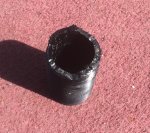
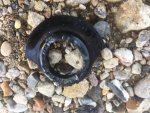
I had one on my old boat that the yard fitted with Sikaflex, and it wasn't glassed in. I came to the boat one day to find 6 inches of water above the cabin sole.
The only thing I can surmise is that the sika had eaten through the fitting.
IMG_2288.JPG

IMG_2292.JPG
 
They don't, if fitted per the manufacturer's instructions.

From Airmar's installation instructions...

CAUTION: Never use solvents. Cleaner, fuel, sealant,
paint, and other products may contain solvents that
can damage plastic parts, especially the transducer’s
face


Which is what I posted in the other thread .... solvents are the main problem as they can literally eat plastics ............. even the propellants in spray paint can do it ...

Take a ceiling tile and take a spray can of touch up paint ... spray and watch the tile surface pickle ... spray more and it will actually eat its way through ... that is an extreme example but shows what can happen.

Many sealants use Acetone or a combination product with Acetone ... which is death to many plastics ........... as I mentioned basically if it has any solvent with 'tone' as latter part of the name - its to be avoided. Its not just those .. it can be petroleum based ....
 
They don't, if fitted per the manufacturer's instructions.

From Airmar's installation instructions...

CAUTION: Never use solvents. Cleaner, fuel, sealant,
paint, and other products may contain solvents that
can damage plastic parts, especially the transducer’s
face

You are highlighting the word "sealant" and using it out of context. The text you quote does not prohibit the use of sealant, it warns against using solvent based sealants. Further on, in the Airmar instructions they say

"Apply a 2 mm (1/16") thick layer of marine sealant around the
flange of the housing that will contact the hull and up the sidewall
of the housing (Figure 5). The sealant must extend 6mm
(1/4") higher than the combined thickness of the hull, the washer,
and the hull nut. This will ensure there is sealant in the threads to
seal the hull and to hold the hull nut securely in place."

Full instructions are here: https://www.airmar.com/uploads/InstallGuide/17-431-01.pdf
 
They don't, if fitted per the manufacturer's instructions.

From Airmar's installation instructions...

CAUTION: Never use solvents. Cleaner, fuel, sealant,
paint, and other products may contain solvents that
can damage plastic parts, especially the transducer’s
face

I think that caution is against using solvents to clean the transducer.

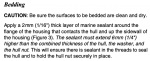
Typical fitting instructions say this...

Screenshot 2021-09-02 at 20.53.13.png
 
Top