What did PhillM do wrong?

A link would have been helpful for when PhillM's thread is not the top dog. :)

Or for those reading on a phone, where the thread originator is not shown.

I hope Phil doesn’t mind us discussing his misfortune.

I’m going to guess that Paean doesn’t have a plotter in the cockpit?

Pete
 
Last edited:
Lateral thinking wot and trying to come up with the most outlandish suggestion.

You need first to read his thread where he is praising Pants. ...
PS, I would not has started this if not for all's well that ends well as a
 
Lateral thinking wot and trying to come up with the most outlandish suggestion.

You need first to read his thread where he is praising Pants. ...
PS, I would not has started this if not for all's well that ends well as a

If that's a translation into English can we have the Latin version? It might make more sense.
 
Here is my statement on the incident. At the below it some ideas about how I could have prevented this accident.

The passage upon which the incident happened was the delivery from Hamble to Plymouth, prior to the Jester Baltimore Challenge. I have previously sailed past Plymouth several times, but not entered before. It appeared to me to be a large, safe port of refuge, so I was not expecting to find entry difficult.

I left my home port (Hamble) around midday on Wednesday 26th May. I sailed all afternoon, experimenting with the new wind vane and reefing systems, then berthed in Cowes. Next morning (Thursday) I left for Plymouth at 0745. Wind was F5/6 WSW (so on the nose). I motor sailed down the Solent and exited via the Needles North Channel. I then turned off the motor and sailed close-hauled out of Christchurch bay. By late afternoon, I was fighting the flood tide, south of the Needles (about 180 T, 12 miles or so off). After the ebb started, I used this to my advantage and by about midnight I had passed St Albans Head. I planned to pass well south of Portland Bill, which I achieved by about midday on Thursday 27th (using a cycle of stemming the flood and making the most of the ebb tides). The wind then dropped to F2 or less variable, so I motor sailed across Lyme Bay.

I arrived in the vicinity of Start Point around 5 p.m. but again had to fight the tide. Winds were variable and then non-existent. Fog patches appeared. There was a lot of shipping about. I was concerned that large ships were neither using their foghorn nor altering speed to take account of the conditions. I was concerned about being run down, so plotted their courses using AIS receive (part of the Standard Horizon VHF radio) and took action to avoid getting to close inshore at the headland, as this is where the ships mainly were.

I slowly made my way around the headland about 3-4 miles off. By mid-evening I was making my down past Bolt Tail and in towards Plymouth, albeit the ebb tide that had helped me to pass the headland was now heading me off, so progress was slow. As I started to motor passed Bigbury Bay, there was a combination of mist and fog, which was confusing. I kept my speed down and eventually arrived outside of Plymouth around midnight.

I decided that my choice was to stay out, but risk being run down by shipping in the fog, or check out the entrances to see if they were viable. I looked at the Eastern entrance and decided against entry. I then motored back west to see what the Western entrance looked like. At about 2 a.m. I identified a Red light, that I thought was the Draystone and followed it and a series of what looked to me in the mist as the sector lights for the Western entrance. My plotter (Garmin Dragonfly 5) on high zoom appeared to confirm what I thought I was seeing. Shortly after, however, my plotter lost the ability to see satellites and stopped working. I had the Reeds almanac open, as well as my pen and paper plan (prepared pre-passage). Furthermore, I could see a line of ships moored behind what looked like a breakwater, this gave me confidence that the lights that I was following would take me into safety.

What I thought was the Western entrance wasn't. After the three white lights, I saw a set of R/G but not where I was expecting them to be. As I slowed down to tick-over, so as to consider what to do next, I ran into submerged rocks. Having heard a lot of water rush around upon impact, seeing more water than expected in the bilge and listing, I called Mayday. While waiting for the Lifeboat, I inflated my (rental) liferaft and activated my lifejacket worn PLB. My thinking being that these might not be needed but I would rather everything ready, just in case. Police Launch Endeavour and RNLI ILB both attended and between them towed me into Mayflower marina.


On reflection:

Simply stayed out and not attempted entry until daylight.

Installed an AIS transponder, so as to be less worried about fast moving ships, in fog.

At Start Point, instead of fighting the tide, I could have turned for Dartmouth. That would have also taken me away from the fog banks around the headland.

Planned a port of refuge or anchorage in case my destination was inaccessible. I had considered that Plymouth WAS my port of refuge, so not planned a backup.

Now over to the forum to add to my knowledge and ideas bank.
 
A sobering tale. There but for the grace of god go I ...

Would a back-up plotter like navionics have helped or was it a total GPS coverage failure? Like when the military jams GPS for exercises?

https://www.ofcom.org.uk/spectrum/information/gps-jamming-exercises

There is one other interesting anomaly I have found on my plotter - don't know if it is relevant here. I have found an occasion where the detailed chart which is displyed at the highest zoom level is actually offset, so the plotted GPS position is false by about 150m. This occured when entering the northern end of an anchorage on Cres, near the village of Ustrine in the Adriatic. Chart was a C-Map card. I can't imagine this being the case in such a heavily used port in the UK though.
 
Last edited:
The lights in Plymouth, even if you can see them, are distant and arranged for big ships so entry at night is not easy. The city itself is well open and there are many distracting false beacons, making for problems even if you know it well.

Plus as you say, at anything except low waters, the breakwater is a low thing and confusing because of all the lights that can show over it. Even the western light is not the overwhelming huge light that you might expect.

Coming from smaller ports the scale can confuse as well, the breakwater is a mile long - a number of arriving very experienced OSTAR racers have hit it.

Heigh ho. You live to sail another day
 
On reflection:

Simply stayed out and not attempted entry until daylight.

.

That's what I would do as being the easiest option for someone who is probably very tired.

Heave to, get well wrapped up. Sit in the cockpit drinking coffee and maybe taking some short catnaps until dawn.
 
Last edited:
Phill
I can't quite work out your timeline, as you write that you left Cowes on Thursday morning, were off St Alban's Head by midnight, then reached Portland Bill by midday Thursday, so you've lost a day somewhere.
Be that as it may, I think the most fundamental error, if you don't mind me weighing in, is to attempt such a long coastal passage against the prevailing wind singlehandedly. I can imagine you were treating it as a training exercise for your race but coastal passage making requires pretty constant alertness, which you were expecting yourself to keep up for more than two days. Then, at the end of it, to manage pilotage into a harbour you haven't been to before. It would have been fine if Plymouth had turned out to be easy as you expected and if there wasn't fog or if your GPS hadn't packed in, but as you found any one of these things happening dramatically escalates the risk.
 
Back up Handheld GPS , paper charts of area and plotter , also a good understanding of the new port its lights and anything else needed to better understand the passage planning .
If All esle fails stay out as said, learned that lesson a few weeks ago trying to get into my Marina in 35knots and a bloody big ferry in the way how dare he be there :p
 
Firstly, kudos to PhillM for his frank account. I'm sure most, if not all, have encountered similar circumstances but with different degrees of luck.
I'm sure I will be in a minority of one but I believe AIS to be more of a distraction than an aid in collision avoidance. I don't have it on board other than via internet which I only use to identify vessels on the basis of curiosity.
I do sail many other boats which are AIS equipped and find it a distraction from visual and auditory tracking. Perhaps if a dedicated crew member is available to filter AIS data then it has merit, though the panic inspired by a vessel 2 miles off with a CPA of 50m, which subsequenty passes at half a mile, is not conducive to composed navigation, IME.
I have sailed in thick fog in a busy harbour (Brest) and felt anxious but not bewildered.
With regards to losing GPS, assuming it was not down to an attack by a foreign power, a second device up and running during testing circumstances is a good idea. A Navionics compatible phone can be had for £30 on eBay.
 
Well done for such an open and honest account.

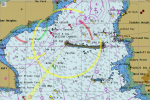
I'm familiar with Plymouth (grew up there, work there and keep my boat on the Tamar) but can't work out from your account what you hit. Did you run into the breakwater?
 
Phill
I can't quite work out your timeline, as you write that you left Cowes on Thursday morning, were off St Alban's Head by midnight, then reached Portland Bill by midday Thursday, so you've lost a day somewhere.
Be that as it may, I think the most fundamental error, if you don't mind me weighing in, is to attempt such a long coastal passage against the prevailing wind singlehandedly. I can imagine you were treating it as a training exercise for your race but coastal passage making requires pretty constant alertness, which you were expecting yourself to keep up for more than two days. Then, at the end of it, to manage pilotage into a harbour you haven't been to before. It would have been fine if Plymouth had turned out to be easy as you expected and if there wasn't fog or if your GPS hadn't packed in, but as you found any one of these things happening dramatically escalates the risk.

Re timeline: arrived Portland Bill midday Friday.

Re sleep, I tend to nap for 20 mins an hour every hours, right from the start of the passage. At 0730 on a dreary day, even the Western Solent is quiet enough. I would say that tiredness is an element in decision making, but I am pretty good at living on disturbed sleep. After all, we had four kids in 5 years and one just a few years after. I went for a decade with disturbed sleep!

Re the escalating risk, yep that's fair. What this experience and the forum will help to teach me now, is how to mitigate or reduce such risks. My aim is to become competent at long single handed passages, so that I can start to explore a wider world. I have sailed in fog occasionally, I have sailed in the dark extensively. However, never before have I sailed in both. So, one lesson is, if the next step of the journey looks difficult, do not attempt it. Go somewhere else and re-plan.
 
Top