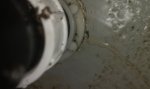
We have a leak

My memory of these things is from removing the fitting to replace it with a blank, in order to avoid damage when lifting.

I’d guess it was a Raymarine fitting, and screwed in, perhaps with a big “O” ring/gasket, rather than being sealed with sealant.

The first time I did it, I was worried about the boat getting flooded. However, with the blank and a bung handy, the water didn’t come in too fast, and it was easy to screw the blank on, or in, (can’t remember over a decade ago).

So I am wondering if there is a way of removing it and fitting a blank, or a bung, thus stopping the leak in the short term.

With hindsight the above wasn’t particularly helpful.

I think I would do what you are planning and, having looked at your picture several times, it does look like it’s a case of failed sealant, where your CT1 would sort it out, even a normal thin bead, as against a big glob. So I would probably squeeze a bead of CT1 in order to stop the inch a day, or whatever it is.

No doubt you will have a plan for the unlikely event of catastrophic failure, something that should never be too far from the forefront of your mind, even when a boat is functioning perfectly.
 
Will maybe leave it alone and head home gingerly end of the week for a lift-out - new skin fitting is on order. I will only bodge it if it gets worse.

If it is the fitting and not the sealant, when it lets go it will be sudden. I could be wrong but I believe that the outer flange separates from the stem. It may have already started to do that.
 
If it is the fitting and not the sealant, when it lets go it will be sudden. I could be wrong but I believe that the outer flange separates from the stem. It may have already started to do that.

Not sure what - other than yanking it about - would cause it to 'suddenly let go'

Failure reports seem to indicate the unit was being manipulated at the time, plus one on launch which could be hull flexing or sling placement.

- W
 
With hindsight the above wasn’t particularly helpful.

I think I would do what you are planning and, having looked at your picture several times, it does look like it’s a case of failed sealant, where your CT1 would sort it out, even a normal thin bead, as against a big glob. So I would probably squeeze a bead of CT1 in order to stop the inch a day, or whatever it is.

No doubt you will have a plan for the unlikely event of catastrophic failure, something that should never be too far from the forefront of your mind, even when a boat is functioning perfectly.

I guess the advantage of a thin bead of CT1 is it will be relatively easy to remove when replacing the skin fitting.

Catastrophic failure plan involves a wooden plug and underwater epoxy putty. .

- W
 
Not sure what - other than yanking it about - would cause it to 'suddenly let go'

There is always extra pressure on the fitting when at sea, even in calm conditions. If it is already down to a 'wing and a prayer', it may well take very little to cause the rest of the failure. Hence my suggestion that you dry out and assess properly - but if you are comfortable in your ability to deal with the possibility of a significant hole whilst at sea then continuing is perfectly rational decision.
 
I appreciate that you may well be tired after your trip and perhaps even a bit apprehensive but I think that you are (understandably) combining two issues that would be better dealt with separately.
Is the the objective to;
a) Stop the leak, or
b) Prevent a more serious ingress until you get home and hence be able to relax.

They sound the same, but you could well stop the leak and yet still suffer a bigger failure. Similarly, there is action that you cantata to prevent major ingress without dealing with the leak. The leak is a minor irritation until you get home, a 2" hole is not.
My advice for what it's worth is to concentrate on b) and then deal with the (very minor) leak in a more relaxed time and fashion.
If you choose to go route a) then you already have it in hand with plenty of advice - if you choose route b) I'll be happy to advise if you need it.
 
Last edited:
From your comments, and others, it sounds like you will be replacing the whole unit at some point soon; if so, the whole unit including the paddlewheel assembly will be removed. If you could get to it outside , underwater, would it be possible to fill the paddlewheel aperture with the CT1 or alternative WaterWeld mentioned.
I'm assuming you have other instruments aboard to give you boatspeed etc .
The suggestion to wrap the tube inside with a string(covered with CT1 or the other sealant}seems a good tempoary fix- but you are there to see if it would work. Good luck with it.


ianat182
 
Talking a quick tempory fix here.

Yes, for a quick and nasty fix, it'll probably be OK. Especially as the OP says he's going to replace it - with another identical one! Hopefully it'll be properly installed.

Nasa is the only manufacturer which seems incapable of specifying decent plastic for its products. You rarely hear of any other log transducer fittings failing.
 
Is there no where handy that you can careen on , whip the whole thing out and fill the hole with isopon P48 , it goes hard in 15 mins , a grinder would be handy
 
Is there no where handy that you can careen on , whip the whole thing out and fill the hole with isopon P48 , it goes hard in 15 mins , a grinder would be handy
That’s what I’d do but I’d use the wooden bung with epoxy or whatever for a similar “get you home” solution.
 
JB water weld certainly sounds like the temporary reinforcement fix you're looking for. I've tried normal epoxy putty on similar situation on a seacock before with no luck as the water was continuously seeping under the putty to hull interface and not allowing the putty to adhere to the hull. The blurb on the advert for JB seems to indicate that this won't be a problem with this product if it sets under water as it says. Good luck and let us know if it works.
Use underwater epoxy on the outside to stop the leak. Then glass the fitting in on the inside with conventional epoxy and glass. A permanent repair
 
Leak definitely appears to be between hull and plastic locknut, and there isn't / never was a huge surplus of Sikaflex.

Greeny's idea of a standpipe is a good one, but there isn't enough height.

I can't imagine that gently pressing Water Weld around the edge of the plastic nut would snap the pipe, I won't be applying sideways pressure, but if it did I would have a bung and epoxy handy.

Lifting out involves a 50 mile sail, and I don't want to go home and finish the cruise early if possible.


That looks like good stuff, but I am far from any chandleries! I have ordered some JB Water Weld from Amazon and it is being sent to a local fisherman, it will be here Wednesday. I have another epoxy stick, but I am not sure if it works on wet surfaces.

Extraordinary to be in Tiree and able to say we will stay until Wednesday, this is a very exposed anchorage but the weather is mentally settled.

- W
Get tek 7. Its available in most good hardware shops and works in the wet and even underwater (perish the thought). I'd there is a hardware shop, plumbers, builders merchant, etc theyll likely have some.
 
Have you been yanking it about to create the problem now? As others have said, it's not sealant failure, it's the reaction of the sealant which degrades the plastic used and could suddenly fail with the outer flange parting company.

Some have said that, others have said it looks like sealant failure. All the accounts of complete flange failure seem to involve some sort of force being applied.

I do know that prior to launch a week ago there was no sign of flange separation. I got up close and personal with SWMBO's nail file to remove a few small barnacles, and would have noticed any signs of imminent failure. There were no signs of cracking.

And of course we have no idea what sealant was used, if it was always meant to be silicone then maybe silicone was used. It was fitted by a previous owner.

Leaning against imaginary walls or careening in Gott Bay sound fine from an armchair. However, there is no hard evidence of imminent flange separation and common sense says a bead of CT1 will probably hold the tube in the hull even if the flange is damaged or becomes separated.

- W
 
Yes but conventional glass or epoxy can take a long time to cure , p 48 ( i think ) fibrous paste goes hard in 15 mins

No shops, no epoxy, no handy place to careen and anyway only about half of you think catastrophic failure is imminent.

My inspection of the fitting prior to launch, close up for barnacle removal, makes me think total failure is unlikely, but I am not leaving here until the underwater miracle putty arrives from Amazon, just in case.

From the inside, it definitely looks like a dearth of sealant that is finally coming home to roost.

IMG_20210828_121827.jpg

Frankly, if people hadn't told me NASA make this fitting from cheese I would have regarded a bead of CT1 as a semi-permanent solution. However, even if flange separation Is happening, a bead of CT1 should still keep the fitting sealed to the hull for a while. It is pretty tough stuff. And I will keep the underwater putty to epoxy the wooden bung into the hole from the inside in the unlikely event there is a catastrophic failure.


- W
 
Last edited:
No shops, no epoxy, no handy place to careen and anyway only about half of you think catastrophic failure is imminent.

My inspection of the fitting prior to launch, close up for barnacle removal, makes me think total failure is unlikely, but I am not leaving here until the underwater miracle putty arrives from Amazon, just in case.

From the inside, it definitely looks like a dearth of sealant that is finally coming home to roost.

View attachment 121584

Frankly, if people hadn't told me NASA make this fitting from cheese I would have regarded a bead of CT1 as a semi-permanent solution. However, even if flange separation Is happening, a bead of CT1 should still keep the fitting sealed to the hull for a while. It is pretty tough stuff. And I will keep the underwater putty to epoxy the wooden bung into the hole from the inside in the unlikely event there is a catastrophic failure.


- W
P48 is not epoxy , fast setting fiberous glass ?( since you replied quote to my post ) i never suggested imminent catastrophic disaster , i thot that was what you were worried about , good luck .
 
Top