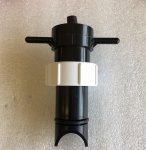
We have a leak

I'd be uneasy about leaving it. If the fitting has cracked, it's clearly got no strength left, so could fail at any time. It may not, but I wouldn't sleep well on may not.

I think I'd have a suitable bung handy then have a go at a fix. I'd far rather have a 2" hole happen suddenly when I'm expecting it and am prepared. than in the middle of the night, only finding out when the duvet starts floating off me.
 
I mentioned that mine failed in order to show that it's a possibility, but I don't necessarily think it's a high probability- how many times has this happened to others?

I don't even know if there was any real correlation between the leak and the failure, so the OP might have absolutely no cause for concern. The weep might have been early warning of failure, but might have been unrelated, except that it caused me to poke around and break it. I can't see how a cracked tube would leak much, given that there's an 'O' ring at the outer end of the tube where the paddlewheel assembly contacts the external flange. Presumably this is why NASA suggest the reinforcing epoxy collar, though this isn't evident in the photo.

I'm sure the OP is well prepared to manage the problem should it arise.
 
Are you suggesting the plastic tube could just snap off? It looks more like a failure of the sikaflex, but I guess no way to tell. All I did to it before launch was gently scrape the inside of the tube around the paddle wheel to remove barnacles.

Will have a bung handy.

I guess ultimately we are going to have to get lifted out and have a new transducer assembly installed. We have just arrived in Tiree, we're planning a few days here then across the Minch. Hard to assess how urgent the situation is, am hoping the underwater epoxy putty will fix it at least temporarily.

- W
be careful, look what happened to James of Zingaro Youtube fame. His transducer tube let go. Have your bung ready just in case.m
 
Replace it. Dry her out and replace.

Tek 7 seals in the wet, even under water and is available in most builders merchants and hardware stores.


Even if a resealing works I'd still endeavour to replace at the earliest opportunity
 
Webby, I don't know your boat, how far below the waterline the transducer is or what access height you have above it.
Maybe get some plastic drainpipe or similar, long enough to be above waterline, and silicone or mastic it to the hull in position over the Tx. You could even use epoxy putty to fix it in place which would probably be better. It will contain the current leak and stop any ingress from a total failure. You will have to cut and rejoin the signal cable though if there's no local joint already there.

p.s. maybe it was damaged/ disturbed by pressure from the sling when you lifted in if they weren't positioned carefully.
 
Last edited:
Leak definitely appears to be between hull and plastic locknut, and there isn't / never was a huge surplus of Sikaflex.

Greeny's idea of a standpipe is a good one, but there isn't enough height.

I can't imagine that gently pressing Water Weld around the edge of the plastic nut would snap the pipe, I won't be applying sideways pressure, but if it did I would have a bung and epoxy handy.

Lifting out involves a 50 mile sail, and I don't want to go home and finish the cruise early if possible.

"Stay Afloat" is very good in this situation, and perhaps worth consideration?

That looks like good stuff, but I am far from any chandleries! I have ordered some JB Water Weld from Amazon and it is being sent to a local fisherman, it will be here Wednesday. I have another epoxy stick, but I am not sure if it works on wet surfaces.

Extraordinary to be in Tiree and able to say we will stay until Wednesday, this is a very exposed anchorage but the weather is mentally settled.

- W
 
Leak definitely appears to be between hull and plastic locknut, and there isn't / never was a huge surplus of Sikaflex.

Sikaflex shouldn't ever have been anywhere near a Nasa fitting. Their plastic is made from recycled chocolate teapots (or something similar), so Nasa warn not to use anything like Sikaflex. However, if it's been OK for 18 years I'd say you've been lucky. Just get the boat out of the water quickly and replace the fitting, using ordinary silicone sealant and with fibreglass over the nut on the inside.
 
Sikaflex shouldn't ever have been anywhere near a Nasa fitting. Their plastic is made from recycled chocolate teapots (or something similar), so Nasa warn not to use anything like Sikaflex. However, if it's been OK for 18 years I'd say you've been lucky. Just get the boat out of the water quickly and replace the fitting, using ordinary silicone sealant and with fibreglass over the nut on the inside.

We are in Tiree. Getting the boat out of the water quickly is not an option.

I've no idea if Sikaflex was used, I am using it as a generic term. I did not fit it, it was there when I got the boat, and it has just worked!

I don't quite understand how it is likely to spontaneously fail if I don't apply any force to it.

I will however be replacing it when we get back to civilisation, before we leave the boat on her mooring for the winter. An extra lift out will come close to breaking the budget, might have to try to dry out somewhere.

Anyone else reading this might be well advised next time their boat is out of the water to replace this fitting if it is more than a few years old. I had no idea it was (apparently) an accident waiting to happen.

- W
 
Last edited:
I hate to be doom and gloom, but I have had two of these spontaneously fail on me, almost leading to a sunk boat.

They are really thin, and although NASA won't admit it ( believe me I tried to get them to ) they have a history of going brittle over time and failing. NASA 's instructions say to glass them in because they are known to fail, and sikalfex eats the plastic? they are made from.

I replaced the NASA kit with Airmar / Raymarine. The gap in build quality between them is vast.

Personally having had two of these fall apart in my hands I would not try to do anything to it. Have a bung the right size next to it in case of failure.
 
When you say "fall apart in my hands" what exactly do you mean?

I am at least 14 hours motoring from anywhere I can lift out and am now led to believe by the doom and gloom merchants on here that the unit could just fail at any second and sink the boat.

Is it likely to fail if I just sit here on this mooring? Is it more likely to fail when I am under way?

Why is reinforcing it with waterproof epoxy more likely to make it fail? The idea is to press the epoxy in round the edge of the plastic nut then build it up in at least two places bridging over the nut to the tube itself to hold the tube in the hull if the exterior flange breaks right off.

I need some practical advice... I need to make the boat safe to sail home so I can fix the problem. At the moment I am scared to go to sleep in case I wake up awash.

- W
 
Last edited:
Is there anywhere that you can dry out to sort it, cheaper than a lift!

I would need to get a new unit to fit first, so need to get the boat back to home waters.

I might be able to dry out to fit it, but not here!

Also, I spoke to a boat building friend and when I told him NASA said to use silicone not Sikaflex he said that would take 24 hours to go off, so could not be done between tides. He also said he would never use silicone underwater, and seemed astounded that NASA recommended this.

- W
 
I had a bad leak, and when I tried to tighten the fitting it broke. I'm not saying this will happen to you, but I would exercise caution.

I'm not saying don't try to reinforce, just be careful. I'm really hoping that it's something basic like leaking sealant and not a mechanical failure, but personally I would approach it as if it was a mechanical failure. If there is anyway you can cover it from outside to stem the leak as others have suggested, and dry it and epoxy / glass it that would be fantastic. If there is no way to do that then anything you can do to gently reinforce it would be a good approach.

I'm sorry, I'm not trying to scare you, just saying treat it with kids gloves just in case.
 
JB water weld certainly sounds like the temporary reinforcement fix you're looking for. I've tried normal epoxy putty on similar situation on a seacock before with no luck as the water was continuously seeping under the putty to hull interface and not allowing the putty to adhere to the hull. The blurb on the advert for JB seems to indicate that this won't be a problem with this product if it sets under water as it says. Good luck and let us know if it works.
 
Top