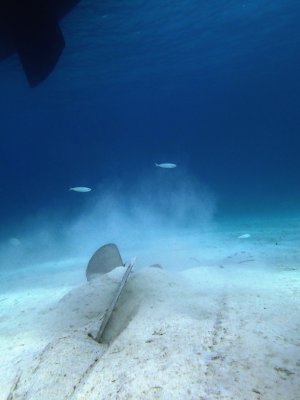
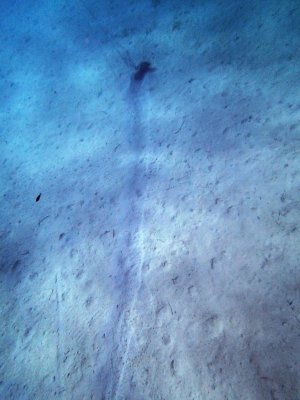
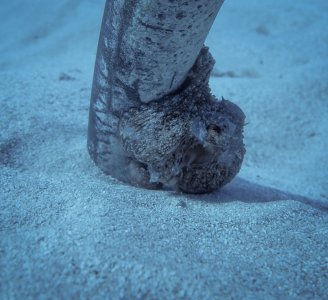
Viking's Odin anchor vs Ultra and the original Viking anchor

Most anchor manufacturers recommend sizing tables that assume the boat is never going to experience anything more than moderately strong winds or poor substrates. This helps sell anchors.

If a manufacturer recommends a smaller anchor, it must be better ;).

This strategy of recommending small anchors particularly helps anchor manufacturers sell to boatbuilders. For a boatbuilder fitting a small anchor as standard equipment means a smaller anchor winch, bowsprit, etc., affording considerable savings. If the customer complains, the boatbuilder can correctly claim they are fitting the anchor manufacturers recommended size.

Some anchor manufacturers are honest and state the maximum windspeed their sizing is based on. This can be as low as 30 knots :oops:. Many others don’t state the criteria (which suggests to me it is low).

I cannot understand why some members of this forum recommend blindly following these recommendations. Or even worse council against installing anchors with more holding ability.

Rocna uses a slightly more realistic 50 knots as a "soft moderate holding bottom" and assumes you have the room to provide reasonable scope. If you anchor frequently, it is not uncommon to exceed these requirements, but it is at least a better starting point if you cannot comfortably manage something with more capability.
I rate my Spade anchor higher than a Rocna of the same weight. I think it sets more easily here in the Caribbean.

Since we don't see boats with well set anchors dragging in 50kt squalls, what does that tell you about the holding capacity of the older anchors such as Bruce, CQR and Delta? May be they are adequate for their intended use? Then you apply the well proven data that NG anchors have twice the holding power of such anchors.
If the old generation anchors can easily stay put in 50kts, I suspect any NG anchor is going to have no problem in substantially more wind, even sized correctly for the boat weight and windage.
 
Aren’t manufacturers recommendations really a best guess? There are so many variables: substrates, technique, scope, rode design and so on, not to mention no standard for sizing anchors for manufactures to offer a direct comparison between models, let alone brands.

On a different note… is one bigger anchor better than two correctly sized anchors…….? In a blow I think I’d rather have two right sized anchors
 
Yes, to the first part.
And yes to the second part. In a real blow, who knows what might fail. The "weakest link" can be any number of things. With two anchors and rodes, you reduce the chance of failure. That's assuming that both anchors are adequate, and that some measures have been taken to avoid yawing.
 
Yes, to the first part.
And yes to the second part. In a real blow, who knows what might fail. The "weakest link" can be any number of things. With two anchors and rodes, you reduce the chance of failure. That's assuming that both anchors are adequate, and that some measures have been taken to avoid yawing.
We have found that with the main anchor set as normal on chain, with a stretchy nylon snubber, a second anchor set on mainly nylon rope, shares the loads pretty effectively. The stretchy nylon rope of the second anchor seems to allow both anchors to share the load rather than continuously swapping from one anchor to the other.
I think for us, this is assisted by us having a ketch rig. We have absolutely minimal yawing at anchor. I think this tends to make our anchoring more effective than some sloops that sail around their anchor dramatically. We see this often on high sided boats like Hanses with masts quite far forward that encourage sailing. The load at the end of their yaw in strong winds must be quite substantial.
Friends anchored next to us have a riding sail set on their Jeanneau 45DS. It reduces yawing but doesn't eliminate it. Even so, it's substantially better than the friends Beneteau 45 anchored behind them. They are doing mini cruises around their anchor in 20-26kts that we currently have.
 
I did a bit of research on the impact of yawing on anchor loads.
A boat that yaws aggressively at anchor (in a gale) is likely to double or even triple the anchor loads compared to one that barely moves. This has a massive impact on how successful you will be in keeping your anchor well set. This assumes both boats have a nylon snubber.
I think when formites suggest you need a massively over sized anchor, they might want to consider a riding sail as well.
If you have a high sided monohull with a forward mast position that has a tendency to yawing aggressively, I can understand why you might need a bigger anchor in a storm. It doesn't mean we all need one. You also have to work out how you will set it in benign conditions
 
I did a bit of research on the impact of yawing on anchor loads.
A boat that yaws aggressively at anchor (in a gale) is likely to double or even triple the anchor loads compared to one that barely moves. This has a massive impact on how successful you will be in keeping your anchor well set. This assumes both boats have a nylon snubber.
I think when formites suggest you need a massively over sized anchor, they might want to consider a riding sail as well.
If you have a high sided monohull with a forward mast position that has a tendency to yawing aggressively, I can understand why you might need a bigger anchor in a storm. It doesn't mean we all need one. You also have to work out how you will set it in benign conditions
Our boat on a single anchor in winds over about 30 knots, will yaw 100 - 120.degrees. the rig does not lend itself to a riding sail. Fork mooring to a Fortress and Anchorplait rode reduces this to around 40 degrees. We have used this technique countless times, relatively risk free in the Aigean, where the prevailing wind direction rarely varies.

Video on this page Fork mooring
 
We have found that with the main anchor set as normal on chain, with a stretchy nylon snubber, a second anchor set on mainly nylon rope, shares the loads pretty effectively. The stretchy nylon rope of the second anchor seems to allow both anchors to share the load rather than continuously swapping from one anchor to the other.
I think for us, this is assisted by us having a ketch rig. We have absolutely minimal yawing at anchor. I think this tends to make our anchoring more effective than some sloops that sail around their anchor dramatically. We see this often on high sided boats like Hanses with masts quite far forward that encourage sailing. The load at the end of their yaw in strong winds must be quite substantial.
Friends anchored next to us have a riding sail set on their Jeanneau 45DS. It reduces yawing but doesn't eliminate it. Even so, it's substantially better than the friends Beneteau 45 anchored behind them. They are doing mini cruises around their anchor in 20-26kts that we currently have.
That has been exactly my experience. I don't often rig a second anchor, but when I do, it's normally a Fortress with a short length (about 6m) of chain, and then stretchy climbing rope.
My boat is also a ketch, but if the conditions require it, I rig a riding sail. My sail is a double sail, attached to the mizzen mast with slides, and sheeted back to the taffrail quarters. The advantage of the double sided sail, is that it is always in the wind, unlike a mizzen sail which tends to flap as the boat swings through the wind.
 
That has been exactly my experience. I don't often rig a second anchor, but when I do, it's normally a Fortress with a short length (about 6m) of chain, and then stretchy climbing rope.
My boat is also a ketch, but if the conditions require it, I rig a riding sail. My sail is a double sail, attached to the mizzen mast with slides, and sheeted back to the taffrail quarters. The advantage of the double sided sail, is that it is always in the wind, unlike a mizzen sail which tends to flap as the boat swings through the wind.
We don't ever set the mizzen to keep her pointing into the wind. She doesnt need it. She naturally points into the wind.
We do set the mizzen if we are in an anchorage where swell is coming from one side and causing us to roll.
Our mizzen is loose footed with full length battens so we set is bar tight on the outhaul and triangulate the mizzen sheet with a block and tackle. There is zero flapping. We simply use it as a roll damper. It changes our natural frequency and is very effective.
Our Fortress setup is identical to yours
 
Testing anchors for their holding capacity is conducted at 'infinite' scope. The anchor is tensioned in one direction only and the anchor continues to dive as the tension increases (until about 2,000kg for a 15kg NG anchor). In holding capacity tests the rode is effectively on the seabed.

When a yacht is yawing and the rode is constantly thrashing the seabed the conditions are very different to the controlled holding capacity tests. The constant movement of the rode will allow the anchor to be constantly twitching and the shear strength of the seabed will be compromised. There will be an increased vertical element to the tension when the chain is thrashing. If you dive on your anchor in benign conditions on a short scope and touch your anchor you will find that the anchor is constantly twitching - the constant twitch will reduce the shear strength of the seabed. If your anchor is well buried use a long screw driver to touch the anchor to feel the twitches.

A riding sail or anchoring in a fork will steady the yacht and calm the thrashing of the rode. A snubber will also reduce the twitching of the anchor - but if you believe in snubbers you will be using one every time you anchor.

If the veering is caused by the wind direction constantly changing, williwaws, a riding sail might make the situation worse and a second anchor, in a fork, is an answer, extend the rode or move.

The closer you can manage your ground tackle to copy holding capacity tests, a steady tension on the anchor or anchors in one direction, the greater the opportunity to set the anchor more and more deeply - simulating the holding capacity tests. You then can expect the anchor to dive more and more deeply with little negative impact of reduced shear strength of the seabed.

Your problem then becomes - how long will it take to retrieve the anchor once it is more deeply set :)

The deeper your anchor(s) are buried the more stable they will be as the shank (and fins of the Odin) act as vertical flukes and increase hold in lateral directions. Similarly the more deeply your anchor is set the more chain you can bury the more stable your anchor - as the buried chain will be less able to transmit twitching to the anchor. For most anchors the depth of set of the toe and the shackle are similar (as the anchors dives at roughly 30 degrees. A shallow set anchor, especially a large one may have considerable difficulty burying chain as the shank is difficult to bury - and needs more setting room.

The thinner the rode, smaller, better shackles, no swivel the easier the rode will bury (its the anchor that is dragging the rode into the seabed).


I found the constant twitching of an anchor and its negative effect on shear strength so underrated and underreported I added those rubber dog bone things to our bridle. My thoughts were the twitching might have different causes so to vary the type of dampening (rubber, the dog bone, and nylon rope the long snubber) might be useful. I never came to a conclusion - but I had the dog bone things - and I could not see them making the situation worse.

I thought the suspension on a car is managed by a host of devices from the upholstery in the seats to springs and pneumatics - why not the snubber?

Jonathan
 
Last edited:
Jonathan, I'm intrigued by this twitching that you suggest. With the water temperatures that I sail in, there is no way that I'll be diving down to feel my anchor, so I don't know if it twitches or not. If the anchor was twitching, and I was anchored with an all chain rode, presumably I would be able to feel the twitching on the chain just outside the bow roller? I'm not aware of it doing anything like that.
 
Jonathan, I'm intrigued by this twitching that you suggest. With the water temperatures that I sail in, there is no way that I'll be diving down to feel my anchor, so I don't know if it twitches or not. If the anchor was twitching, and I was anchored with an all chain rode, presumably I would be able to feel the twitching on the chain just outside the bow roller? I'm not aware of it doing anything like that.
I have dived on my anchor many times and not witnessed twitching but then again I wasn't looking for it.
Its pretty windy here at the moment with squalls over 30 kts. If I get time tomorrow between kite surfing, I may dive on the anchor to see how it's behaving. We are in 7 metres of water and with all the wave action, the water is a bit murky so hope I can find the anchor
 
Top