Viking's Odin anchor vs Ultra and the original Viking anchor

Yes, I am only showing one example in this post, but I have seen photographed many more to draw my conclusions. The photo below is just one more example I observed of a less than brilliant performance. It shows an Ultra not coping well with only light weed. It had slowly dragged about 15m at this stage. You can see from the cloud of disturbed substrate that it was still slowly moving. 8m @ 6:1.

The best anchors can consistently penetrate much thicker weed than this without any difficulty.

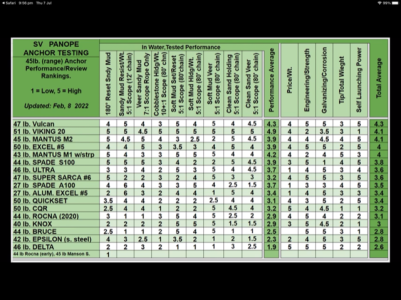
However, I have also seen some excellent performances by the Ultra. Overall, I would rate it as a very good anchor. When observing the anchor underwater, it is easy to see it vastly superior to the majority of models, but it is not as good as the steel Spade or the better roll bar models.
I have not experienced any problems in weed with my Ultra. I agree with Geem that setting technique is probably the issue here.

Where I notice a difference to the Spade is in the aggressiveness of setting in softer mud. The Spade bites in slightly but noticeably harder than the Ultra, and generally gives fewer "missed approaches."

I have not tried Mantus or Viking roll bar anchors, but I have years of experience with a 121 pound Rocna. Both Spade and Ultra are far better than the Rocna, a very large difference in performance. Spade and Ultra work in almost any seabed -- they are extremely versatile. Rocna does not.

Rocna is really flummoxed by soft mud, because the roll bar clogs and turns the anchor into a ball of mud which can't dig in. In addition, the Rocna is top-heavy and so goes down, and comes up, upside-down. It's hard to get into the anchor roller (I needed a swivel, and a boat hook), and setting requires it to successfully rotate on the roll bar. If you say different roll bar anchors are better than that, I'll have to take your word for it, since I don't have my own experience, but my experience with Rocna convinced me provisionally that the roll bar is an inherently inferior solution, compared to ballast, a band-aid intended to paper over the inherent problems of bad balance. Bad balance which results from saving money by not using ballast.

That may or may not be correct, but based on my experience, it sure seems like that.

The poor balance of the Rocna also creates challenges in weed, in my experience, which I have not experienced with Spade or Ultra. If you try to drop it hard to get some penetration, it lands on its side, and this doesn't work. Spade or Ultra come down right on their tips and punch right through most weed, if you drop hard enough. Good technique means falling back slowly, just enough to keep the chain from piling up, but slow enough so that the anchor hits in one place and penetrates, without skidding across the top of the weeds.

Balance issues getting the anchor into the roller would be enough for me to choose Spade or Ultra, even if the performance were the same. It's a PITA, and even a safety issue. I can raise Spade or Ultra from the helm without even being able to see the anchor before the shank enters the roller. I know it will go in straight. A huge boon when single handed. With the Rocna, I had to wrestle it around with a boat hook before coaxing it in -- a whole dance at the bow -- a whole problem in rough conditions, or when single handed, or near to a lee shore. I don't know if Mantus or Viking are better for this.
 
Quote 'Nobody ever see my anchor.'

It does not always boil down to 'performance' - fit can be the deciding factor. Viking does not fit many multihull bow rollers, Odin is perfect.

Jonathan
Indeed! Fit is a critical issue for many. Also, balance, and how the anchor comes into the roller, are really important. Setting performance, and holding, are not indeed the only important qualities of anchors.

The best anchor in terms of holding or setting behavior may not always be the best anchor for every boat or sailor. Small differences in holding or setting may not be significant, especially if your anchor is well oversized. Especially true of very large anchors; I know people on big boats who are very happy with their 180lb or 200lb Bruce anchors.
 
Indeed! Fit is a critical issue for many. Also, balance, and how the anchor comes into the roller, are really important. Setting performance, and holding, are not indeed the only important qualities of anchors.

The best anchor in terms of holding or setting behavior may not always be the best anchor for every boat or sailor. Small differences in holding or setting may not be significant, especially if your anchor is well oversized. Especially true of very large anchors; I know people on big boats who are very happy with their 180lb or 200lb Bruce anchors.
Is hold-per-weight everything? It's on the list, but as you say, not everything.

The other factor (and Bruce fails a bit on this) on my list is consistent hold on all bottom types.
a. I may not actually know what is down there. It might be good mud 100 feet away, weeds here.
b. You don't always have a choice. Sometimes you can move. Sometimes a storm pops up and you have to make do with what you have, since navigating around rocks and shoals in a storm is bad and holding a short distance away may be worse.

Weed, hard sand, hard pan (or mudstone), and jointed rock all offer different challenges that are hard to test. I don't want an anchor (other than as a kedge or secondary) that is brilliant at a few things and terrible at others (Fortress comes to mind--great as a kedge but not as a main IMO). They're butt ugly and can have fit problems, but darn it, Mantus M1 and Viking are hard to beat for across-the-board hold. They fit my PDQ and I loved them ... but they don't fit my Corsair, so I use an Excel.

I fact, I often us a Northill utility, since it is the best weed and hardpan anchor I've found ... but it has other serious flaws (veer and fouling).
 
Last edited:
Is hold-per-weight everything? It's on the list, but as you say, not everything.

The other factor (and Bruce fails a bit on this) on my list is consistent hold on all bottom types.
a. I may not actually know what is down there. It might be good mud 100 feet away, weeds here.
b. You don't always have a choice. Sometimes you can move. Sometimes a storm pops up and you have to make do with what you have, since navigating around rocks and shoals in a storm is bad and holding a short distance away may be worse.

Weed, hard sand, hard pan (or mudstone), and jointed rock all offer different challenges that are hard to test. I don't want an anchor (other than as a kedge or secondary) that is brilliant at a few things and terrible at others (Fortress comes to mind--great as a kedge but not as a main IMO). They're butt ugly and can have fit problems, but darn it, Mantus M1 and Viking are hard to beat for across-the-board hold. They fit my PDQ and I loved them ... but they don't fit my Corsair, so I use and Excel.

I fact, I often us a Northill utility, since it is the best weed and hardpan anchor Ive found ... but it has other serious flaws (veer and fouling).
I have never swapped anchors because the bottom was not suited to the anchor on my bow roller. In an approaching storm I have set a second anchor ( a large Fortress anchor) from the dinghy, just in case. Gone are the days of carrying lots of anchors for different bottoms. NG anchors probably out perform every single old fashioned anchor variant
 
Last edited:
Top