Viking's Odin anchor vs Ultra and the original Viking anchor

vyv_cox


Had an educational picture of hs Rocna anchor after a bit of a blow. I wonder if he still has the image.

The anchor did not drag - but it did move.

Jonathan
Thanks Jonathan,

Yes, I still have the photos and include a couple more for reference. We were anchored at Sandbar Bay, Kithnos, initially in a force 4 from about south, veering to north-westerly force 7 overnight. There were four or five boats there, all on different anchors. These photographs were taken over a period of about half an hour on the following day.

The first, a 55 ft boat on a Manson anchor shows perfectly how the wind veered and that the flukes of the anchor simply rotated, never dragged in the slightest.
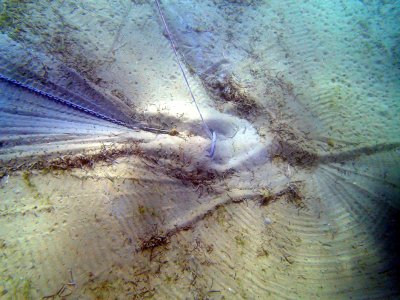
Manson low res.jpg
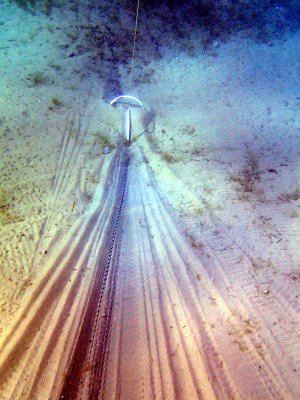
Our Rocna, demonstrating quite nicely that the whole length of the chain, right up to the anchor, was lifting from the seabed in gusts and yaws. Again, the path of the chain as the wind veered is clear.
Rocna1 low res.jpg

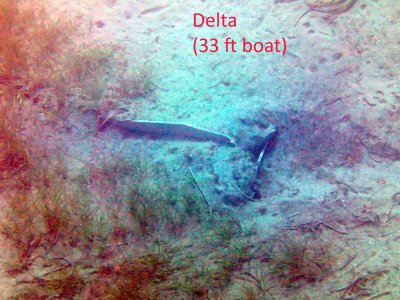
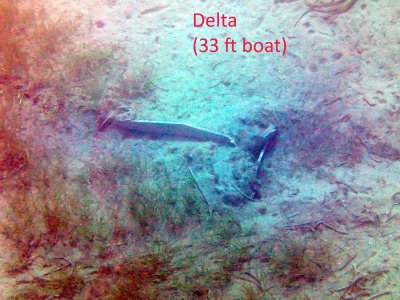
A Delta on another boat. In good holding such as this a Delta is reliable.
Delta 33 ft boat low res.jpg

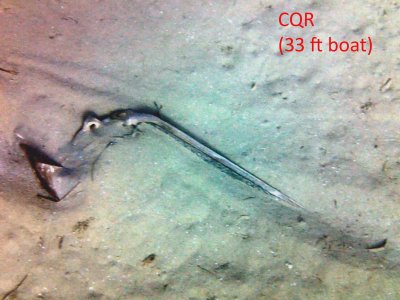
And a CQR. I have photographed many CQRs over the years and have yet to see one that had rotated to place the flukes down, as apparently was the design intent.
CQR low res.jpg
 
Interesting that none of these anchors was buried with a F7. I don't mind my chain making pretty patterns on the sand/mud, but in real blow I want my anchor to be completely buried so that the pretty patterns don't reach the anchor.
 
Interesting that none of these anchors was buried with a F7. I don't mind my chain making pretty patterns on the sand/mud, but in real blow I want my anchor to be completely buried so that the pretty patterns don't reach the anchor.
My experience is that in UK water we generally have softer sand or mud/ muddy sand. A result of so many rivers discharging mud into the sea.
In lots of tropical locations, there are no rivers. The seabeds see little tidal influence and hard packed sand and stone/coral are more prevalent. Its a far tougher seabed to penetrate with the anchor.
 
My experience is that in UK water we generally have softer sand or mud/ muddy sand. A result of so many rivers discharging mud into the sea.
In lots of tropical locations, there are no rivers. The seabeds see little tidal influence and hard packed sand and stone/coral are more prevalent. Its a far tougher seabed to penetrate with the anchor.
Fair enough. My experience is mostly in UK waters. Having said that, there's not much in the way of rivers in the smaller Hebrides, Orkney or Shetland. I have experienced anchoring in a particular bay in the Monach Isles, which turned out to be a thin layer of sand over smooth rock. Not a success.
 
Fair enough. My experience is mostly in UK waters. Having said that, there's not much in the way of rivers in the smaller Hebrides, Orkney or Shetland. I have experienced anchoring in a particular bay in the Monach Isles, which turned out to be a thin layer of sand over smooth rock. Not a success.
UK beaches are certainly not always soft. The only time in about 20 years of anchoring that my Delta would not set was just outside Pwllheli marina, on what is effectively a surf beach. We tried countless times but the tip could not penetrate the sand.
 
Interesting that none of these anchors was buried with a F7. I don't mind my chain making pretty patterns on the sand/mud, but in real blow I want my anchor to be completely buried so that the pretty patterns don't reach the anchor.
In Greece I don't think I have ever seen any anchors fully buried in many years of snorkelling around anchorages.
 
UK beaches are certainly not always soft. The only time in about 20 years of anchoring that my Delta would not set was just outside Pwllheli marina, on what is effectively a surf beach. We tried countless times but the tip could not penetrate the sand.
A lot of what is outside Pwllheli is gravel and rock that are routinely dredged out of the channel. They use a trawler with a scraper that runs along the seabed and simply drive it along the chanel until they reach open water. It a pretty rubbish system but cheap. They have been doing that for years.
If you were anchoring in the large tidal bay to the left of the training wall as you exit the harbour, yep, that sand there is hard. I guess is sees little tidal impact being protected by the training wall
 
Top