Viking's Odin anchor vs Ultra and the original Viking anchor

vyv_cox


Had an educational picture of hs Rocna anchor after a bit of a blow. I wonder if he still has the image.

The anchor did not drag - but it did move.

Jonathan
Thanks Jonathan,

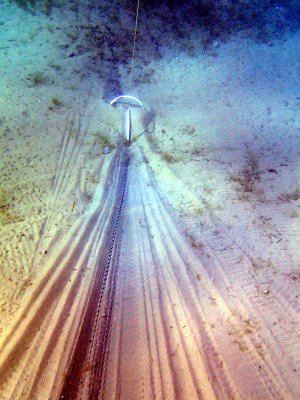
Yes, I still have the photos and include a couple more for reference. We were anchored at Sandbar Bay, Kithnos, initially in a force 4 from about south, veering to north-westerly force 7 overnight. There were four or five boats there, all on different anchors. These photographs were taken over a period of about half an hour on the following day.

The first, a 55 ft boat on a Manson anchor shows perfectly how the wind veered and that the flukes of the anchor simply rotated, never dragged in the slightest.
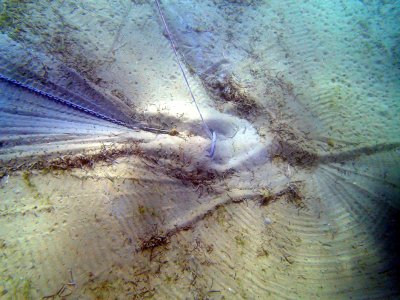
Manson low res.jpg
Our Rocna, demonstrating quite nicely that the whole length of the chain, right up to the anchor, was lifting from the seabed in gusts and yaws. Again, the path of the chain as the wind veered is clear.
Rocna1 low res.jpg

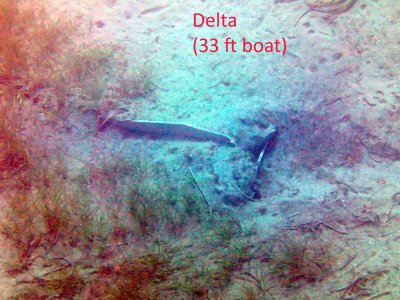
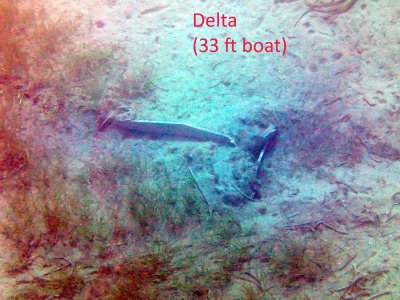
A Delta on another boat. In good holding such as this a Delta is reliable.
Delta 33 ft boat low res.jpg

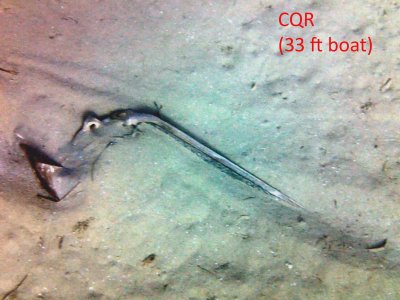
And a CQR. I have photographed many CQRs over the years and have yet to see one that had rotated to place the flukes down, as apparently was the design intent.
CQR low res.jpg
 
Interesting that none of these anchors was buried with a F7. I don't mind my chain making pretty patterns on the sand/mud, but in real blow I want my anchor to be completely buried so that the pretty patterns don't reach the anchor.
 
Interesting that none of these anchors was buried with a F7. I don't mind my chain making pretty patterns on the sand/mud, but in real blow I want my anchor to be completely buried so that the pretty patterns don't reach the anchor.
My experience is that in UK water we generally have softer sand or mud/ muddy sand. A result of so many rivers discharging mud into the sea.
In lots of tropical locations, there are no rivers. The seabeds see little tidal influence and hard packed sand and stone/coral are more prevalent. Its a far tougher seabed to penetrate with the anchor.
 
My experience is that in UK water we generally have softer sand or mud/ muddy sand. A result of so many rivers discharging mud into the sea.
In lots of tropical locations, there are no rivers. The seabeds see little tidal influence and hard packed sand and stone/coral are more prevalent. Its a far tougher seabed to penetrate with the anchor.
Fair enough. My experience is mostly in UK waters. Having said that, there's not much in the way of rivers in the smaller Hebrides, Orkney or Shetland. I have experienced anchoring in a particular bay in the Monach Isles, which turned out to be a thin layer of sand over smooth rock. Not a success.
 
Fair enough. My experience is mostly in UK waters. Having said that, there's not much in the way of rivers in the smaller Hebrides, Orkney or Shetland. I have experienced anchoring in a particular bay in the Monach Isles, which turned out to be a thin layer of sand over smooth rock. Not a success.
UK beaches are certainly not always soft. The only time in about 20 years of anchoring that my Delta would not set was just outside Pwllheli marina, on what is effectively a surf beach. We tried countless times but the tip could not penetrate the sand.
 
Interesting that none of these anchors was buried with a F7. I don't mind my chain making pretty patterns on the sand/mud, but in real blow I want my anchor to be completely buried so that the pretty patterns don't reach the anchor.
In Greece I don't think I have ever seen any anchors fully buried in many years of snorkelling around anchorages.
 
UK beaches are certainly not always soft. The only time in about 20 years of anchoring that my Delta would not set was just outside Pwllheli marina, on what is effectively a surf beach. We tried countless times but the tip could not penetrate the sand.
A lot of what is outside Pwllheli is gravel and rock that are routinely dredged out of the channel. They use a trawler with a scraper that runs along the seabed and simply drive it along the chanel until they reach open water. It a pretty rubbish system but cheap. They have been doing that for years.
If you were anchoring in the large tidal bay to the left of the training wall as you exit the harbour, yep, that sand there is hard. I guess is sees little tidal impact being protected by the training wall
 
Been anchored in soft mud over rock where exactly this happened.

It blew up at 3am ... a larger boat snapped it's shore line and left,, we released our shore line to reduce our windage and free the boat if we needed to move - the wind was a "localised thunderstorm" from the beam and the shore line was like a bowstring (rope + chain).


Wind speed was unknown but we had been heeling significantly on bare poles.
Seems a good description of a Croatian nevera/neverin :)
 
Thanks Jonathan,

Yes, I still have the photos and include a couple more for reference. We were anchored at Sandbar Bay, Kithnos, initially in a force 4 from about south, veering to north-westerly force 7 overnight. There were four or five boats there, all on different anchors. These photographs were taken over a period of about half an hour on the following day.

The first, a 55 ft boat on a Manson anchor shows perfectly how the wind veered and that the flukes of the anchor simply rotated, never dragged in the slightest.
View attachment 205234
Our Rocna, demonstrating quite nicely that the whole length of the chain, right up to the anchor, was lifting from the seabed in gusts and yaws. Again, the path of the chain as the wind veered is clear.
View attachment 205235

A Delta on another boat. In good holding such as this a Delta is reliable.
View attachment 205236

And a CQR. I have photographed many CQRs over the years and have yet to see one that had rotated to place the flukes down, as apparently was the design intent.
View attachment 205237
Thanks Vyv,

Powerfull pictures - which with your description are much more insightful (and illustrate reality) than a Panope spread sheet or video.

I confess not to be impressed with the performance of the CQR.

The Supreme looks good - but seldom gets a mention - its all Rocna, Rocna, Rocna.

Jonathan
 
Thanks Vyv,

Powerfull pictures - which with your description are much more insightful (and illustrate reality) than a Panope spread sheet or video.

I confess not to be impressed with the performance of the CQR.

The Supreme looks good - but seldom gets a mention - its all Rocna, Rocna, Rocna.

Jonathan
I guess its all Rocna because they are the most popular NG anchor. We see more of those than any other anchor followed by Spade
 
Thanks Vyv,

Powerfull pictures - which with your description are much more insightful (and illustrate reality) than a Panope spread sheet or video.

Jonathan
I totally lost what little faith I had in Panope tests when I read that his 25(?) kg Rocna test was carried out on an anchor with a bent shank that he was given. He 'straightened' it but compared it with new, other, makes.

In the far-off days when Craig Smith posted here, he said that when he and his father were asked to provide a Rocna for test they would select one that was absolutely perfect. Their tests had found that even one of two degrees of unsquare would reduce performance significantly.
 
A lot of what is outside Pwllheli is gravel and rock that are routinely dredged out of the channel. They use a trawler with a scraper that runs along the seabed and simply drive it along the chanel until they reach open water. It a pretty rubbish system but cheap. They have been doing that for years.
If you were anchoring in the large tidal bay to the left of the training wall as you exit the harbour, yep, that sand there is hard. I guess is sees little tidal impact being protected by the training wall
No, it was well to the east, away from the training wall. This beach is often pounded by surf.
 
I totally lost what little faith I had in Panope tests when I read that his 25(?) kg Rocna test was carried out on an anchor with a bent shank that he was given. He 'straightened' it but compared it with new, other, makes.

In the far-off days when Craig Smith posted here, he said that when he and his father were asked to provide a Rocna for test they would select one that was absolutely perfect. Their tests had found that even one of two degrees of unsquare would reduce performance significantly.


To further answer

JRCO26

I had been unable to see all of the "Odin, Viking, Ultra' video as The Chinese restrict access to specific internet sites and functions, nemely google, gmail and others and though we have a universal mobile moden for just such problems its both slow and expensive.

My brief take is as follows

There were 3 major gripes.

The first was that the fillet/flange of steel welded to the bottom of the shank and which contains the bolt holes (to bolt to the fluke) was a backward step because it detracts from performance. It was suggested that the flange was carried to the toe to increase tip weight, would hinder setting and might detract from other characteristics. The second fault underlined was that the anchor has a propensity to roll onto its side when push comes to shove. This is a new test I have never seen used on other anchors in the Panope series of over 150 vids (in fact I've never seen it used on any other test, Classification Societies, Fortress, The YM/est Marine tests 2005 etc. Finally Odin had a poor resistance to weed clogging.

1. To put weed clogging in perspective.

When we anchor in weed, by necessity, we find weed free patches and anchor in the biggest we can find. If the anchor does not set, we lift the anchor de-weed it and try again. We don't simply leave it clogged and try with a clogged anchor.

Any anchor can clog with weed

IMG_7557.jpeg


IMG_7571.jpeg

And rather than take a risk - we would move (one of the pleasures of anchoring).

The test location sounded very variable in its weed content (hardly the sort of location to generate a result and then use the answer to damn an anchor. An anointed guru has responsibilities - his tests must be realistic and reproducible). It is comforting to think both Ulta and Viking shed weed such water off a ducks back - but based on my limited exposure to weed (we tend to avoid it) we would not rely on the result to be universal

I certainly would place little credibility in the test protocols and would recommend that the weed reset tests give a skipper enough confidence to rely on them when choosing an anchorage.

I have a Viking 10 - I would prefer anchorages without weed - for a reliable night at anchor

2. Odin has a propensity to roll onto its side.

The anchor is designed to self right when setting. Lay it on its side and the down side fin self rights the anchor as the fluke buries - the fins are hydro dynamic and designed to roll the anchor right way up. The fault identified - is part of the mechanism to allow it to self right.

When on its side and under tension the fluke buries, on its side and as one fin buries it slowly self rights the anchor such that when the fin nears full burial the fluke is nearing horizontal. Self righting and setting, depends on the seabed, but is around for 1m for the Odin 40. If you watch this happening it seems unreal - as the fins just look like a simple bent metal plates - not a carefully designed. The ability to roll over from the position when the fluke is flat - is part of the opposite characteristic to self right during burial

Mention is made that there is no welding of the fluke tip. My Odin 40 has two welds at the toe. To enable tho concave form of the fluke, the tip has been slit and then welded, post bending. The steel is so tough, 1450Mpa, it is impossible to 'bend' the toe - even with a 30t press. (Noting the original Rocna shanks, now Excel shanks, use 800Mpa steel for the shank (not the flue- which is a 300/400Mpa quality.

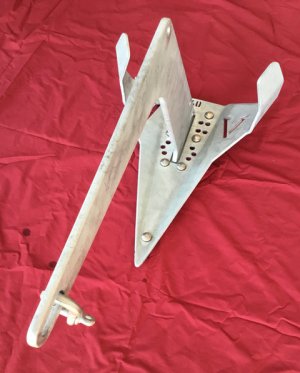
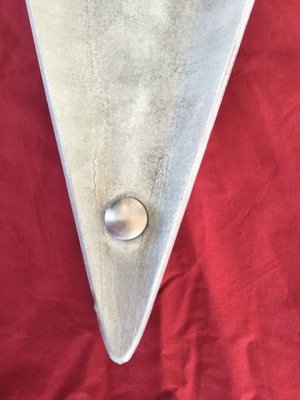
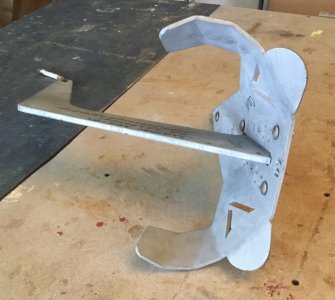
3. The shank has a flange welded to its base. The flange is the same quality steel as the shank and fluke, 1,450Mpa steel. The shank is located from underneath the fluke through a slot in the fluke and then bolted. The bolts are pan headed with the nuts below. The bolt heads would offer resistance to burial (hence the pan heads) and the nuts are in 'the void'

When an anchor sets under tension from either the wind or motor and excavates a trench as it moves forward and dives. The flange simply moved through a 'void', the excavated tench (which slowly back fills naturally). The flange is to secure the shank and (as its there) offers support to the fluke. To suggest the flange detracts from performance seems indicative of an misunderstanding on how anchors 'work'. The flange entering a void is hardly novel - the ballast chamber of both the Excel and Spade offer no resistance to burial - they too simply fill the void as a result of the digging of a trench.

An omission?

Mention is made that there is no welding of the fluke tip. My Odin 40 has two welds at the toe. To enable tho concave form of the fluke, the tip has been slit and then welded, post bending. The steel is so tough, 1450Mpa, it is impossible to 'bend' the toe - even with a 30t press. (Noting the original Rocna shanks, now Excel shanks, use 800Mpa steel for the shank (not the flue- which is a 300/400Mpa quality).

Maybe my anchor is different to the one subject to the pane interrogation.

Jonathan
 
Last edited:
I had a bit more time, and the thread is about Odin, Viking and Ultra or that is what was tested. Why Odin, Ultra and Viking are the 3 anchors - maybe Ultra is mainstream in NW USA

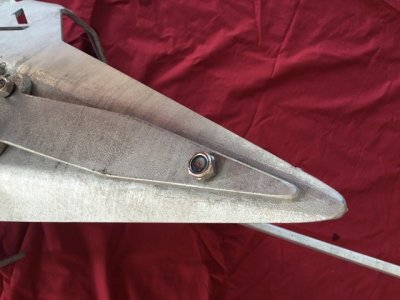
It was suggested that the flange extended to the toe would be ballast, to increase toe weight.

Is the man serious? Ballast is a big lump, think Spade, Excel, Delta, Kobra, and ....Ultra

This is the underside, with Nyloc nuts


IMG_0817.jpeg


and the top, pan headed bolts

IMG_0811.jpeg


Quote "The toe is not welded", but mine was (not saying the test anchor was welded......

I think the slits and welded lines are clear

with a 1,450 Mpa steel - I'd not worry about toe integrity.

IMG_0814.jpeg


Separately - Odin is an unballasted anchor, like Fortress, Danforth, Knox, SARCA, Mantus M1 and has the crown (junction of shank and fluke) at the heel (well except Mantus which has the crown in the location of ballasted anchors, Spade, Excel, Delta ....etc.

Jonathan
 
Photographs don't lie

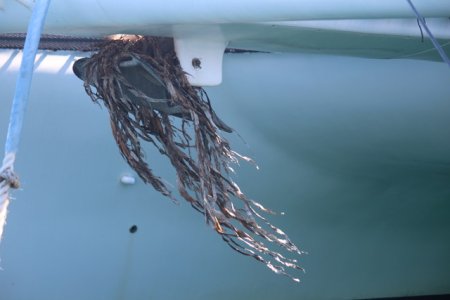
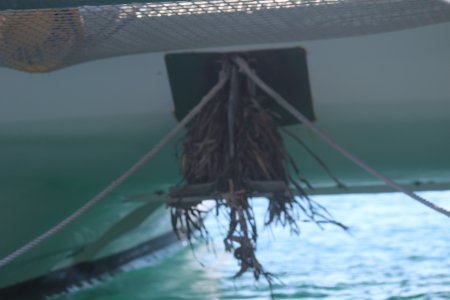
In the Panone YouTube video 156 Steve Godwin states that extending the flang right to the toe of the anchor, see immediately previous images, post 134. was a negative development, without defining quite why it was a damaging development. I made the comment that the flange enhanced strength and was not an attempt to ballast the toe. I also made the comment that the flange did not impact setting and further setting as the flange simply, part, filled a void underneath and behind the fluke of a setting/diving anchor.

Vyv's post of a Delta clearly illustrates the void behind a setting and diving anchor

Delta 33 ft boat low res.jpg

All anchors, big or small, NG or 'old', when they are setting develop the same void behind and below the fluke as they set. The seabed is shoveled aside, or over the heel of the fluke (or both) forming a trench that will fill with time. The fluke is moving forward and more deeply, simultaneously, as it 'sets'. Even a large and protruding ballast chamber is not a hinderance to setting even though there maybe no noticeable void the seabed will be a slurry and/or have low shear strength.

The trench and the void will fill with time and (if the anchors is left undisturbed) and redevelop the shear strength it had before the anchor was introduced under the influence of movement of the sea, wave action.

Jonathan
 
Hi Jonathan,

Forgive me I am confused. In the video, Panope (Steve) pretty much bags the Odin in all areas apart from the beginning test of a series of tests in his video using Odin and the other anchors.

This is interesting because I have purchased an Odin 50 at a not inconsiderable cost (though way less than the Ultra of course) - before Steve's video came out - (I am yet to use it as my boat is going through a major refit), and frankly - after watching the video I am strongly inclined to change from the Odin as my proposed main bower, to relegate it to the rank of a spare anchor only. Steve's video is not kind to the Odin at all.

So when you say something diametrically opposite as in "To me Odin is a revelation" - then I am rather interested how you and Steve can come to such different conclusions.

I am interested in your thoughts.
Cheers.

In the video Steve has a totally new test which he implies is a negative facet. He sits the anchor flat on its fluke and gives the anchor a gently shove. Odin rolls over with ease (because its designed to roll over). It can roll over to the orientation

It lies sitting on one edge of the fluke and on the shank tip (shackle point). it also easily possible if you deploy your Odin in lands and takes the same orientation.

IMG_1160.JPG

On the basis this is all possible, Steve implies its a negative position, then testing shows that the shove test is simply 'clutching at straws' without testing to full conclusion with an anchor orientated in the results of the shove test actually being set

This is a short video of Odin set as shown above and set in a soft sandy seabed.


Rolling over is NOT a negative characteristic.

In answer to JRCO26

My investigation of Odin is in conflict with Vid 256 - because there are too many errors in the video and suggestions of a total lack of understanding as to how anchors perform and how to test anchors. I repeat my comments its is difficult to separate the performance of Odin and Viking. Use your Odin, report your experiences.

Ignore the falso prophet.

I'm like Vyv, I have little confidence in Steve Godwin's results.

Jonathan
 
Arguably, the most important parameter for a modern primary anchor is a consistently good performance over the range of substrates and situations likely to be encountered.

Unfortunately, in this test, the Odin did not do particularly well in this department.

I'd love see something with a bit more meat. Surely an anchor Guru can better define the weaknesses demonstrated of the Odin design. Without evidence its trolling

Jonathan
 
Last edited:
Top