Viking's Odin anchor vs Ultra and the original Viking anchor

Yes, I am only showing one example in this post, but I have seen photographed many more to draw my conclusions. The photo below is just one more example I observed of a less than brilliant performance. It shows an Ultra not coping well with only light weed. It had slowly dragged about 15m at this stage. You can see from the cloud of disturbed substrate that it was still slowly moving. 8m @ 6:1.

The best anchors can consistently penetrate much thicker weed than this without any difficulty.

However, I have also seen some excellent performances by the Ultra. Overall, I would rate it as a very good anchor. When observing the anchor underwater, it is easy to see it vastly superior to the majority of models, but it is not as good as the steel Spade or the better roll bar models.
I have not experienced any problems in weed with my Ultra. I agree with Geem that setting technique is probably the issue here.

Where I notice a difference to the Spade is in the aggressiveness of setting in softer mud. The Spade bites in slightly but noticeably harder than the Ultra, and generally gives fewer "missed approaches."

I have not tried Mantus or Viking roll bar anchors, but I have years of experience with a 121 pound Rocna. Both Spade and Ultra are far better than the Rocna, a very large difference in performance. Spade and Ultra work in almost any seabed -- they are extremely versatile. Rocna does not.

Rocna is really flummoxed by soft mud, because the roll bar clogs and turns the anchor into a ball of mud which can't dig in. In addition, the Rocna is top-heavy and so goes down, and comes up, upside-down. It's hard to get into the anchor roller (I needed a swivel, and a boat hook), and setting requires it to successfully rotate on the roll bar. If you say different roll bar anchors are better than that, I'll have to take your word for it, since I don't have my own experience, but my experience with Rocna convinced me provisionally that the roll bar is an inherently inferior solution, compared to ballast, a band-aid intended to paper over the inherent problems of bad balance. Bad balance which results from saving money by not using ballast.

That may or may not be correct, but based on my experience, it sure seems like that.

The poor balance of the Rocna also creates challenges in weed, in my experience, which I have not experienced with Spade or Ultra. If you try to drop it hard to get some penetration, it lands on its side, and this doesn't work. Spade or Ultra come down right on their tips and punch right through most weed, if you drop hard enough. Good technique means falling back slowly, just enough to keep the chain from piling up, but slow enough so that the anchor hits in one place and penetrates, without skidding across the top of the weeds.

Balance issues getting the anchor into the roller would be enough for me to choose Spade or Ultra, even if the performance were the same. It's a PITA, and even a safety issue. I can raise Spade or Ultra from the helm without even being able to see the anchor before the shank enters the roller. I know it will go in straight. A huge boon when single handed. With the Rocna, I had to wrestle it around with a boat hook before coaxing it in -- a whole dance at the bow -- a whole problem in rough conditions, or when single handed, or near to a lee shore. I don't know if Mantus or Viking are better for this.
 
Quote 'Nobody ever see my anchor.'

It does not always boil down to 'performance' - fit can be the deciding factor. Viking does not fit many multihull bow rollers, Odin is perfect.

Jonathan
Indeed! Fit is a critical issue for many. Also, balance, and how the anchor comes into the roller, are really important. Setting performance, and holding, are not indeed the only important qualities of anchors.

The best anchor in terms of holding or setting behavior may not always be the best anchor for every boat or sailor. Small differences in holding or setting may not be significant, especially if your anchor is well oversized. Especially true of very large anchors; I know people on big boats who are very happy with their 180lb or 200lb Bruce anchors.
 
Indeed! Fit is a critical issue for many. Also, balance, and how the anchor comes into the roller, are really important. Setting performance, and holding, are not indeed the only important qualities of anchors.

The best anchor in terms of holding or setting behavior may not always be the best anchor for every boat or sailor. Small differences in holding or setting may not be significant, especially if your anchor is well oversized. Especially true of very large anchors; I know people on big boats who are very happy with their 180lb or 200lb Bruce anchors.
Is hold-per-weight everything? It's on the list, but as you say, not everything.

The other factor (and Bruce fails a bit on this) on my list is consistent hold on all bottom types.
a. I may not actually know what is down there. It might be good mud 100 feet away, weeds here.
b. You don't always have a choice. Sometimes you can move. Sometimes a storm pops up and you have to make do with what you have, since navigating around rocks and shoals in a storm is bad and holding a short distance away may be worse.

Weed, hard sand, hard pan (or mudstone), and jointed rock all offer different challenges that are hard to test. I don't want an anchor (other than as a kedge or secondary) that is brilliant at a few things and terrible at others (Fortress comes to mind--great as a kedge but not as a main IMO). They're butt ugly and can have fit problems, but darn it, Mantus M1 and Viking are hard to beat for across-the-board hold. They fit my PDQ and I loved them ... but they don't fit my Corsair, so I use an Excel.

I fact, I often us a Northill utility, since it is the best weed and hardpan anchor I've found ... but it has other serious flaws (veer and fouling).
 
Last edited:
Is hold-per-weight everything? It's on the list, but as you say, not everything.

The other factor (and Bruce fails a bit on this) on my list is consistent hold on all bottom types.
a. I may not actually know what is down there. It might be good mud 100 feet away, weeds here.
b. You don't always have a choice. Sometimes you can move. Sometimes a storm pops up and you have to make do with what you have, since navigating around rocks and shoals in a storm is bad and holding a short distance away may be worse.

Weed, hard sand, hard pan (or mudstone), and jointed rock all offer different challenges that are hard to test. I don't want an anchor (other than as a kedge or secondary) that is brilliant at a few things and terrible at others (Fortress comes to mind--great as a kedge but not as a main IMO). They're butt ugly and can have fit problems, but darn it, Mantus M1 and Viking are hard to beat for across-the-board hold. They fit my PDQ and I loved them ... but they don't fit my Corsair, so I use and Excel.

I fact, I often us a Northill utility, since it is the best weed and hardpan anchor Ive found ... but it has other serious flaws (veer and fouling).
I have never swapped anchors because the bottom was not suited to the anchor on my bow roller. In an approaching storm I have set a second anchor ( a large Fortress anchor) from the dinghy, just in case. Gone are the days of carrying lots of anchors for different bottoms. NG anchors probably out perform every single old fashioned anchor variant
 
Last edited:
Is hold-per-weight everything? It's on the list, but as you say, not everything. . .
It depends on the boat. On a light multihull, weight will mean a lot. On mine -- which is "light displacement" according to the definitions, less than 200 l/d, so racing boat territory, but nevertheless 25 long tonnes in the slings . . . I care a lot less about "hold-per-weight" than "hold", full stop. Weight is much less a limiting factor than bulk, which is why the Viking doesn't seem to be too much appealing for my specific use case. YMMV.
 
It depends on the boat. On a light multihull, weight will mean a lot. On mine -- which is "light displacement" according to the definitions, less than 200 l/d, so racing boat territory, but nevertheless 25 long tonnes in the slings . . . I care a lot less about "hold-per-weight" than "hold", full stop. Weight is much less a limiting factor than bulk, which is why the Viking doesn't seem to be too much appealing for my specific use case. YMMV.

If you believe in weight then your choices are almost infinite - just spend more money and move up the weight of your chosen design. A heavier anchor of a design will also be bigger and you need to watch that it fits in the allocated space.

Now whether you need the increased hold, in which you invested your hard earned cash, is a different issue and many would say (including me) - you have wasted your money. From manufacturers of modern anchors, say since Spade was introduced, have decades of feedback with which they will hone their size spreadsheets and anyone wanting a bigger anchor is really saying - I don't believe your recommendations.

Seems daft to me you choose a design, so you trust the designer, but then ignore the size recommendations from the same designer.

Many yachts are now super lightweight simply because they are capable of being built - lightweight - and would benefit from a lighter load on the bow, lighter anchor and lighter rode. Geem removes his anchor for ocean passages - but does not say if this is to reduce weight in the bow or because its a hazard to sheets etc.

If you don't believe in weight but want the best performing anchor that is as light as possible then your choice is much more restricted to.

Alloy Spade and Excel (both ballasted), Viking, roll barred, Odin and Fortress (the ballast free group).

Each of these weighs about 50% of the steel version because they use a light material and the Viking duo use HT steel at half the weight of less strong (and cheaper) steel used by other steel anchors.

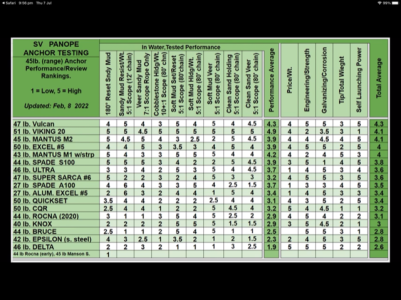
If you don't believe in weight then buying a ballasted anchor is really not a good investment (or a bit of a contradiction), and only Fortress, Viking and Odin fit the specification. Incapable of fitting a roll bar anchor? the choice falls further to Fortress and Odin. The Panope spread sheets, with which you may not agree, seem to suggest that weight is a phurphy - as the lightweight Viking tops the polls, see a spreadsheet below, (or Steve Godwin is quite gushing, see the Vid) of all the anchors he has tested (and included on his spreadsheets). It merits note that for every Viking their is a similarly sized Odin with exactly the same file size and exactly the same shackle (tension point) in relation to the fluke


IMG_9522 2.PNG

In my testing I cannot differentiate the, anchor, performance of Viking and Odin. A nuance here, another there - but nothing that's a deal breaker. To me Odin is a revelation - an anchor where much of the engineering is to improve performance, without the crutches of a roll bar catching mud or ballast (that adds nothing to hold). The fluke is 5mm thick, so slices like a knife in butter (perfect for those difficult seabeds) and the shank and fins offer lateral resistance where winds are oscillating.

Jonathan.
 
Last edited:
If you believe in weight then your choices are almost infinite - just spend more money and move up the weight of your chosen design. A heavier anchor of a design will also be bigger and you need to watch that it fits in the allocated space.

Now whether you need the increased hold, in which you invested your hard earned cash, is a different issue and many would say (including me) - you have wasted your money. From manufacturers of modern anchors, say since Spade was introduced, have decades of feedback with which they will hone their size spreadsheets and anyone wanting a bigger anchor is really saying - I don't believe your recommendations.

Seems daft to me you choose a design, so you trust the designer, but then ignore the size recommendations from the same designer.

Many yachts are now super lightweight simply because they are capable of being built - lightweight - and would benefit from a lighter load on the bow, lighter anchor and lighter rode. Geem removes his anchor for ocean passages - but does not say if this is to reduce weight in the bow or because its a hazard to sheets etc.

If you don't believe in weight but want the best performing anchor that is as light as possible then your choice is much more restricted to.

Alloy Spade and Excel (both ballasted), Viking, roll barred, Odin and Fortress (the ballast free group).

Each of these weighs about 50% of the steel version because they use a light material and the Viking duo use HT steel at half the weight of less strong (and cheaper) steel used by other steel anchors.

If you don't believe in weight then buying a ballasted anchor is really not a good investment (or a bit of a contradiction), and only Fortress, Viking and Odin fit the specification. Incapable of fitting a roll bar anchor? the choice falls further to Fortress and Odin. The Panope spread sheets, with which you may not agree, seem to suggest that weight is a phurphy - as the lightweight Viking tops the polls, see a spreadsheet below, (or Steve Godwin is quite gushing, see the Vid) of all the anchors he has tested (and included on his spreadsheets). It merits note that for every Viking their is a similarly sized Odin with exactly the same file size and exactly the same shackle (tension point) in relation to the fluke


View attachment 204881

In my testing I cannot differentiate the, anchor, performance of Viking and Odin. A nuance here, another there - but nothing that's a deal breaker. To me Odin is a revelation - an anchor where much of the engineering is to improve performance, without the crutches of a roll bar catching mud or ballast (that adds nothing to hold). The fluke is 5mm thick, so slices like a knife in butter (perfect for those difficult seabeds) and the shank and fins offer lateral resistance where winds are oscillating.

Jonathan.
I certainly don't remove my anchor for ocean passages. It stays firmly on the bow.
I do move weight out of the ends of the boat though, particularly the bow
 
"In my testing I cannot differentiate the, anchor, performance of Viking and Odin. A nuance here, another there - but nothing that's a deal breaker. To me Odin is a revelation - an anchor where much of the engineering is to improve performance, without the crutches of a roll bar catching mud or ballast (that adds nothing to hold). The fluke is 5mm thick, so slices like a knife in butter (perfect for those difficult seabeds) and the shank and fins offer lateral resistance where winds are oscillating".
Hi Jonathan,

Forgive me I am confused. In the video, Panope (Steve) pretty much bags the Odin in all areas apart from the beginning test of a series of tests in his video using Odin and the other anchors.

This is interesting because I have purchased an Odin 50 at a not inconsiderable cost (though way less than the Ultra of course) - before Steve's video came out - (I am yet to use it as my boat is going through a major refit), and frankly - after watching the video I am strongly inclined to change from the Odin as my proposed main bower, to relegate it to the rank of a spare anchor only. Steve's video is not kind to the Odin at all.

So when you say something diametrically opposite as in "To me Odin is a revelation" - then I am rather interested how you and Steve can come to such different conclusions.

I am interested in your thoughts.
Cheers.
 
If you believe in weight then your choices are almost infinite - just spend more money and move up the weight of your chosen design. A heavier anchor of a design will also be bigger and you need to watch that it fits in the allocated space.

Now whether you need the increased hold, in which you invested your hard earned cash, is a different issue and many would say (including me) - you have wasted your money.
An anchor with increased holding power (whether through greater size or a better design) will expand the range of anchorages that are viable for particular conditions and/or reduce the scope required for the same holding power (this can be handy).

This means it is hard to "waste your money". The exception is if you mistakenly select an anchor size that is too large to be comfortably managed.

Having an anchor with higher holding power is a bit like buying a boat with a shallow draft; suddenly the number of anchorages and locations within an anchorage are greater. You can now safely anchor in locations that previously would have been unwise; it is helpful extra versatility for typically only a very small increase in ground tackle weight.
 
Last edited:
It depends on the boat. On a light multihull, weight will mean a lot. On mine -- which is "light displacement" according to the definitions, less than 200 l/d, so racing boat territory, but nevertheless 25 long tonnes in the slings . . . I care a lot less about "hold-per-weight" than "hold", full stop. Weight is much less a limiting factor than bulk, which is why the Viking doesn't seem to be too much appealing for my specific use case. YMMV.

Yes (I'm a life long multihull guy and I sail fast), and at the same time no.

We're talking about increments of 10-20 pounds. We could lose that on a diet, clean up one locker, or carry 3 gallons less water. The difference might be 1 part per 1,000 of the of the boat's weight, even on a light cruising multihull. 10 feet less chain or a better grade of chain. So yes, holding first.

Lightweight for a kedge or secondary is a different issue. If you need to dinghy it out anchor weight matters and you're using rope, not chain.
 
Yes (I'm a life long multihull guy and I sail fast), and at the same time no.

We're talking about increments of 10-20 pounds. We could lose that on a diet, clean up one locker, or carry 3 gallons less water. The difference might be 1 part per 1,000 of the of the boat's weight, even on a light cruising multihull. 10 feet less chain or a better grade of chain. So yes, holding first.

Lightweight for a kedge or secondary is a different issue. If you need to dinghy it out anchor weight matters and you're using rope, not chain.
I will certainly defer to you on multihulls, where I have very little experience.

On my boat the difference between a 45kg anchor and an even 145kg anchor is meaningless. The chain is 330kg; the anchor is just a bauble at the end of it, in the grand scheme.

I took the whole main ground tackle off the boat for a couple of seasons of racing, taking almost 400kg or nearly half a short ton out of the bow. You would think that would make a noticeable difference, but nah.
 
An anchor with increased holding power (whether through greater size or a better design) will expand the range of anchorages that are viable for particular conditions and/or reduce the scope required for the same holding power (this can be handy).

This means it is hard to "waste your money". The exception is if you mistakenly select an anchor size that is too large to be comfortably managed.

Having an anchor with higher holding power is a bit like buying a boat with a shallow draft; suddenly the number of anchorages and locations within an anchorage are greater. You can now safely anchor in locations that previously would have been unwise; it is helpful extra versatility for typically only a very small increase in ground tackle weight.
Absolutely right.

There is no such thing as too much holding power, as poor holding has no lower limit. Comparing a bigger anchor to shallower draft is even trivializing it, I think. More holding power gives you more options -- less than perfect bottoms, less than ideal scope, worse conditions. More holding power is extremely desirable, and that is why Dashew correctly advised us to oversize our anchors as much as possible.

One corollary of this is that anchors which are light but bulky -- like the Viking -- have disadvantages, because you hit the limit of fit before you get to the weight you might otherwise like. I suspect the reason the Viking guy Izzi was always giving the ludicrously wrong advice "don't oversize your anchor!" was because of this.

Ballasted non-rollbar anchors have a big advantage in that larger sizes, fit better, everything else being equal.

Ultimate holding power is related to fluke area, not weight, but ultimate holding power is not at all the only thing we care about. For a given fluke area, the more weight the better, the better the setting behavior, the higher the density and better burying.

Obviously fluke geometry is really important, but the DENSITY of the anchor has also got to play a big role role. I still think about a Spade-like anchor, with a bolted-on tungsten, or depleted uranium tip. That would be a heck of an anchor. An anchor with the dimensions of a 55kg Spade, but with another 15kg in the very tip. Wow.
 
Absolutely right.

There is no such thing as too much holding power, as poor holding has no lower limit. Comparing a bigger anchor to shallower draft is even trivializing it, I think. More holding power gives you more options -- less than perfect bottoms, less than ideal scope, worse conditions. More holding power is extremely desirable, and that is why Dashew correctly advised us to oversize our anchors as much as possible.

One corollary of this is that anchors which are light but bulky -- like the Viking -- have disadvantages, because you hit the limit of fit before you get to the weight you might otherwise like. I suspect the reason the Viking guy Izzi was always giving the ludicrously wrong advice "don't oversize your anchor!" was because of this.

Ballasted non-rollbar anchors have a big advantage in that larger sizes, fit better, everything else being equal.

Ultimate holding power is related to fluke area, not weight, but ultimate holding power is not at all the only thing we care about. For a given fluke area, the more weight the better, the better the setting behavior, the higher the density and better burying.

Obviously fluke geometry is really important, but the DENSITY of the anchor has also got to play a big role role. I still think about a Spade-like anchor, with a bolted-on tungsten, or depleted uranium tip. That would be a heck of an anchor. An anchor with the dimensions of a 55kg Spade, but with another 15kg in the very tip. Wow.
Yep, the bigger the better, without going silly.

I’m a Rocna fan. I’ve owned CQR, Delta, Bruce, Rocna, Fortress and then Mantus more recently. Rocna wins. Clearly. Mantus 2nd. No Spade or Ultra experience, but I can see they will be good too.
 
Obviously fluke geometry is really important, but the DENSITY of the anchor has also got to play a big role role. I still think about a Spade-like anchor, with a bolted-on tungsten, or depleted uranium tip. That would be a heck of an anchor. An anchor with the dimensions of a 55kg Spade, but with another 15kg in the very tip. Wow.
Most of the weight of a Spade anchor is in the ballast chamber in the tip. It would be possible to melt out the lead and have a tungsten weight made that inserted in the existing ballast chamber, and epoxied in place.
Tungsten is 50% heavier than lead so you would dramatically increase the weight of the anchor, over the tip. This would be very achievable. A friend of mine actually owns a company that makes tungsten components. It would be an interesting project.
I guess it would aid setting through seagrass and hard compact seabeds but wouldn't increase hold once set.
I don't think tungsten is tough enough to function as the anchor fluke itself
 
If you believe in weight then your choices are almost infinite - just spend more money and move up the weight of your chosen design. A heavier anchor of a design will also be bigger and you need to watch that it fits in the allocated space.

Now whether you need the increased hold, in which you invested your hard earned cash, is a different issue and many would say (including me) - you have wasted your money. From manufacturers of modern anchors, say since Spade was introduced, have decades of feedback with which they will hone their size spreadsheets and anyone wanting a bigger anchor is really saying - I don't believe your recommendations.

Seems daft to me you choose a design, so you trust the designer, but then ignore the size recommendations from the same designer.


Jonathan.
I really strongly disagree with this. There is no such thing as too much holding power. A better holding anchor -- whether it's from a better design, or a larger version of the same thing -- is ALWAYS better, provided it fits your boat and you and your gear can handle it.

As I wrote, there is no lower limit to poor holding bottoms. The more holding power you have, the more excess holding power beyond the minimum required to get you through a given set of average conditions as per the manufacturer's recommendations, the more options you have, to anchor in a less than good bottom if you need to (and I HAVE needed to), to anchor with less than ideal scope if you need to (DITTO), or a combination of the two.

A manufacturer's recommendation does NOT tell you -- you will not get any benefit ABOVE this size. It only tells you -- better not choose BELOW this size. It cannot be otherwise. You will always get benefit from a larger size -- provided it fits, and you can handle it. Therefore the single daftest thing I ever heard in regard to anchoring, the most foolish proposition ever, is "Don't oversize your anchor!" Directly contradicts all logic, and also Dashew's excellent advice about sizing anchors. John of Morgan's Cloud and basically everyone else with experience in remote places and hard conditions, will all tell you the same.

I have brutal, real life experience with this, having been forced to go through a storm on about 2:1 scope in Northeastern Greenland, 1000 miles from the nearest port or rescue services. There was simply no place to anchor with any shelter and without an adversely sloping bottom, in less than 45m of water. If I had not had a two sizes oversized anchor of excellent type, I might very well not be here to tell the story. Oversizing my anchor likely saved my boat, and my life.
 
Last edited:
Most of the weight of a Spade anchor is in the ballast chamber in the tip. It would be possible to melt out the lead and have a tungsten weight made that inserted in the existing ballast chamber, and epoxied in place.
Tungsten is 50% heavier than lead so you would dramatically increase the weight of the anchor, over the tip. This would be very achievable. A friend of mine actually owns a company that makes tungsten components. It would be an interesting project.
I guess it would aid setting through seagrass and hard compact seabeds but wouldn't increase hold once set.
I don't think tungsten is tough enough to function as the anchor fluke itself
Thank you; hot tip! Since I'm going to regalvanise my old Spade anyway, meaning I will have to melt out the lead anyway, this could be a chance to experiment with that. I could make a casting of the cavity he could use to make the weight. If you don't mind, PM me and put me in touch with your friend.
 
I really strongly disagree with this. There is no such thing as too much holding power. A better holding anchor -- whether it's from a better design, or a larger version of the same thing -- is ALWAYS better, provided it fits your boat and you and your gear can handle it.

As I wrote, there is no lower limit to poor holding bottoms. The more holding power you have, the more excess holding power beyond the minimum required to get you through a given set of average conditions as per the manufacturer's recommendations, the more options you have, to anchor in a less than good bottom if you need to (and I HAVE needed to), to anchor with less than ideal scope if you need to (DITTO), or a combination of the two.

A manufacturer's recommendation does NOT tell you -- you will not get any benefit ABOVE this size. It only tells you -- better not choose BELOW this size. It cannot be otherwise. You will always get benefit from a larger size -- provided it fits, and you can handle it. Therefore the single daftest thing I ever heard in regard to anchoring, the most foolish proposition ever, is "Don't oversize your anchor!" Directly contradicts all logic, and also Dashew's excellent advice about sizing anchors. John of Morgan's Cloud and basically everyone else with experience in remote places and hard conditions, will all tell you the same.

I have brutal, real life experience with this, having been forced to go through a storm on about 2:1 scope in Northeastern Greenland, 1000 miles from the nearest port or rescue services. There was simply no place to anchor with any shelter and without an adversely sloping bottom, in less than 45m of water. If I had not had a two sizes oversized anchor of excellent type, I might very well not be here to tell the story. Oversizing my anchor likely saved my boat, and my life.
Your advice is sound - if you intend sailing to Greenland.

Whilst high latitude sailing may be an ambition then for those with that intention I hope they are wise and knowledgable enough to make their own investigations and subsequent decisions. I'd worry if they look to YBW for their answers - unless they initiate a high latitude thread - and are realists on the numbers who can actually respond.

I frankly think it unreasonable to suggest to the typical owner here, buying a bigger windlass, running heavier cables etc etc to support use of a bigger anchor for sailing in UK (or Australian) waters. Your ideas are worthy of debate and honing but are simply excessive for the average owner. Your ideas are the equivalent of the 4WD with bull bars, recover winch used used by residents of the West End London to run the kids to tennis and do the supermarket shopping - basically a waste of money. People here have been using the manufacturers/boat builders suggestion of anchor size and would find a bigger anchor totally unnecessary. Those same people here might have upgraded the anchor from a Delta to one nearer the top of the 'Panone' spreadsheets - but I suspect it has never crossed their mind to go significantly bigger anchor and buy a new windlass.

Jonathan
 
Your advice is sound - if you intend sailing to Greenland.

Whilst high latitude sailing may be an ambition then for those with that intention I hope they are wise and knowledgable enough to make their own investigations and subsequent decisions. I'd worry if they look to YBW for their answers - unless they initiate a high latitude thread - and are realists on the numbers who can actually respond.

I frankly think it unreasonable to suggest to the typical owner here, buying a bigger windlass, running heavier cables etc etc to support use of a bigger anchor for sailing in UK (or Australian) waters. Your ideas are worthy of debate and honing but are simply excessive for the average owner. Your ideas are the equivalent of the 4WD with bull bars, recover winch used used by residents of the West End London to run the kids to tennis and do the supermarket shopping - basically a waste of money. People here have been using the manufacturers/boat builders suggestion of anchor size and would find a bigger anchor totally unnecessary. Those same people here might have upgraded the anchor from a Delta to one nearer the top of the 'Panone' spreadsheets - but I suspect it has never crossed their mind to go significantly bigger anchor and buy a new windlass.

Jonathan
Any sailor who doesn't just sail from marina to marina is very well served with the anchoring equivalent of a "4WD with bull bars". There is no equivalent to "West End London" at sea, unless all you do is just day sail in the Solent. The sea is not a tamed, paved over suburb. The sea is much more like the Mojave Desert, than that.

Like many on this forum, I suspect, I learned about anchoring the hard way, and as a callow young chap. My dad and I had a CQR and a Danforth kedge, and when the wind blew up at night, we were dragging. In the pitch black night and no chart plotter and no GPS. We never went on the rocks, thank God, but we knew plenty who did, and pulled a couple off.
Decades later, and not having drug anchor in decades (we got our first Spade in the late 90's), I nevertheless still sleep with one eye open at anchor.

I will take all the holding power I can get, thank you very much, and I think most of us on here have a similar use case. If you never have to anchor in a dodgy bottom or in dodgy weather, if there's always a marina nearby, then by all means, "don't oversize your anchor." In fact, if you sail like that, just keep the Delta your boat was delivered with -- why bother with fussing over anchor design -- it'll be fine. For the rest of us -- the bigger, the better, just as Dashew taught us years ago.
 
The anchoring conditions in the UK are not always easy. Areas such as the Outer Hebrides, Orkney, and the Shetland Islands are unfortunately sometimes challenging.
Greenland was an extreme challenge, uncharted water, steeply sloping bottom, rocks, no shelter. I was lucky to get through that summer unscathed.

But where is anchoring actually easy, at least in any kind of weather? Not around the UK coasts. Not in the Baltic. Not in the Adriatic, or the Aegean. Not if you're are venturing at all far. Maybe in the Caribbean it's easy sometimes, with all that sand. But that's pretty far from here. Around the UK, I can count challenge-free anchorages on one hand, probably -- Osborne Bay, St. Aubin's Bay on Jersey, Falmouth Harbour, Salcombe.

I guess there are weekend sailors who always get to pick their weather, and never anchor out of necessity. Who never anchor in the winter, or in an unfamiliar place, or in bad weather. Such sailors might have little need for extra holding power. I don't think that describes anyone in this thread, however.
 
Top