VHF antenna types

PabloPicasso

Well-Known Member
Joined
12 Feb 2010
Messages
2,892
Visit site
Hi all

With the mast down it's time to replace the VHF whip antenna.

Why do yachts usually have a long whip antenna? Alternatives might be stubby rubberised short antennas, or even enclosed dorsal types?

Apart from a little loss in height, are there other reasons for choosing/not choosing a whip type?
 
Not an expert but believe its about performance. Different shaped lobes on the transmission give better performance. No doubt someone will explain who knows more.
 
Not an expert but believe its about performance. Different shaped lobes on the transmission give better performance. No doubt someone will explain who knows more.
And then which is the best make of aerial.

I had the mariens ? aerial supplied by saltyjohn who used to post here, and then used a thicker wire, RG58 ? It was all quite a few years ago, but it worked very well.
 
Different antenna designs have different gains. Sailing yachts need low gain, wide lobes for when they heel over. Motor boats can have higher gain narrow lobes as they don't lean as much.

You can get much better performance cable at proper radio shops than at chandlers. On a 20m mast, you can easily be radiating 10w when your radio is outputting 25w with poor cable and connectors.
 
Different antenna designs have different gains. Sailing yachts need low gain, wide lobes for when they heel over. Motor boats can have higher gain narrow lobes as they don't lean as much.

You can get much better performance cable at proper radio shops than at chandlers. On a 20m mast, you can easily be radiating 10w when your radio is outputting 25w with poor cable and connectors.
Agreed (as an ex radio engineer/licensed amateur). I like this stuff - EXTRAFLEX BURY 7 /.300
 
And then there's the need to have a wideband antenna (I believe that's the word) for AIS transmission. The documentation with transceivers suggests that the normal VHF whip aerial commonly fitted isn't sufficient. Although they work, the range might be compromised. A problem or not, I'm not sure. If its so distant that you can't see it, is it a problem for a yacht?
 
And then there's the need to have a wideband antenna (I believe that's the word) for AIS transmission. The documentation with transceivers suggests that the normal VHF whip aerial commonly fitted isn't sufficient. Although they work, the range might be compromised. A problem or not, I'm not sure. If its so distant that you can't see it, is it a problem for a yacht?
Marine vhf aerials are 'designed' to cover marine vhf frequencies, which ais uses. I believe that channel 16 is in the middle of the frequencies, so the aerials are tuned for that, which gives a slightly better performance, not that the average boater will notice.
 
Channel 0 (RNLI in the UK) is 156MHz, 16 is 156.8MHz and the AIS high frequency is at 162.025MHz

I've measured our Metz 6 before, it's tuned to approx 156.6 and has a decent VSWR between 155.8 and 162.2
 
A simple antenna is known as a quarter wave length antenna about 17 iinches long. However this type of antenna requires a ground plane ie a metal surface larger than the quarter wave length for attachment of the screen of the cable. An ali mast is a suitable ground plane. Some antenna are made and sold which have in effect a ground plane within fibre glass tube typically 1 metre long. Suitable for the GRP roof of a mobo. These as said often have a gain over a quarter wave because radiation is concentrating the radiation closer to horizontal. As said can leave poorer performance at a heel elther upwards or down in to the water.
A stub antenna has in effect the quarter wave radiator coiled to reduce length. So a compromise in received signal strength and possibly radiated power.
So for OP a quarter wave length rod type antenna might be best cheapest. ole'will
 
I on my current boat I use a metz at the masthead with the posh coax that wonkywitch recommended. I get fantastic reception, in fact it is too good at times as I get French and uk coastguards at times whilst in West Cork...

The Italian manufacturers of the cable have a great site, good prices and quick delivery to Ireland..

Buying the metz was a different story, I had to get it via the North from a UK mainland supplier and it was expensive, and I found them awkward to deal with.

I am refurbishing my old boat at the mo and will be ordering the same bits and pieces again so I am on the look out for a Metz or equal that I can get from a European supplier..

I use a stubby at the masthead also, for the AIS. (Some on here will condemn this practice but it seems to works fine. )
 
I use a stubby at the masthead also, for the AIS. (Some on here will condemn this practice but it seems to works fine. )
Any metalwork in the same plane within a few wavelengths will change the radiation pattern. You'll have a lobe of extra gain and a null with hardly any gain.
 
Buy the best you are prepared to buy.
The good quality ones have a tough rigid glassfibre tube to hold the simple bit of copper wire within. Plastic tubes types tend to flex more and will split.
Stainless mounting if possible , ideally with the ability to be adjusted on both planes, plastic mounts all fail eventually.
You really do get what you pay for with marine antennas.
The longer the antenna the better . The shorter the aerial the more coil and the less efficient.
Be very wary of Db gains on budget aerials , Italian Dbs can be different to the rest of the world and compared to what exactly.
 
Buy the best you are prepared to buy.
The good quality ones have a tough rigid glassfibre tube to hold the simple bit of copper wire within. Plastic tubes types tend to flex more and will split.
Stainless mounting if possible , ideally with the ability to be adjusted on both planes, plastic mounts all fail eventually.
You really do get what you pay for with marine antennas.
The longer the antenna the better . The shorter the aerial the more coil and the less efficient.
Be very wary of Db gains on budget aerials , Italian Dbs can be different to the rest of the world and compared to what exactly.
Thank you - good explanation: On most stores I find the "Glomex" brand. Are there other / real professional brands or types?
My focus is on quality, reliability and durability. I will fit it with professional RG58 cable along with 1. quality connectors.
 
Thank you - good explanation: On most stores I find the "Glomex" brand. Are there other / real professional brands or types?
My focus is on quality, reliability and durability. I will fit it with professional RG58 cable along with 1. quality connectors.
Any good quality antenna will come complete with a tuned length ( Do not shorten if at all possible )of good quality RG58 (the thin stuff).
This hopefully means a multistrand centre conductor and loads of silver plated copper shielding.
A decent good quality PL259 will finish the job with a dab of solder.
Leave the gold plated PL 259 for those with money to waste.
 
Any good quality antenna will come complete with a tuned length ( Do not shorten if at all possible )of good quality RG58 (the thin stuff).
This hopefully means a multistrand centre conductor and loads of silver plated copper shielding.
A decent good quality PL259 will finish the job with a dab of solder.
Leave the gold plated PL 259 for those with money to waste.
I would not agree that the cable length of RG 58 is tuned. In fact simply the shorter the better. Less losses. ol'will
 
Thank you - good explanation: On most stores I find the "Glomex" brand. Are there other / real professional brands or types?
My focus is on quality, reliability and durability. I will fit it with professional RG58 cable along with 1. quality connectors.
There are much better cables than RG58 available now for similar prices.

Some old Radar antennas required a specific length of cable, but that was for timing purposes, not tuning.
 
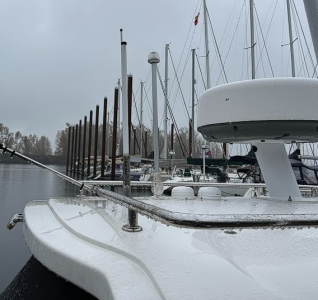
Seems like maybe the right forum? Will do more digging on the boat, but any idea what the antenna behind the light and radar is for? About 2' tall.

Cheers!

1764956891995.png
 
Top