Trot Mooring Issues

laurence_penpol

New Member
Joined
18 Mar 2019
Messages
6
Visit site
Hi all - i’ve been on my trot mooring now for a few months and am having real difficulty getting on and off it and was hoping for some words of advice! Today I cut the line with my prop which is at least better than the prop getting wrapped and jammed!

My Current Setup:
2 mooring lines to fore and aft buoys that i connect together when leaving with a single line with a carabena at each end with pickup buoys on each carabena point. In the centre of the line I have a loop to go over my centre cleat if needed.

The boat has to point up river to to the strength of the ebb tide so my usual routine without side wind it to approach the buoy that is upstream of the tidal direction and connect that first and then the other end. This seems to work ok when there is no side wind!!!

When there is a side wind, if I approach the line on the windward side (as I did today), if my crew don’t manage to pick up the line on first attempt it will slide under the boat against the keel and prop. The wind pins me on it and there is no way of lifting it or getting my fire and aft lines connected.

If I approach on the leeward side, If i try to connect the mid-ship cleat after picking up the line, we get blown off to the point the line is tight and getting the fire and aft lines on are almost impossible.

I’m hoping someone has a few pointers that may help me out as I’m new to this mooring type. An additional complication is that where my trot is has an eddy which can push the boat to the side as well. I can judge which side to approach from based on the position of other boats but i’m not even sure which side is the right side at the moment!

Thanks
 
I'm on trots. I don't like them, but there you go. Normally I work out which direction I need to approach them (into tide so that I can stop the boat) and which side I need to be on (leeward side so I get blown off).

On the one occasion I had a strong wind against a strong tide we picked the best of a bad bunch of approaches, got ourselves hooked on at the bow, then I took the pickup rope off the bridle, got it in one of the main winches and winched the stern in to the point I could get the stern ropes over the cleats. Not fun.
 
Yes we spend the winter on trot moorings, I haven't got any magic answers! We pretty much what Balbas does. Haven't come a cropper yet, but I always think we are going to snag the prop when leaving, as entails a "spin on a sixpence" U turn to get out of the estuary! :o
 
Unless it is impossible I would always split the fore and aft line in the middle making it handy to get off, or on. either side. Use a knot rather than some form of shackle as they can damage the topsides.

Always come alongside your mooring into the tide and the boat will lie quietly, parallel (ish), it can't do anything else unless there is a huge sidewind when all bets are off, this would be very unusual. Even then you could pull the stern in on a winch.
Secure the bow first with a short line to the fore and aft rope (rolling hitch). The boat can't swivel uptide, you are in. If you need to turn the boat, attach aft, let go forward and walk the boat around. Last job is to make fast with your strops.
If there is no tide the wind dictates.

In essence, I always sort it so I can:

- come on, or off, in either of four directions and
- am able to secure at the bow promptly and
- turn the boat on the mooring as required.
 
Hi all - i’ve been on my trot mooring now for a few months and am having real difficulty getting on and off it and was hoping for some words of advice! Today I cut the line with my prop which is at least better than the prop getting wrapped and jammed!

My Current Setup:
2 mooring lines to fore and aft buoys that i connect together when leaving with a single line with a carabena at each end with pickup buoys on each carabena point. In the centre of the line I have a loop to go over my centre cleat if needed.

The boat has to point up river to to the strength of the ebb tide so my usual routine without side wind it to approach the buoy that is upstream of the tidal direction and connect that first and then the other end. This seems to work ok when there is no side wind!!!

When there is a side wind, if I approach the line on the windward side (as I did today), if my crew don’t manage to pick up the line on first attempt it will slide under the boat against the keel and prop. The wind pins me on it and there is no way of lifting it or getting my fire and aft lines connected.

If I approach on the leeward side, If i try to connect the mid-ship cleat after picking up the line, we get blown off to the point the line is tight and getting the fire and aft lines on are almost impossible.

I’m hoping someone has a few pointers that may help me out as I’m new to this mooring type. An additional complication is that where my trot is has an eddy which can push the boat to the side as well. I can judge which side to approach from based on the position of other boats but i’m not even sure which side is the right side at the moment!

Thanks

we were on a trot for 18 months and ended up with the same set up as you, although we could only access our trot from one side due to shallow water opposite it, so even more restricted!!

that said, stick your middle loop over the midships cleat, the boat isnt going anywhere then, obviously dont use the prop at that point, keep the caribinas connected and loop the best you can on fore and aft,

a bit like this;

UZilRxu.png


Our starboard lines were always alot longer and we could always attach them no matter how far blown off, and slowly pull them in tighter, connecting another line to a winch if necessary; the port sides were just loops to hook over the cleats once finally close enough. i do remember winching in the aft lines during a 25knt wind blowing us off... not nice

equally leaving the trot with the wind blowing us onto it could turn into a right faff!

we no longer have a trot, spent some time on a swing mooring which was 100 times easier but we currently have the luxury of a pontoon where tieing up is a doddle compared to trots.
 
My mooring is on the River Frome (Poole - Wareham) and I have the same issues. The Environment Agency (try to) insist that the boats all point up stream!
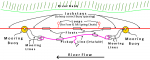
The secret in setting up your mooring is to have a permanent Jackstay (on floats) between the fore and aft buoys to keep the spacing between the buoys correct and a separate detachable Pickup line also with floats and longer than the Jackstay so you always have slack in it, which you attach to your fore and aft mooring lines.
The floats help stop the lines disappearing under the boat. If I'm leaving my dinghy on the mooring when I go sailing, I attach it fore and aft to the Jackstay line (not the pickup line) which also helps to stop it disappearing.
I have also put two short eye spliced strops on the Jackstay line which I attach my dinghy to, also they line up with my spring cleats so when the boat is left they keep the Jackstay line out of the water.
I have snap shackles and rings spliced onto the ends of the Pickup line to make it easy to attach / detach the Pickup line to the eye splice on the ends of the Mooring lines.
I have twin fore and aft Mooring lines which I oxo onto the bow and stern boat cleats and I leave the eye spliced ends hanging free so that when I prepare to leave the mooring, I undo the 'River Side' Mooring lines and move them across to the 'Bank Side' and attach the Pickup line to both Mooring lines eye spliced ends before detaching the Bank Side Mooring lines from the bow and stern boat cleats.
Returning to the mooring, hooking the slack Pickup line near the forward float is quite easy, I have also attached a centre strop to the Pickup line, but I'm not sure that it's necessary.
Another tip, when you make your Mooring lines, put an eye splice in each end. Then you can cow hitch the Mooring lines onto the eye on top of the Mooring Buoy eliminating the use of a shackle and a point of failure. It also makes it easy to remove the Mooring lines from the buoy as you don't have to take a spanner to a rusting shackle.

Sorry if this is all a bit long winded but I hope this helps:

Mooring Lines.png
 
It took me years to work out some of those techniques! (And a few more clever wheezes here I never found.) If only there'd been a forum like this in those days.

Of course, single line trots with a river bank on one side and a river on the other are just the basic shenanigans. For a real challenge try doubled-up trots (two boats side by side between each pair of buoys) - the work of the devil - where line tension (or lack of), mast positioning, etc, etc. becomes critical (and of course the owner of the boat alongside will have entirely different views on how it should be set up). Then have additional lines of trots close along side so you can't turn your boat. Throw in a few random shallow patches, a boat that won't steer in astern, and a boatyard that can't seem to position the buoys in line with the tidal stream, and you'll have hours of fun!

Thanks to all contributors for their helpful suggestion and some spiffing diagrams, and to the OP for raising the question in the first place.
 
A lot of useful tips on this thread. My contribution relates to jackstay use rather than mooring procedure.

I use an orange polypropylene jackstay attached to the bow (upstream) buoy. This is long enough so that when the boat is on the mooring I can tie the aft end to the topping lift and then mast so that it hangs about a foot above the boom. This appears to discourage birds (and keeps the jackstay out of the water and slime free.) There is enough spare to secure the remainder to a foredeck cleat. It is not a major hassle to undo all this and the tie the aft end of the jackstay to the aft mooring buoy before leaving. The excess length of jackstay is use to make a spare grab loop.
 
Trot moorings are the spawn of the devil . I had one for a few months on the Tamar ... that was long enough for me .. not only do you have to battle with wind tide etc but also neighbours cocking it up and drifting into your boat then trying to stop their 6 ton boat by hanging onto your stantions . Now on a swinging mooring simple to get on and off ....no problem even single handed ?
 
I single hand a trot mooring on the Thames. Coming alongside into the tide on the leeward side.
Have a line spliced through trot bridle with a fender and loop attached about halfway along the bridle on both ends. That loop goes over the bow cleat and I'm on.
When coming off with the wind pushing the boat onto the bridle, I open the bridle in the middle and move it around to the windward side.
End of mooring lines attached to the bridle in the middle.
When coming off, i just drop the aforementioned loop and let the tide or the wind do the rest. When I am clear of all lines I put the engine into gear.
My boat is a long keeler with a ransom hung rudder and prop protected. Had I a fin keeler or other keeler with spade rudder or skeg I would think twice before putting the boat on trot moorings.
 
Last edited:
Sorry to resurrect an old post, but this has been quite helpful to me.
Having only ever been in Marina's and now on a Trot, its been quite the learning curve!

I just wondered if you could share the best thing to do with an inflatable tender when leaving the trot.
My setup is very similar to the diagram Cactus Sailing posted above, except we only have 1 strop off each buoy.

My worry is that the tender will be in the way when I get back.

Thank you
Andy
 
It took me years to work out some of those techniques! (And a few more clever wheezes here I never found.) If only there'd been a forum like this in those days.

Of course, single line trots with a river bank on one side and a river on the other are just the basic shenanigans. For a real challenge try doubled-up trots (two boats side by side between each pair of buoys) - the work of the devil - where line tension (or lack of), mast positioning, etc, etc. becomes critical (and of course the owner of the boat alongside will have entirely different views on how it should be set up). Then have additional lines of trots close along side so you can't turn your boat. Throw in a few random shallow patches, a boat that won't steer in astern, and a boatyard that can't seem to position the buoys in line with the tidal stream, and you'll have hours of fun!

Thanks to all contributors for their helpful suggestion and some spiffing diagrams, and to the OP for raising the question in the first place.
You could be describing the River Bono in the Gulf of Morbihan.

I shudder as I recall my attempts to pick up a fore-and-aft mooring there some years ago.

Not my 'finest hour'.

I'm sure it didn't take an hour before I eventually succeeded but it felt like it!
:oops:
 
You could be describing the River Bono in the Gulf of Morbihan.

I shudder as I recall my attempts to pick up a fore-and-aft mooring there some years ago.

Not my 'finest hour'.

I'm sure it didn't take an hour before I eventually succeeded but it felt like it!
:oops:
Although very used to strong tides I was amazed at the rate of flow in the Morbihan. Every move needs to be planned beforehand, especially near the exit to the sea
 
When I had a yacht on a trot I would often approach from down tide, pick up the down-tide buoy as if it was a swinging mooring, and tie a temporary line onto the buoy. Everything was then stable and under control; I'd turn off the engine, then retrieve the line running to the up-tide buoy and haul the boat up to it by hand. But that was a 23 footer, and that might not work with a bigger boat!
 
Laurence I feel your pain. I've been on two different trot moorings, with two different boats for around ten years. I have described what we do, hope it helps.

Like Doug I split the "slime line" or "slackline" and hang each half off the fore and aft rails while the boat is moored. That way it doesn't rub against the side of the boat, get stuck underneath or get covered in slime or mussels :sick:.

we have two fwd and two aft mooring lines of 24mm each. Our boat is a Moody 41 and I usually depart solo and often berth solo.

Departure
1. attach the slack line together on the upwind side, pull it really tight. We don't have any floats on this line. (no rush)
2. I have a small pickup buoy with a 2X couple of metres of floating line attached, eye splice at the free ends. I gave up with carabiners years ago, just something else to go wrong. (no rush)
3. both fore and aft on the downwind/departure side are removed and attached to the free ends; bowlines will do, I prefer a couple of half hitches. (still no rush, the boat is still held fore and aft), make sure everything is led outside all guard wires and stays etc;
4. detach the downtide line and attach to the free end alongside it's partner. (no rush, the boat is not really going anywhere)
5. I take the free end of the remaining mooring line and attach it to the pickup rope before I cast off (still no rush, the boat is secure on a single line)
6. steer in an appropriate ferry glide direction (away from your mooring) and cast off the remaining line. Sometimes I walk it to pull the boat uptide a few metres.
7. cast off the final line.
8. ferry glide away from your lines

sometimes I tie the pick up buoy to the slackline, to keep it all together.

arrival
1. approach downtide and downwind, aim for the uptide half between the pickup buoy and your mooring buoy; aim to ferry glide in, at very slow speed, just enough to maintain steerage way against wind and tide .
2. aim to arrive there with very little way on, like a MOB, walk to the uptide upwind corner (which should be slowly approaching the rope) and snag it with the boathook. You're aiming for the line, not the pickup buoy.
3. untie a mooring line and get it around the deck cleat, it doesn't have to be pretty, once it is on the boat isn't going anywhere.
4. keep hold of the pickup rope and walk to the other end of the boat and get a line on at the other end. the boat is now moored fore and aft.
5. get the two remaining ropes on fore and aft.
6. pickup the slackline and keep it at the side of the boat, with a turn around a mid cleat or a rope supporting it (so it doesn't dissappear under the boat)
7. I then tighten up lines fore and aft, it's quite easy to alternately tighten up each of the four ropes to get some slack in the slackline, sometimes by turning the wheel one way then the other, then detach the slackline and hang it fore and aft.

with two people whoever snags the line detaches the first line and makes it fast. The helm can then walk to the other end and make the second fast.

it can be done from the windward side, and we do this occasionally but as you have found out it can often result in the slackline disappearing under the hull so we only do it in very light winds, and that is why we sometimes attach the slackline to the pickup buoy. On approach once the line is snagged with a boathook we do not engage the engine for just this reason; if you are approaching too fast, sort it out on approach, at the last moment if you need the speed to maintain steerage; not always easy. If the line goes under the hull, it doesn't really matter so long as you don't try to motor anywhere. The line can be detached from the mooring at either end and pulled out once you're moored.

You are not alone :ROFLMAO:in ten years I have:-
  • run over the slackline (one way of mooring the boat...)
  • tried to motor off with one of the mooring lines still attached (that didn't work well)
  • tried to motor off with one of the mooring lines led through a stanchion (fortunately no damage)
  • misjudged which way the (very slight) tide was flowing (don't ask how that went)
  • got the slackline so wedged under the boat I had to take to the dinghy, detach it from the mooring and pull it out
  • Left lines trailing in the water that my very kind neighbour reattached.
Hope any of the above helps.
Andrew
 
I have a jackstay line as well as a pickup line (see #6) I tie my dinghy midway along the jackstay line using its painter and stern line. I try to rest the pickup line on top of the dinghy.
I did notice your diagram. The problem I have is the tide direction will change whilst I am out.

I am unsure if it’s the same for you?
 
Trot moorings vary quite a lot.
Some have little space fore and aft, from one boat to the next.
Others have little space between rows.

Our mooring has little space between rows and usually a strong tide.
Two things I find helpful are:
A pre-rigged stern bridle with a carbiner, to clip on a loop on the buoy.
The ability to quickly lock the helm amidships.

Once the up-tide end of the boat is secured, it doesn't take a lot to control the other end and make fast.

I suspect the worst case is having enough tide to make things awkward, but not enough to give steerage way.

Once you let go of the helm to fiddle with ropes, the rudder becomes a menace if the tide is behind you.
 
Splicing a small loop about 10 inches from the eye on the mooring lines allow you to get on your cleats without struggling with the tight lines as eye remains slack.
I sometimes use a short 4ft length of line tied off on the cleat to feed through eye and back on the cleat which is easier than struggling to get an eye on the cleat in a rush.
I was also recommend putting foam pipe insulation onto the mooring lines to keep them afloat and away from my prop
 
I thought it worth coming back and posting an update as this thread has helped me loads.

My boat is just 23ft, so I maybe dont experience some of the problems others had earlier in the thread.

Changing the marriage line to two lines joined in the middle is a game changer. I can access my mooring either side and if the wind has changed on my next visit to the point its blowing me onto the line, I can swap sides.

Additionally, I have personally found that going into the tide works best for me as I can get the boat to a stop, with the tide doing the last bit as I run round with my boat hook.
Lastly and this was the most important one, I was going too close to the line (trying to do it like a finger pontoon). If I got my speed wrong, it was a nightmare. There is no need to get too close as you can obviously hook the line from quite a distance.

Once I have the line hooked, I just attach which ever strop is going to hold. i.e. if I am going into the tide, I need to put the bow line on first. Then I can take my time walking back to get the stern on.
Its the same for coming off, which someone mentioned above, undo the slack one first. Which in my case is almost always the bow. This makes it really easy as I can do the stern line from the cockpit and just drive away.

I suppose like everything, its just practice. Took all these replies and quite a few attempts (including stressy bad ones) to get it right and be more confident.
 
Top