
Trident 24 drop keel quick question.

bremar

Active Member
Joined
23 Jan 2015
Messages
66
Location
Stratford upon Avon
Visit site
Does the keel on "Trident 24 drop keel" actually retract all the way up into the boat so it will dry out upright or does it still stay outside so it will fall to one side.?

The reason I am asking is that whilst looking for a mooring for our 18ft trailer sailer, ( going down to Chichester and Portsmouth to look in next few weeks) my wife said wouldn't it be better to think about a slightly bigger mooring and boat with standing head room, separate heads and for 4 people and that will go on canals? and up rivers ( we have been watching Keep Turning Left (I made a contribution earlier this year) ) as she doesn't like the open sea and our boats is too small!, and will sit upright on a drying mooring and I also though, want to be able to trailer it home in the winter.
I think the Hunter Minstrel is great but she thinks not enough headroom and only sleeps 3 so no friends can join us. Some one suggested (but to expensive for me) boats such as the Ocean 760 and Sportina 760. the Macgregor 26 almost fits the bill but it doesn't appear to be very seaworthy , it's probably delicate underneath to dry out and it's fround upon by many in the know. A number of other boats have bulb sub lifting keels so will also fall over to one side on sand ( mud may be different).
I have searched the forum and read a number of similar postings but so far I can't find the perfect Trailerable sailing boat.
Thanks Bremar.
 
I have a lift keel boat with a ballast bulb which stays outside ( 9" deep ) with the keel fully up.

She's just completed her 37th season on a half tide mooring in Chichester Harbour; always stays upright, in fact a lot moreso than twin keelers, where one side always finds a softer or harder bit of mud.

The ballast bulb sinks in and supports the hull, also gives protection from sharp stones etc in the mud, which could well be a problem to a boat with a fully retracting keel, like say an E-Boat.

IF you look at any lift keel boat, ask the owner what he does to maintain the keel plate when she's out of the water; a snag with boats kept on trailers for instance is one cannot lower the keel to inspect and maintain the plate.

I don't trail my boat anyway, a serious hassle and I don't need or want to; in winter she is hoisted onto high trestles to get her high enough to lower the keel.

That's a vertical lifting keel; with a swing centreplate type, also carefully check the pivot pin and hole in the plate for wear.
 
Last edited:
In answer to your question, 'yes' and 'no':

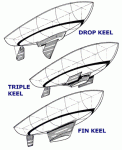
Yes, the keel retracts all the way but no, it won't stay upright since it retracts into a stub keel, as shown here:

3keels-bw.gif

We had one a very long time ago, and they were smashing boats, very seaworthy and we used to take the ground regularly. When grounded and the keel retracted the weight would rest on the stub keel and one of the bilges. Of course you'd have to make sure there were no rocks or debris around that could damage the hull. I don't think the rudder was lifting, it was no deeper than the stub keel.

I hope this helps.
 
I don't know of the types of boats you might find in UK. However yes a larger than 18ft will give you a lot more but of course you will need a bigger car to haul it home on trailer. I have a friend with an 8metre with retractable keel and he has towed it long distances but only with a large 4x4.
Anyway the retractable swing into a stub keel is the best option for best cabin usable space. The other option is for the keel box inside the hull dividing the floor space and is really horrible but has a very flat bottom so easy to dry out or winch onto a trailer.
My little 21fter has a vertically lifting part ballasted keel. It does not have a bulb but more ballast under floor. So self righting is not so powerful. (but adequate IMHO) The keel rises into a box up to the inside of the cabin roof. This also doubles as the mast support but does make passage main to front bunk area cramped. This is not as bad as one migh think as the forward cabin becomes stowage but means only 2 bunks. You could sleep 4 but there is not much room for stuff. This retractable keel makes it able to float in very shallow water and easy to winch onto a trailer.
The modern version of my boat has a cast iron drop keel about 250kg so better righting but heavy to retract uses a traler type winch.
A bulb keel will make trailer design a bit tricky and deeper min depth. I can't comment on whether it settles in the mud on drying out. No drying out here comparitively no tides.
Regarding maintenance of drop keel. The keel box on mine is low like a dinghy so top half of the keel when retracted can be painted (antifoul) from inside the cabin. I push the boat back on the trialer rollers by 25cms Which enables me to drop the keel down throught the rollers and frames to the ground. If I jack and block the trailer by 50mm it makes it easier to get underneath and that little bit extra space means more keel can be exposed for painting. I did however a long time back haul the 100kg keel out of the top of the cabin roof using a high garage beam. No real problems and I added more lead and eepth to the keel (about 30mm 15kg) as there was room for extra length.
So I can't say buy this or that boat but I hope I have given you some thoughts on retractable keel TS. good luck olewill
 
Last edited:
Olewill,

very few UK lift keel boats have the keel accessible inside the cabin; some do a bit, but not enough to allow proper maintainence.

I'm not suggesting my boat type to the OP as he has the usual inexperienced misconception that headroom is everything; in fact I have found good sitting headroom is what's important.

For the record, the A22 has a 900lb ballast bulb, 4'6" deep on a 100lb plate, she's also 7'7" wide so a lot of ballast and form stability.

Unlike the Trident 24 which is narrow and deep, the Anderson is lower and wider; each to their own, but I have never found the keel case to be intrusive.

View attachment 54888
 
Olewill,

very few UK lift keel boats have the keel accessible inside the cabin; some do a bit, but not enough to allow proper maintainence.

I'm not suggesting my boat type to the OP as he has the usual inexperienced misconception that headroom is everything; in fact I have found good sitting headroom is what's important.

For the record, the A22 has a 900lb ballast bulb, 4'6" deep on a 100lb plate, she's also 7'7" wide so a lot of ballast and form stability.

Unlike the Trident 24 which is narrow and deep, the Anderson is lower and wider; each to their own, but I have never found the keel case to be intrusive.

View attachment 54888

Hello Seajet Yes I should explain my little boat was the original prototype. In fact they are still building essentailly the same boat after 37 years. The now production boats have a GRP keel case from inside bottom of hull to cabin top. Mine has 2 wooden posts one at the front of the keel slot doubles as mast support and one at the back. The keel box only goes up about 40 cms. Leaving top of the keel exposed to inside the cabin. Also leaves the top of the keel and keel box open when down. In fact if I drop the keel fast it splashes water into the cabin. This open top was thought to be a danger of water ingress and at one stage had perspex covers but it has never actually let any sea water into the cabin.
So yes I can paint the top of the keel from inside but as you say this is unusual.
If mine were a later model I would have to hoist the keel out of the top with a gantry or jack the boat up so high keel could be dropped right down. Or dig a big hole for it to drop into. Anyway I suspect mine is the only one of 250 or so built that is kept on a mooring so antifouled. A nearby club has 2 Castles kept on trailers on the hard but kept rigged and are backed in by car each time they are used. Both are newer than mine by about 18 years yet not very different. I have tried to organise a head to head in a race with these newer ones but it just seems a bit difficult.
Incidentally the Castle is exactly 2.5 metres beam which I think is 8ft 2 inches there is no rubbing strip at the gunwhale as that would make it too wide to tow. So hull at gunwhale gets a bit battered.
good luck olewill
 
Does the keel on "Trident 24 drop keel" actually retract all the way up into the boat so it will dry out upright or does it still stay outside so it will fall to one side.?

The reason I am asking is that whilst looking for a mooring for our 18ft trailer sailer, ( going down to Chichester and Portsmouth to look in next few weeks) my wife said wouldn't it be better to think about a slightly bigger mooring and boat with standing head room, separate heads and for 4 people and that will go on canals? and up rivers ( we have been watching Keep Turning Left (I made a contribution earlier this year) ) as she doesn't like the open sea and our boats is too small!, and will sit upright on a drying mooring and I also though, want to be able to trailer it home in the winter.
I think the Hunter Minstrel is great but she thinks not enough headroom and only sleeps 3 so no friends can join us. Some one suggested (but to expensive for me) boats such as the Ocean 760 and Sportina 760. the Macgregor 26 almost fits the bill but it doesn't appear to be very seaworthy , it's probably delicate underneath to dry out and it's fround upon by many in the know. A number of other boats have bulb sub lifting keels so will also fall over to one side on sand ( mud may be different).
I have searched the forum and read a number of similar postings but so far I can't find the perfect Trailerable sailing boat.
Thanks Bremar.

If you want regular trailability then almost certainly standing headroom is something you have to sacrifice. once you get to a size where headroom is possible, then the boat is too large and heavy to trail other than perhaps once a season to take home for the winter.

So if that is your requirement then there is no such thing as a "perfect" trailerable boat. You have to make your choice of what is more important and if you decide on a laid mooring then all sorts of possibilities open up, which may or may not include lifting keel designs, some of which have flat bottoms which arguably make them easier to get on a trailer in necessary and others which have the keel retracting into a ballast stub. The latter has its own, but different benefits, and either are usually suitable for a drying mooring.
 
To be clear, lift keel designs which have a ballast bulb on the end of the keel plate will enjoy considerably more stability when sailing, as the weight is in the best place, as low as possible with the lever moment of the extended keel.

Designs which have a plate operating through a slot in a fixed ballast stub - the Seal 28 and Anderson 26 are examples - can suffer from mud and stones intruding into the slot and jamming the plate.

Such designs also seem to handle less well, the long ballast stub making them hard mouthed to steer, and they will of course be more tender due to the ballast position mentioned above.
 
Hi,
Thank you for the replies so far. I only want to trailer the boat home for the winter. It's comforting to have my existing boat at home now the weather is turning bad. And I am looking for a swing mooring. ( cheap and cheerful is always appealing) I live in the midlands and I couldn't regularly check on the boat. I don't know how you guys manage without permanently worrying about your boats, unless they are in an expensive marina.
I would like standing headroom, so I can encourage my wife to sail. She likes barging with its comforts and I like the idea of a boat with low draft that will go up rivers and even some canals. ( I think that the macgregor 26 is perfect? And would do everything I want except sail properly)
So I was after a Trailerable boat, with standing headroom, separate heads, seaworthy ( ie not to delicate like the macgregor), with shallow draft and that would settle out on sand and mud without falling to one side and around £5,000.
The trident 24 was getting close. The Hunter minstrel has a great keel arrangement but only really sleeps 2 and hasn't much headroom. The Anderson 22 falls over to one side on sand. Hmmmm. Has anyone put small bilge keels on a bulb keel boat to stop this happening?
Thanks anyway. I'm still searching for the right boat but have to say as much as everyone criticises the Macgregor 26 it's a pretty good package until you apparently sail it?
Bremar.
 
Your budget severely limits your choice to older boats which simply don't have what you want - and even more modern boats can't offer very often. You just have to accept that standing headroom just is not possible without compromising sailing ability and trailerability. some of the water ballasted boats get closer, but are not only outside your price bracket but have other compromises to offset the interior space.

Yes, it used to be common to add bilge stubs to a central keel boat - with or without a drop keel as in the the triple keel Trident. However this further compromises sailing ability with the increased drag. Drying out leaning over is not normally the constraint you think. Such boats sit happily on a swinging mooring, but of course are uncomfortable if you want to dry out and stay the night on a hard sand bottom. Not a problem though drying out in soft mud.
 
The thing is, have you ever dried a boat out on hard sand ? The pounding is awful, it feels like the end of the world !

Legs are no answer by the way, far too unreliable to leave a boat unattended on them.

Drying moorings in Chichester are mud anyway.

If looking at a Conservancy or other non-club mooring, check there is car parking and a secure place to leave a rigid tender; this is a big problem if not in a club.

You simply will not get a boat to your spec' for any money.

The Anderson 26 is very seaworthy and has pretty good headroom but they are rare - the company lost their MOD contract and folded with only about 16 built inc by another firm, Conyer who didn't last much longer - anyway you won't get one for anything like £5K.

I would suggest your best bet is a Centaur; there are lots around to choose from inc some bargains, do try to get one with a newish engine and decent sails - the keel reinforcement is simple and relatively cheap if not already done.

Good boats, seaworthy and they sail well in the right hands.

If you join a club you won't need to take any boat home; remember trailers corrode and are a pain to store most of the time.

Insurers get snotty about using a swinging mooring in winter; my and other clubs have our own hoist and get the cruisers ashore for the winter.

When the boat is on her mooring I know it's good as I helped lay and maintain it and others, also friends who live close by keep an eye on all the boats.

Ditching the trailing idea would help make a lot more boats available to you.
 
Last edited:
...Ditching the trailing idea would help make a lot more boats available to you.

Thats true, but its a great luxury to have your boat next to your house all winter to work on, though less of a luxury for your neighbours perhaps. Mines been sat outside my place for a few weeks now and I love being able to pop out to it when I have a spare mo and cross off another job from the list.
 
Oh don't get me wrong, I'd love to have my boat here rather than an hour and a quarter's drive away.

The snags though are many; an Anderson 22 becomes a very big boat when you try to tow it; I have been involved with first, the delivery of mine from Whitstable to here, then when ' completed ' from here to the club, also on the collection of other Andersons by road.

A RangeRover seems to be required, both physically and now I think legally.

It is not a relaxing process, especially if one has the 26' mast along as well.

My next door neighbour has an A22 ( can't think what influenced him :) ) and is a very good engineer; he bought a new trailer a while ago and has adapted it to allow lowering the keel, but was not happy with the stability so is having a rethink.

He alternates between trailing the boat home one winter, leaving her at the club on high trestles the next.

He is very lucky in having a relative with lots of fields to store the trailer in when the boat is not on it - a major drag for a lot of people.

Also he would never dream of immersing the trailer in salt water; he has the boat lifted on and off it by the club hoist.

There is also the notion of repositioning the boat by road to somewhere distant for a summer cruise; personally this has no attraction at all, I want to sail to places, and the boat takes a fair bit of setting up, so my idea of a sailing holiday is setting off in a well set up boat.

I'll give an example, which is very sad but completely true, extreme maybe but it shows the worst case and domino effect of consequences.

An A22 owner of quite a few years had moved to the Med', taking the boat with him; he then spent a lot of time and money preparing her for long trips on retirement.

He and his wife, not in the first flush of youth, decided to investigate the Danube.

To cut a long story short, the conditions were a lot worse than they had been told and the river almost in spate; the boat was damaged at the rudder by high speed logs, and the wife injured.

He drove back a very long way to get the trailer; on the way back the car broke down at some tiny village.

When he returned the trailer had been stolen.

They ended up cutting their losses and giving the boat away, just to get back to a safe environment and medical care.

Even normal ' trailer sailing ' is fraught with difficulties such as finding a slipway and being able to use it among the many who will want to, parking the car and trailer securely, somewhere safe to tig and de-rig, catching tides, etc.

The OP is already asking a great deal in his spec', especially headroom on this size boat; if he could join a club in Chichester - they are often good value, mine is - that would remove the problem of specifying a trailable boat.

I suspect the OP has not much experience on this sort of size range; if the silly quest for standing headroom could be relaxed, then he might find a boat which will suit him well.

I am not pushing the Anderson 22, but as an example it has good sitting headroom right to the sides of the saloon so people can sit around - also navigate and cook - comfortably.

She also has a good engine well which I believe is the best compromise around 22'; low drag with the engine stowed, and it can be taken home for work or winter storage, and an engine change just means driving to and fro.

Another factor is that 2 people, neither Arnold Schwartzenneger, can raise and lower the mast; that becomes a serious proposition even with a Centaur.

So my overall advice would be;

Forget drying out on sand, something to avoid

Join a club with moorings in Chichester

Forget standing headroom

If those are agreed then a trailable boat is possible if insisted upon, but if that requirement was dropped a huge amount of boats become available.
 
Thank you Seajet,
Ref the conservancy moorings I have an inflatable that I would take with me in the car and use to get out to a mooring (providing there was water) but you are right I need to think about parking the car too.
I have looked at Centaurs. They are very nice boats and I am well able to do most maintenance myself so I'm am not to worried about general maintenance on an older boat. The Centaur or very similar, is the alternative boat if I decide trailering isn't doable.
The problem with the mud moorings which I used at Salcomb and, I gather from the moorings chap at Chichester too, is that there is no way you can overnight on the boat and then walk onto land if it's low tide because the mud is too deep. That means finding overnight accommodation (at that's the case if I'm using our 18ft trailer sailer! which is the one we've got now without separate heads or cooking facilities. ) and that all adds to the expense and inconvenience. At Salcomb after the high season I got a deep water mooring for the weekend and it was great staying on the boat and going into Salcomb at any state of the tide as and when we needed.
It's a shame the bulb lift keel boats or boats like the Trident 24 won't sit upright. It seems that the larger trailerable boats don't have small bilge keels or flat bottoms that that allow a shallow draft and upright settling on an eg sand bottom for overnight sleeping. Perhaps after settling you can just jump out and add 2 wedges under the boat if it's on sand to get it upright. Has anyone done something similar with a bulb keel? Just So you can sleep on it. And is this the "legs"? You were referring to Seajet.?
If I am going to be marooned on mud I would like a bigger boat to stay on.
I'm going to investigate porchester sailing club and dell quay in Chichester harbour where it might be possible to get a mooring in mud you can walk through.

Thanks again for listening. it does actually help clarify things by just putting it all in words on this forum which as high litre the fact I need to considered car parking and I need to find out what legs are?
Bremar.
 
Bremar,

for a start let's get one thing clear; on any mooring worth having, an Anderson 22 or Trident 24 ( and others ) WILL settle upright.

I stay on my boat overnight on the mooring very often.

I forget the layout of the Trident but the A22 has a separate loo, not the dreadful ' under the middle of the forepeak ' often inflicted by lazy designers.

It is completely correct one cannot walk to and from drying moorings in Chichester; this is a very good thing for 2 reasons; it's not so hard as to pound the boat, and theves and yobs cannot easily get there.

Drying out on hard sand is REALLY cruel on any boat, you would not believe the bone-jarring pounding; done on 2 tides a day any boat will suffer.

Wedges would not work, again too hard and ungiving; it has been tried with thngs like large inflatable bags, but only over one low water with the owner present.

The legs I referred to are wooden or alloy posts whch bolt onto prepared hard points on a boat's side.

As they can pivot fore and aft the usual set-up is a line from the bow at deck level, down to the foot of the leg, then along up to the stern.

The huge problem with these is, if one foot sinks into a softer patch - and the seabed is NEVER the same consistency all along - then the boat will lean on it; imagine the damage that the boat leaning heavily on a leg bolted through her topsides could do...definitely only for when one is there and light conditions.

I'll say it again, on any useable mooring a Trident, bulb or stub keeled boat will be upright.

If planning to be on the boat overnight it should always be possible to get aboard and scoot her either into deep water, into a marina or in my case alongside a pub wall if I wanted, but apart from the odd case of being away for an early start at lowish tides I don't feel the need.

There's only a period of roughly 3-4 hours when one can't row ashore, even if the cruiser is aground.

Inflatable tender; I was afraid you were thinking on those lines, in my view a really big mistake.

Inflatables are scuffed and chafed surprisingly quickly when used for this off slipways and beaches.

Also even a moderate inflatable takes up a very large amount of space in a car, and remember on the return trip you'll probably be putting it into the car wet.

A rigid dinghy kept somewhere secure is the way to go.

I really enjoy staying aboard my boat aground on the mooring, and have done it regularly with up to 4 adults aboard, but she's best for 2, or 2 + children or pets, I have had happy holiday cruises of 3 weeks with 3 adults aboard.

One always has wildlife to watch and listen to, and there are the sounds of the returning wavelets lapping around the hull; in the morning I open the forehatch if I'm using the double in the forepeak and peer around, it's quite magical.

I strongly suggest you get aboard as many boats of your target size range as you can, if there is a club near you I'm sure people will be happy to show you around their pride and joy.
 
Last edited:
A boat the size of a Trident ( I own one) cant be just propped up again once she starts to lean over aground. Theres a lot too much weight once she is gone off vertical. So theres no question of just hopping over and popping in some wedges! Dell Quay Sailing club, and neighbouring Wyche Marine do have some moorings where the mud is manageably shallow. Definitely a welly job though! All the o9ther branches of the harbour are deep mud, apart from some shallow moorings in Emsworth which are mostly privately owned.

The Trident does have a seperate loo compartment, and in her day was regarded as a 'proper' cruising boat for a family of 4, yet small enough to be trailed home. Tighter towing regs nowadays mean you do have to be careful about all up weights, Trident weighs just on 2 tons, plus 100kg or more for the engine, plaus the weight of a susbtantial trailer. So you are looking at a fairly hefty tow vehicle to comply with modern requirements. The day has long gone that you could hook one up to a larger family car! (Though people used to quite happily).
 
Thank you Seajet. Hmm there is more to this than I 1st thought. Maybe back to plan A, get a mooring and use existing 18 footer this summer before changing boat. I sincerely mean the thank you too. And of course thanks to the others that replied all the info was helpful in deciding simply not to jump yet.( till you get that offer you think is to good to refuse and then all the plans go out the window)
Bremar.
 
bremar,

probably a good move, for a start there's the old saying ' the cheapest boat is the one you've already got ! '

So maybe sort out a base and mooring to operate from and try with your present boat, as you seem to fancy Chichester, even with a drying mooring there are loads of places you could either go into deep water, alongside a pub or in a marina - but life on an 18 is not that bad unless you have 4 St Bernards and 5 kids or something.

You are always welcome to come for a spin on my boat next season ( PM me if you'd like details & more info ) to check out the area and possibly design; but this one is not for sale !

Incidentally I meant to mention re Old Harry's ( we know each other ) comments on trailers and modern vehicle requirements versus the ' old days ', the original Anderson 22 brochure shows one being towed by a Simca 1500 car which probably weighed less than a Fiesta and had the towing power of a wristwatch !
 
Last edited:
Just to add you more than likely going to be either at anchor or on a visitors mooring when staying overnight and a lot of harbours the visitors moorings are in deeper water or pontoons. You probably won't stay on your own mooring overnight that often. I originally was looking for a Newbridge ventured when buying a boat as liked the design and trailerability but on reflection I didn't have anywhere to store it so went for a bigger bulge keel tomohawk 25. Similar to the trident but more modern looking. Trouble with any boat thus size is the weight so it's illegal to tow. The macregor boats get away with it as they use water ballast. The interior on them is a bit pants though considering their size but it's to keep the weight down for the trailer.
 
Thing is though the MacGregor is to sailing what crochet is to contraception...

If owning one and joining a club don't be surprised to be given a pointy hat and a corner of the room to stand in.

There's one near our mooring and it's always roaming all over the place in any wind, doesn't behave like the proper boats around.

I agree re trailing weights etc, but I do stay aboard overnight on my mooring quite often, as it's a very pleasant sheltered spot with lots of wildlife & stuff to peer at, also only a short row from the club & 2 nice old pubs !
 
Top