Storm tactics and choice of drogue (if that held to be best approach)

eddystone

Well-Known Member
Joined
18 Aug 2013
Messages
1,944
Location
North West Devon
Visit site
Research on best option for an emergency drogue tends to bring up broader questions on storm tactics. Grossly simplified, there are 3 approaches:

"the Pardeys" sea anchor off the bow - it works for them and the sort of boats they sail but I don't like it as I just don't think blade rudders will stand being reversed into a violent sea

Heaving to; Skip Novak only sees the downsides of streaming anything - ropes, drogues whatever and points to loads on attachment points and difficulty of setting and recovering. He advocates heaving to. I find with heaving to (and I've done it with a centreboard gaffer and longish fin keel) it's hard to get the stern at the right angle to the waves - I would feel uncomfortable with this as a main tactic

- running downwind with a drogue to slow the boat. Intuitively I feel this is safest approach (with plenty of sea room obviously). I may not be alone in having got into this situation in the past through poor seamanship, but without the benefit of anything to slow the boat down.

Which takes me onto choice of drogue. I think "Jordan" is a pattern rather than a brand so finding one in UK might be an issue - Oceanbrake do something like it. PBO did a comparative review about 10 years ago and considered the "best" was the Ocean Signal Para Drogue which can also be used as emergency steering.

Any thoughts?
 
There's a USCG analysis available on line showing that a drogue trailed from astern is safest but keep your washboards on lines attached to the boat.
I have two builders bags that I have used in series . They work and are really strong. Much better than my parasail series drogue that was shredded under the load.
 
JSD is what you want.

You're right, it's not a brand, but a design -- created by the late, great Don Jordan, former Chief Engineer of Pratt & Whitney, who did a lot of research after the '79 Fastnet, and then gave his design to the sailing world for free. See: https://jordanseriesdrogue.com/pdf/droguecoastguardreport.pdf

I made mine myself; it's a pretty simple if tedious job (you'll get lots of practice splicing). I bought the cones from OceanBrake, or you can sew them up yourself. I also bought the very nice deployment bag from OceanBrake.

You'll want proper cordage -- Dyneema or some other UHMWPE (I used Acera Amundsen), and you'll want to pay attention to the anchor points, which need to be strong enough to support the entire weight of the boat. In most cases you will need to install chain plates.
 
Surely the blade rudder will take a bigger beating if running as waves will smash directly into it, effectively slamming you into reverse as far as the sea and rudder are concerned.
If the boat is facing the waves the rudder may steer a little but wont bang to the side.
 
Surely the blade rudder will take a bigger beating if running as waves will smash directly into it, effectively slamming you into reverse as far as the sea and rudder are concerned.
If the boat is facing the waves the rudder may steer a little but wont bang to the side.
That's not how waves work.

Lying to a JSD, you are making way through the water ahead. Waves don't touch the rudder, and the boat is not taken aback.

On the contrary, if you lie to a parachute drogue head to the weather, you will make some way in reverse and there is some risk to your rudder (small, if the parachute is big enough to just about stop you). That is one of the drawbacks of lying head-to.
 
Last edited:
That's not how waves work
Waves push forwards when they're breaking so it absolutely is how waves work. Water moves over the rudder, and that could break the rudder or steering gear.

Or are you suggesting no boat ever got water over the stern?
 
Waves push forwards when they're breaking so it absolutely is how waves work. Water moves over the rudder, and that could break the rudder or steering gear.

Or are you suggesting no boat ever got water over the stern?
The rudder does have to be lashed fore and aft to prevent the crests having an effect.
But the rudder has a lot less load on it when stern to the waves than lying head on and drifting back.
The drogue creates a lot of turbulence and in my experience its this that reduces the crests behind you.
 
But the rudder has a lot less load on it when stern to the waves than lying head on and drifting back.
I'd say that depends on how you look at it. Average load, I'm sure you're right. Maximum loads, I think you're wrong and a sudden large wave will create a much worse situation for a rudder. Remember that bows in the sudden loads will reduce rudder stresses, not increase them.
 
Theres a short analysis here
Storm tactics: Sailing safely through a storm — DECKEE
The full report is here
Defense Technical Information Center and open the pdf
On page 16 it says
"Without a drogue all the models would be capsized by the breaking wave. When struck abeam they would often roll through 360 degrees. When struck on the quarter they would sometimes pitchpole end over end."
A drogue of 3 to 4 1/2 ft diameter was required to prevent a 30ft yacht from capsize.
 
Waves push forwards when they're breaking so it absolutely is how waves work. Water moves over the rudder, and that could break the rudder or steering gear.

Or are you suggesting no boat ever got water over the stern?
Water over the stern is not indeed the same as water onto the rudder.

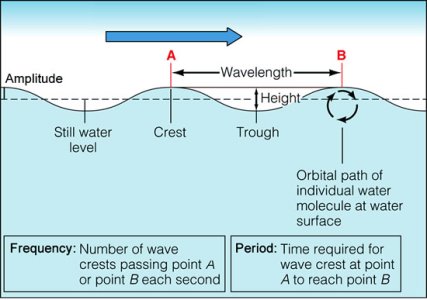
Waves are not caused by masses of water moving horizontally.

SurfWavesFive550x387JPG-2334128067.jpg

Masses of water move horizontally only when waves break. And they don't break underwater.

Getting pooped (water over the stern) is very rare when lying to a JSD. The boat rides up and down with the waves. A direct strike of a breaking wave can do it. One of the great advantages of the JSD is that being held by the stern is inherently stable (see Don Jordan's work on this); the bow is blown off downwind in a stable position, rather than constantly trying to yaw off like it is when you are held by the bow.

There has never been a recorded case of a boat being broached whilst lying to a JSD, and no case of rudder damage I ever heard about.

All this is why the JSD is now the choice of 90%+ of ocean sailors. Written about extensively by John Harries at Morgan's Cloud, Steve Dashew, etc. etc. The last advocate of parachute anchors was the Pardeys, and their last book is now more than 40 years old. And the Pardeys wanted you to use the parachute anchor whilst hove-to, not just lying bows to it. Practically no one does that anymore.
 
I'd say that depends on how you look at it. Average load, I'm sure you're right. Maximum loads, I think you're wrong and a sudden large wave will create a much worse situation for a rudder. Remember that bows in the sudden loads will reduce rudder stresses, not increase them.
That's incorrect. When you're making way forward through the water, not broaching or yawing, there is no stress on the rudder.

There is no recorded case of rudder damage to a boat lying to a JSD.
 
I built my JSD after getting knocked down and rolled in a terrible North Sea storm off the coast of Holland a decade ago. My experience with it is the same as that of this sailor, quoted in Harries' Heavy Weather Tactics:

". . . At last daylight revealed what was really going on and I felt alarmingly scared. All surface of the sea was streaked in white. Enormous breakers were visible all around and when one of them wanted to overrun Nehaj, water spit over the transom and the spray was carried forward till well ahead of the bow. Then the 22 mm ropes of ‘the bridle’ and of ‘the leader’ got under tension and were visible for 20 meters. The actual cones and the end weight stayed way down in deep water, acting like a huge bungee stopping us softly from pitch poling. Our speed never exceeded 4 knots and the rudder will always have positive flow through the water…

"…The drogue was perfect, Nehaj being in absolute safety and not harmed at all. Yes, it was a force 11 which I had seen only once before when So Long [Suzanne’s previous boat, she now sails a self-built aluminum Koopmans 39] rolled through and nearly sunk in the South Atlantic, only then did we deploy the drogue which saved our lives."

Just Get a Series Drogue Designed By Don Jordan…Dammit!

Note what is said about the rudder here. That's related by a single-hander (Susanne Huber-Curphey) who did a circumnav via the Southern Ocean and went through 11 storms of F10 or more in the process. My chat with King Neptune: A note from Susanne Huber-Curphey

My experience has been exactly the same -- it's like a giant bungee cord -- soft and smooth as silk, no yawing, no violent motion, no stresses.

Now these devices have one big drawback -- they are very difficult to retrieve. In my case it's even worse because my drogue lines are UHMWPE (like Dyneema), so slippery. It took me more than two hours the first time I used mine, and it was hard work. A sea anchor is a snap -- you collapse it with the trip line and it comes right in. But after using a JSD I'll never touch a sea anchor again (I gave mine away).
 
Last edited:
. . . The drogue creates a lot of turbulence and in my experience its this that reduces the crests behind you.
Ah, so you also have experience? Yes, it's not written about anywhere that I've seen, but in my experience the waves don't really break on you when you're lying to a JSD. It seems to me to be like that effect the Pardeys write about when you're hove-to, your wake (they call it the "slick") seems to calm the waves and stop them from breaking. I don't understand the principle, but maybe it's like oil on the water?
 
. . . Heaving to; Skip Novak only sees the downsides of streaming anything - ropes, drogues whatever and points to loads on attachment points and difficulty of setting and recovering. He advocates heaving to. I find with heaving to (and I've done it with a centreboard gaffer and longish fin keel) it's hard to get the stern at the right angle to the waves - I would feel uncomfortable with this as a main tactic . . .
Skip was talking about that 11 years ago, without any actual experience. He was arguing against either drogues or sea anchors for boats over 50'. Main argument was that the forces are huge and you need really good attachment points, and that on a big boat they will be hard to deploy and retrieve. For boats smaller than 50' he thought a series drogue could be a good idea.

He's absolutely right about all that. Most boats (even less than 50') will need special chainplates. Deployment isn't so bad but retrieval is pretty awful. Mine has 164 cones and is something like 140m long and takes hours to get back on board.

Where I disagree with Skip (and with the Pardeys) and agree with you is that heaving-to is not suitable as a main storm tactic. I love heaving-to in weather of F8 or less for various purposes -- repairing something, giving the crew a break, etc. -- but over F8 I feel it's positively dangerous, at least in my boat (54', bulb keel).

Harries writes about getting partially knocked-down whilst hove-to:

When Heaving-To Is Dangerous
 
For retrieval I have just put the engine on in reverse and take in the slack.
I then use a boat hook to grab the bottom of the bag and into the cockpit when empty. Roll it up for another day.
 
For retrieval I have just put the engine on in reverse and take in the slack.
I then use a boat hook to grab the bottom of the bag and into the cockpit when empty. Roll it up for another day.
I do too, but if there's still any kind of sea state you have to really watch the leader getting into the prop. I shudder to think what 16mm Acera would do to my prop and shaft (probably rip the shaft out of the boat). I have never round this easy, even practicing in calmish water. Much worse in my case because of the slippery cordage.
 
Everything posted here has confirmed my belief that a drogue is best option but I would be interested if anyone has any thoughts on the Ocean Safety Drogue which is doesn't have lots of pockets but a single parachute (although they do go to tandem and triple for boats over 50'.
 
Everything posted here has confirmed my belief that a drogue is best option but I would be interested if anyone has any thoughts on the Ocean Safety Drogue which is doesn't have lots of pockets but a single parachute (although they do go to tandem and triple for boats over 50'.
The advantage of a series drogue is that the drag is produced over a long distance, and can't be interrupted by popping out of a wave face. I think by consensus view it's much preferable to a parachute - type drogue. Another advantage is that it's easy to make a series drogue yourself, which can save a lot of money.

Downside, again, is retrieval.

Don't forget about chainplates.
 
Everything posted here has confirmed my belief that a drogue is best option but I would be interested if anyone has any thoughts on the Ocean Safety Drogue which is doesn't have lots of pockets but a single parachute (although they do go to tandem and triple for boats over 50'.
The best advert that sold me the JSD was Roger Taylor’s’ account of riding out a serious storm in the arctic in a Corribee with one. If a little day sailor can be kept safe in a big sea with little drama with a JSD then that is the ultimate safety device for me and my 10m boat!
 
Top