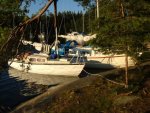
Stern anchor

If you really want to stay pretty much in the one position, but be able to swing through 360°, to face into wind or tide, consider a Bahamian Moor.
Probably about to be corrected again but it’s not enough for the boat to face 360 on the same spot, the boat needs to be able to move to the end of its scope too so that other boats won’t come down onto them when the wind turns.
 
In the Med anchorages are packed. Really crowded. If your boat isn’t swinging freely round a single point with similar scope out to your neighbours you will collide with adjacent boats, so using a stern anchor or anything else which limits the ability to swing is not really an option. You must either swing freely or anchor close to shore and take lines ashore.
 
Probably about to be corrected again but it’s not enough for the boat to face 360 on the same spot, the boat needs to be able to move to the end of its scope too so that other boats won’t come down onto them when the wind turns.
Granted, and that's why I qualified my suggestion by saying, "if you want the boat to stay in pretty much the one position".
 
The posts are predominately from people with keeled yachts. With the keel lifted you should be able to get much closer to shore than almost anyone else, multihulls excepted, and a stern anchor might be very appropriate and/or shore lines.

Just note that being close to shore might make you more subject to the effects of waves which will stand up as they get into shallower water.

You do need to be prepared for any situation and proximity to shore might be denied for a variety of reasons.

Jonathan
 
A friend of mine has an internally ballasted 38ft boat with daggerboard and lifting rudder. 27” draft with everything up. In the Caribbean he would anchor close to the beach then from the dinghy, set a second anchor to keep him off the beach should the wind change. Never an issue swinging in to another boat since any other keel boat would have been aground before they got near him! Both anchors were deployed from the bow such that the boat could lie to the wind. The second anchor did nothing until the wind shifted
 
We have a very shallow drafted wing keeler which tends to range about quite a bit. I have found that in everything but over 20 knots of wind a 12kg chum in a bucket slid down your main rode to just above the sea floor will completely stop your swing. It is also considerably damped once the rode is bar taught. This worked with our previous lift keeler but we usually found it was easier to just beach the boat and use the shallower anchorages that the deep fins couldn't access. Plus you could walk ashore without blowing a dinghy up.
 
Nosing up to shore is picturesque, but depending on the location, not always a good idea.
  • If there are mosquitos or flies you will be safer 200 feet out.
  • If there are wakes you may strike the shore.
  • Getting on and off via the bow aint' that easy. The dinhy is easier and will allow me to explore.
With a cat I nearly always had that option, and never used it for more than a few hours, and very seldom then. I'd rather get the dinghy out and be safer.
 
Nosing up to shore is picturesque, but depending on the location, not always a good idea.
  • If there are mosquitos or flies you will be safer 200 feet out.
  • If there are wakes you may strike the shore.
  • Getting on and off via the bow aint' that easy. The dinhy is easier and will allow me to explore.
With a cat I nearly always had that option, and never used it for more than a few hours, and very seldom then. I'd rather get the dinghy out and be safer.
My previous two boats were catamarans. We got more trouble going in close to the shore in those boats (because we could) than with our current 7ft 2” draft monohull. We dont go in close. To be fair, we used to try and get out of the waves in the cats as they were bouncy being so light. With a heavy monohull it is so much more comfortable in the same conditions that would have made the small cats miserable. We find that with a big dinghy and engine everywhere is accessible
 
Top