Steel boat as a long-term liveaboard (in a warm(er) climate).

Status
Not open for further replies.
I have no idea what a Maple Leaf is like or how it is built, but you seem woefully ill informed about how GRP boats are designed and built - at least this side of the Atlantic. Nobody uses chopper guns to lay up hulls. GRP hulls are immensely strong composites and often incorporate aramids such as Kevlar in the layup.

I suggest for a start you order the series of articles published about 10 years ago in Yachting Monthly which records a series of experiments aimed at identifying what causes yachts to sink. A real boat (1980s Jeanneau about 38'). Once you have read it you will realise how difficult it is to actually sink a modern GRP boat, particularly noting the difficulty the testers found trying to smash the hull with sledgehammers.

Then consider the chances of hitting something at sea, which is vanishingly small, which despite your handful of anecdotal reports means that an individual sailor has an almost zero chance of sinking. This of course varies according to where you are sailing and the chances of breaching the hull is arguably more likely in areas where there are lots of rocks, coral reefs etc in shallow water. So one can understand why some may be at a higher level of risk than others.

However, the reality is still that only a very tiny minority consider it worth living with the negatives of steel construction to gain whatever marginal benefit they may gain if they are unfortunate to hit something. You wrote elsewhere about the benefits of building your own boat and that steel is good for this - but it has also been the cause of many failed dreams and yards littered with rotting, badly built boats. On this side of the Atlantic there has been virtually no self build activity for the last 10 years. There are many reasons for this, probably chief among them high cost, long time scales, legislation, poor market for such boats and a huge stock of perfectly adequate GRP boats, both new and used available at modest prices for the would be ocean voyager.

So while it is interesting to hear what is going on in your part of the world from your perspective, it has little relevance to the European, particularly UK boating scene. As you have seen from some of the posts here, there is a tendency to look for hard evidence when somebody takes a position and makes claims that do not accord with our own experience. Hopefully by engaging with these discussions you learn a thing or two about how things are done here and why your claims might be challenged.
---------------------------------------------------------------------------------------

For a comparison, read "Storm Passage "by Web Chiles. Then read "The Long Way" by Bernard Moitessier. Chiles was constantly pumping for his life, the whole way, while Bernard's voyage was a breeze ,with no pumping. A recent series of Sail Magazine articles about someone doing he same trip in a Perry design, showed him constantly pumping, mostly soaking wet the whole way, shows little has changed.
Forums have some long lists of "missing at sea" boats.
The Sleavin family would have probably all survived, had they been in a steel boat.
I have hit enough in mid ocean, that I wouldn't be here ,had I been in plastic. Ditto my friends.
Around here, there are a lot of huge logs, which we hit with impunity, which often severely damage and sink plastic boats. They fear being out after dark, while we enjoy night sailing .
Further north, reports of uncharted reefs are a daily occurrence.
An Alaskan said he hit several with one of my boats, with no consequences.
The further north you get on this coast, the more popular steel becomes.
The complete elimination of deck leaks is another factor, in these wet latitudes.
Yes ,the availability of cheap plastic boats has reduced the number of home built boats .It's only after dealing with one, over some extensive cruising, that some take a keen interest in building their own, in steel. Some thoroughly enjoy the building process.

Yes , I do see the odd spot of rust, which takes me a couple of hours a year to adequately deal with. The trick is not to panic at the first sign , and to stay on top of it. I have never found it to be a major problem, less so than having to keep rebedding, leaky, bolted down fittings on plastic.
Much easier to deal with than sinking in mid ocean.
95% of my boats are finished in reasonable time by their original owners .
 
Last edited:
---------------------------------------------------------------------------------------For a comparison, read "Storm Passage "by Web Chiles. Then read "The Long Way" by Bernard Moitessier.

I don't think you understand that most of us disagree with you and, quite frankly, your banging on about the virtues of steel has become rather tedious. Personally, I've seen too many rust streaked steel boats and others having their hulls patched to ever consider buying one.
 
Maybe the reason steel boats are not often damaged by collisions with submerged objects relates to their not going very fast to come to harm. Indeed some may even be overtaken by floating logs drifting on the wind rather than run into at speed..:p

In case you may not have guessed I am taking the pi$$, because frankly the constant stream of extremely biased drivel attracts that kind of response.
 
---------------------------------------------------------------------------------------

For a comparison, read "Storm Passage "by Web Chiles. Then read "The Long Way" by Bernard Moitessier. Chiles was constantly pumping for his life, the whole way, while Bernard's voyage was a breeze ,with no pumping. A recent series of Sail Magazine articles about someone doing he same trip in a Perry design, showed him constantly pumping, mostly soaking wet the whole way, shows little has changed.
Forums have some long lists of "missing at sea" boats.
The Sleavin family would have probably all survived, had they been in a steel boat.
I have hit enough in mid ocean, that I wouldn't be here ,had I been in plastic. Ditto my friends.
Around here, there are a lot of huge logs, which we hit with impunity, which often severely damage and sink plastic boats. They fear being out after dark, while we enjoy night sailing .
Further north, reports of uncharted reefs are a daily occurrence.
An Alaskan said he hit several with one of my boats, with no consequences.
The further north you get on this coast, the more popular steel becomes.
The complete elimination of deck leaks is another factor, in these wet latitudes.
Yes ,the availability of cheap plastic boats has reduced the number of home built boats .It's only after dealing with one, over some extensive cruising, that some take a keen interest in building their own, in steel. Some thoroughly enjoy the building process.

Yes , I do see the odd spot of rust, which takes me a couple of hours a year to adequately deal with. The trick is not to panic at the first sign , and to stay on top of it. I have never found it to be a major problem, less so than having to keep rebedding, leaky, bolted down fittings on plastic.
Much easier to deal with than sinking in mid ocean.
95% of my boats are finished in reasonable time by their original owners .

You are still relying on specifics of your location, and you rightly say that the chances of collision are higher where you sail - just as I pointed out earlier. Therefore it is more likely that people will respond to the higher risk by choosing steel and accepting its negatives. You also live in a part of the world where home building and "pioneering" in general is more common. Similar conditions apply in (or used to) in Australia and New Zealand, where home building in steel (and ferro) was common.

It is a mistake, however to generalise and assume that these conditions apply in other parts of the world. To be fair, home building was common in UK and parts of Europe (particularly France) 20-50 years ago. This was primarily because of the lack of suitable and affordable boats on the market. Experience of these home built boats has not been good and they are very difficult to sell for all sorts of reasons so sink (metaphorically) to the bottom of the market and end up abandoned. The situation has changed dramatically in the last 20 years and there is no incentive to build boats from scratch, or even fit out GRP mouldings when you can buy a sound, substantial boat for less than the cost of materials to build a similar size hull.

So the collective experience this side of the Atlantic of steel boats and home builds in general is mainly negative. Our GRP boats are not "fragile" as you claim, nor is there any evidence that losses through collisions is a big issue. Does not mean that it does not happen but the incidence is extremely low, and not something that causes real concern to ocean voyagers. The problem with relying, as you do, on selected individual events is that you ignore all the other 99.99999....% of the sailors who undertake passages in the same places and conditions completely incident free.
 
You are still relying on specifics of your location, and you rightly say that the chances of collision are higher where you sail - just as I pointed out earlier. Therefore it is more likely that people will respond to the higher risk by choosing steel and accepting its negatives. You also live in a part of the world where home building and "pioneering" in general is more common. Similar conditions apply in (or used to) in Australia and New Zealand, where home building in steel (and ferro) was common.

It is a mistake, however to generalise and assume that these conditions apply in other parts of the world. To be fair, home building was common in UK and parts of Europe (particularly France) 20-50 years ago. This was primarily because of the lack of suitable and affordable boats on the market. Experience of these home built boats has not been good and they are very difficult to sell for all sorts of reasons so sink (metaphorically) to the bottom of the market and end up abandoned. The situation has changed dramatically in the last 20 years and there is no incentive to build boats from scratch, or even fit out GRP mouldings when you can buy a sound, substantial boat for less than the cost of materials to build a similar size hull.

So the collective experience this side of the Atlantic of steel boats and home builds in general is mainly negative. Our GRP boats are not "fragile" as you claim, nor is there any evidence that losses through collisions is a big issue. Does not mean that it does not happen but the incidence is extremely low, and not something that causes real concern to ocean voyagers. The problem with relying, as you do, on selected individual events is that you ignore all the other 99.99999....% of the sailors who undertake passages in the same places and conditions completely incident free.

That's probably largely true for the majority of posters on here. Maybe worth noting that for longer term more off the beaten track steel starts coming into it's own and the greater maintenance is well worth it for many. Major plus is when someone banhs into you or you bang into something it's usually no big deal. A few days sanding and load of epoxy instead of more major surgery> And even in the Med there can't be many boats more than a few hundred miles of facilities capable of bigger GRP repair work as opposed to being on your own.


Your figure of 99.99999....% doesn't really fit with anecdotal evidence, plenty stories abound , the other day talking to a couple stuck for a year battling insurance and trying to get a boat fixed on some islands after a ferry ran into them. Steel it would have been very likely to have bounced off, few days painting and you're on your way again. Plenty more examples, especially if you have a modern lightweight. Very likely to be fine short term on a jaunt round the Atlantic, go up a league and the odds change.
The collective experience of steel amongst long term cruisers is most definitely not negative, risk of collision is most definitely something which causes concern to ocean voyagers!!

Plus if the boat is all you have in the world then it's nice to have something that will put up with some big battles and be fixable anywhere. Chopping out a bit of plate isn't really an afternoon job but at least it is possible pretty much anywhere.
 
The collective experience of steel amongst long term cruisers is most definitely not negative, risk of collision is most definitely something which causes concern to ocean voyagers!!

Plus if the boat is all you have in the world then it's nice to have something that will put up with some big battles and be fixable anywhere. Chopping out a bit of plate isn't really an afternoon job but at least it is possible pretty much anywhere.

When trying to quantify the risk, you have to decide what the population is - and if you take all the yachts sailing in the world the %age of them lost through collision would be that tiny number I suggested. However if you then try to define your population by other criteria such as miles travelled, area of operation, time of year etc you will get a different figure as illustrated by the location of BC and Alaska or the coral reefed islands of the Pacific. When the odds change the decision of what hull material to use may also change.

That is what I meant by saying that you cannot generalise from a specific and offer a universal solution. The fact remains that for the vast majority of sailors, including ocean voyagers, the risk is small, hence the majority find GRP satisfactory, or are not prepared to put up with the negatives of steel in exchange for the possible mitigation of the consequences of the rare collision. This is of course a personal decision.

The difficulty many of us have with Brent's approach is the universalistic nature of his claims which are based largely on anecdote and opinion, while not seemingly willing to consider the known facts on the one hand (strength of GRP for example) or the lack of hard evidence to support his claims. The reality as you know from your own experience is that steel is a potentially high maintenance material and if neglected the boat quickly deteriorates and becomes valueless. This alone makes it a poor choice for typical yacht use, unlike say a fishing boat or other small commercial boat where its other virtues outweigh the need for constant attention.
 
When trying to quantify the risk, you have to decide what the population is - and if you take all the yachts sailing in the world the %age of them lost through collision would be that tiny number I suggested. However if you then try to define your population by other criteria such as miles travelled, area of operation, time of year etc you will get a different figure as illustrated by the location of BC and Alaska or the coral reefed islands of the Pacific. When the odds change the decision of what hull material to use may also change.

That is what I meant by saying that you cannot generalise from a specific and offer a universal solution. The fact remains that for the vast majority of sailors, including ocean voyagers, the risk is small, hence the majority find GRP satisfactory, or are not prepared to put up with the negatives of steel in exchange for the possible mitigation of the consequences of the rare collision. This is of course a personal decision.

The difficulty many of us have with Brent's approach is the universalistic nature of his claims which are based largely on anecdote and opinion, while not seemingly willing to consider the known facts on the one hand (strength of GRP for example) or the lack of hard evidence to support his claims. The reality as you know from your own experience is that steel is a potentially high maintenance material and if neglected the boat quickly deteriorates and becomes valueless. This alone makes it a poor choice for typical yacht use, unlike say a fishing boat or other small commercial boat where its other virtues outweigh the need for constant attention.

Very well put. Sums it up very well.
 
Very well put. Sums it up very well.

My own view is that its not the percentage of each type of hull material that is used it the risk of being damaged in a collision with a container, whale or being hit by a ship at night, its the resultant damage and the effect of that damage on the ability of the boat to its self afloat and thus safeguard the life of the people on board.

Some friends of mine lost their life in a GRP boat when the keel came off when sailing in the Indian Ocean. this was due to bad construction in my view. Another boat of the same design and manufacture had the outer and inner skin separate due to the foam core not being bonded properly. Any badly constructed boat in any material could fail and cause loss of like.

But why I went for steel is it ability to resist fatal damage when hitting a large object in the ocean and being able to survive to protect the occupants.

If you wish to do a statistical analysis you need to look at the incidents of hitting objects at sea and the resultant loss of the vessel of different hull materials.

Statically flying on a commercial airliner is the safest form of travel in terms of mileage traveled but if an serious incident does occur the the percentage chance of surviving is not too good.

It is human nature to justify our choices when challenged but you make you choice and have to accept the consequence.

Mine is to accept a little extra maintenance in rust prevention and repair for what I consider a boat that will survive better, in my view in a collision with a large object at sea.
 
My own view is that its not the percentage of each type of hull material that is used it the risk of being damaged in a collision with a container, whale or being hit by a ship at night, its the resultant damage and the effect of that damage on the ability of the boat to its self afloat and thus safeguard the life of the people on board. ....

For both hull materials, the event is collision, of which one possible consequence is breach of hull and foundering of vessel i.e. the event has happened irrespective of probability or hull material. The question then becomes how are you going to prevent loss of life because the thickness of your steel hull is irrelevant now.

The steel hull will be more resistant to yielding than GRP. However, your logic is flawed, if you are worried about avoiding foundering after a collision then buy a boat that floats when it is full of water, otherwise, your risk profile is the same i.e. after puncturing, your boat sinks. I guess this is why Category 0 boats have collision bulkheads and water tight compartments, not because the probability is very high, but because they want to float if they do have a punctured hull thousands of miles from land.
 
. The fact remains that for the vast majority of sailors, including ocean voyagers, the risk is small, hence the majority find GRP satisfactory, or are not prepared to put up with the negatives of steel in exchange for the possible mitigation of the consequences of the rare collision. This is of course a personal decision..

That may be so on paper, but if you actually spend time around the planet with ocean sailors it's not so cut and dried. It's not just loss through collision either, get out there and the more likely problems are getting spanked into by some other boat or whatever. Not a big deal on steel but could well be a game changer on a lighter grp.

"hence the majority" ... again may look fine on paper as a good argument but get out there it's not so cut and dried. If anyone knows the compromises involved it's long distance ocean cruisers.

The ''majority" you mentioned isn't defined. Long distance, long term there are a lot of steel boats out there. Where do you get these figures from? Go spend time with some world girdlers, chances are most will be after a heavy tough boat if they were to choose again with a fair number liking the benefits of steel , you're gonna get hit or you'll hit something sooner or later and be on your own to fix it. Rogers South Africa storm link is a prefect example, bit of painting and you can be back on the move. Heavy GRP possible get away with it. Lightweight may well be game over..

Quick Atlantic circuit doesn't really cut it for a definition of long distance or long term..

All of which is of very little interest to almost everyone on here. .. :)
 
For both hull materials, the event is collision, of which one possible consequence is breach of hull and foundering of vessel i.e. the event has happened irrespective of probability or hull material. The question then becomes how are you going to prevent loss of life because the thickness of your steel hull is irrelevant now.

The steel hull will be more resistant to yielding than GRP. However, your logic is flawed, if you are worried about avoiding foundering after a collision then buy a boat that floats when it is full of water, otherwise, your risk profile is the same i.e. after puncturing, your boat sinks. I guess this is why Category 0 boats have collision bulkheads and water tight compartments, not because the probability is very high, but because they want to float if they do have a punctured hull thousands of miles from land.

Point taken but what is the probability of a 6 mm thick steel boat hull being pierced compared with the thickness of the AWB.

The ductility of steel is more likely to bend and be dented that to be holed IMHO.

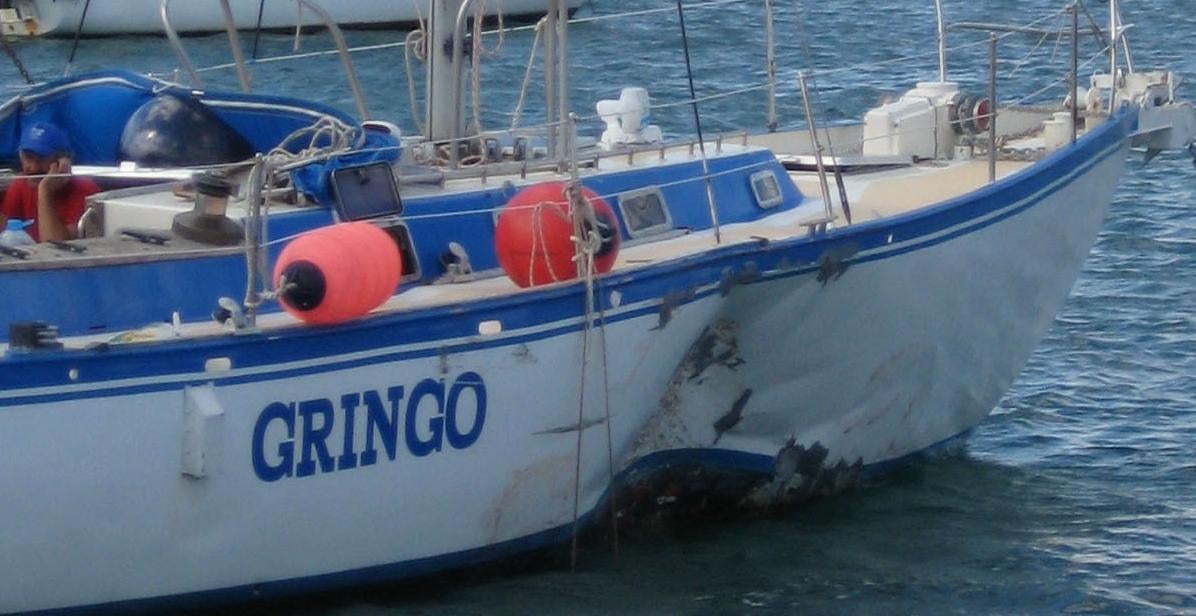
I do question how a GRP boat would look like in this event.

post-31704-0-06377200-1476939499.jpg


Or this when a southern right whale breached on a steel boat in Table bay Cape Town

ss-100721-whale-02.grid-8x2.jpg


http://www.yachtingworld.com/blogs/elaine-bunting/yacht-run-down-by-ship-18229
 
That may be so on paper, but if you actually spend time around the planet with ocean sailors it's not so cut and dried. It's not just loss through collision either, get out there and the more likely problems are getting spanked into by some other boat or whatever. Not a big deal on steel but could well be a game changer on a lighter grp.

"hence the majority" ... again may look fine on paper as a good argument but get out there it's not so cut and dried. If anyone knows the compromises involved it's long distance ocean cruisers.

The ''majority" you mentioned isn't defined. Long distance, long term there are a lot of steel boats out there. Where do you get these figures from? Go spend time with some world girdlers, chances are most will be after a heavy tough boat if they were to choose again with a fair number liking the benefits of steel , you're gonna get hit or you'll hit something sooner or later and be on your own to fix it. Rogers South Africa storm link is a prefect example, bit of painting and you can be back on the move. Heavy GRP possible get away with it. Lightweight may well be game over..

Quick Atlantic circuit doesn't really cut it for a definition of long distance or long term..

All of which is of very little interest to almost everyone on here. .. :)

We are currently in Curacao. This is a stop over point for lots of yachts going through Panama. The vast majority of boats here are grp. There is a steel yacht next to us and another in the yard being worked on. The yacht in the yard had corrosion problems so the owners have spent several weeks welding, grinding and painting. The boat is going trans-Pacific to New
Zealand to be sold. The owners say they will never own another steel boat. Far too much work. Even though they will still sail oceans they will go for grp next time.
The reality is even off the beaten track grp hulled boats still vastly out number steel.
 
We are currently in Curacao. This is a stop over point for lots of yachts going through Panama. The vast majority of boats here are grp. There is a steel yacht next to us and another in the yard being worked on. The yacht in the yard had corrosion problems so the owners have spent several weeks welding, grinding and painting. The boat is going trans-Pacific to New
Zealand to be sold. The owners say they will never own another steel boat. Far too much work. Even though they will still sail oceans they will go for grp next time.
The reality is even off the beaten track grp hulled boats still vastly out number steel.

Maybe some differences of definitions, I wouldn't put there "well off the beaten track". But it is certainly a load of work, or can be if you let your guard down. In his book Scott fratcher reckons 2 to 4 weeks a year on maintenance, probably not far off to keep steel tip top for a lifetime. Benifits are being near totally self sufficient and completely dry down below amongst others. I'm looking at a while in a boatyard welding in new plate for not being on the ball enough to spot a drip and the rust it's caused.... No ideal boat, but a load of the arguments against on here don't get repeated much around the cruisers bars of the world. For your one bloke there will be plenty others who would not like to disappear over the big horizon on a hull less strong.
 
Last edited:
Point taken but what is the probability of a 6 mm thick steel boat hull being pierced compared with the thickness of the AWB......

I agree that steel is a great material compared to GRP for impact, maybe aluminium is even better. Where probability does come into the decision bit is that these sort of events are probably quite rare with lots of other risks more likely to effect our enjoyment, hence the acceptance of GRP. I know a sailing school (Oban Sea School - I have no association with this company) who have a home built steel yacht (12 years old now) and it's a great boat, well looked after. The boat sails many, many miles April to October. The owner is cost conscious and runs a successful one man, one boat sailing school. If there is ever a testimony required that hard worked steel boats don't rust away, his boat is it. There are probably many old steel boats that are bargains, but would be expensive to refurbish and repair unlike a lot of old GRP hulls. Neglected steel in a salt water environment does not last long unlike neglected GRP.

This is the boat http://www.obanseaschool.co.uk/the-yacht.html and http://www.obanseaschool.co.uk/gallery.html
 
Last edited by a moderator:
I agree that steel is a great material compared to GRP for impact, maybe aluminium is even better. Where probability does come into the decision bit is that these sort of events are probably quite rare with lots of other risks more likely to effect our enjoyment, hence the acceptance of GRP. I know a sailing school (Oban Sea School - I have no association with this company) who have a home built steel yacht (12 years old now) and it's a great boat, well looked after. The boat sails many, many miles April to October. The owner is cost conscious and runs a successful one man, one boat sailing school. If there is ever a testimony required that hard worked steel boats don't rust away, his boat is it. There are probably many old steel boats that are bargains, but would be expensive to refurbish and repair unlike a lot of old GRP hulls. Neglected steel in a salt water environment does not last long unlike neglected GRP.

This is the boat http://www.obanseaschool.co.uk/the-yacht.html and http://www.obanseaschool.co.uk/gallery.html

As said before different materials have different pros and cons.

I agree a badly maintained and neglected older GRP boat will be in better condition than a badly maintained and neglected steel boat. The trick is not to neglect the maintenance on a steel boat until it becomes an eyesore with rust. One thing the average boat owners forgets the 1mm thickness of steel will produce 11mm thickness of rust, so a small amount of rust can look very bad indeed.

My boat was built in mid 1970's but only launched by me in 2009 and the only rust maintenance I have had to do is paint cracking/ chips on the deck work. The hull which was grit blast and painted with lots of coats of epoxy tar had no rust or paint blisters at every 2 year inspection/antifouling. The only anodes I have had to replace were the shaft anode next to the bronze prop. With the stainless steel prop I fabricated I hope that anode will not last longer.

BTW the best boat hull material IMHO is cupronickel but the cost is just too much for me.
 
Maybe some differences of definitions, I wouldn't put there "well off the beaten track". But it is certainly a load of work, or can be if you let your guard down. In his book Scott fratcher reckons 2 to 4 weeks a year on maintenance, probably not far off to keep steel tip top for a lifetime. Benifits are being near totally self sufficient and completely dry down below amongst others. I'm looking at a while in a boatyard welding in new plate for not being on the ball enough to spot a drip and the rust it's caused.... No ideal boat, but a load of the arguments against on here don't get repeated much around the cruisers bars of the world. For your one bloke there will be plenty others who would not like to disappear over the big horizon on a hull less strong.

I never said Curacao was off the beaten track. It is firmly on the beaten track for boats heading off the beaten track........
Two to four weeks a year on hull maintenance!! The average grp boat gets nothing. Thats is one hell of a commitment and way too much work for most people. If stee didnt rot away I am sure lots more people would use it. The impact resistance is great but not at the cost of all that maintenance and the very poor resale values down the line.
 
I never said Curacao was off the beaten track. It is firmly on the beaten track for boats heading off the beaten track........
Two to four weeks a year on hull maintenance!! The average grp boat gets nothing. Thats is one hell of a commitment and way too much work for most people. If stee didnt rot away I am sure lots more people would use it. The impact resistance is great but not at the cost of all that maintenance and the very poor resale values down the line.

That's maybe a big bit! :) The long distance likers of steel aren't in it for the short term, their in it for the long haul which means being able to keep the boat hull rock solid strong anywhere. Which probably isn't high up the list of posters on here
 
Anyone on a circumnavigation, who has only crossed the Atlantic as far as Curacao, is just a beginner. His opinions on many things will have changed, by the time he has completed a circumnavigation.
The opinions I had after reaching New Zealand, after crossing the Pacific, and thus having become a "One trip expert" have changed radically , as I gained far more experience.
People around here, who went the older plastic boat route ,have far more work to do than I have. Most are dreaming of owning a steel boat. Most prefer to rely on surviveability, rather than odds. ( which is far better seamanship).

One added advantage of metal, is any part of the hull can be made into keel cooling surface, easily, eliminating the heat exchanger , sea water intake , strainer , pump , thru hull, all sources of potential problems. One mechanic on metalboatsociety.org ,was quoted as saying
"If everyone went for keel cooling and dry exhaust, we mechanics would all be out of work!"
Using welded in stainless pipe nipples and ball valves has totally eliminated all thru hull problems of any kind, for me and my clients, for over 40 years.
 
I never said Curacao was off the beaten track. It is firmly on the beaten track for boats heading off the beaten track........
Two to four weeks a year on hull maintenance!! The average grp boat gets nothing. Thats is one hell of a commitment and way too much work for most people. If stee didnt rot away I am sure lots more people would use it. The impact resistance is great but not at the cost of all that maintenance and the very poor resale values down the line.

Plastic boaters tell me they have to re-bed all their deck fittings down every three years, due to leaks . Welded down fittings never leak or work loose. Welding is the best bedding compound ever invented.Not an option on plastic.
 
I agree that steel is a great material compared to GRP for impact, maybe aluminium is even better.

Steel welds are 100% the strength of the surrounding material, aluminium only 60%. Aluminium welds often break ,but I have never seen a mild steel weld break on a small craft, even bad welds.
It's far easier to get a bad weld on aluminium than on steel. Steel is far more forgiving.
 
Status
Not open for further replies.
Top