State Pension

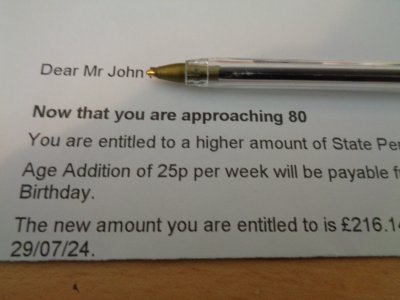
Hmmmmm suspicious, We live abroad and its a regular occurrence for one of our friends to receive a request for proof that they're still alive. Do you think they're touting for business for their sister company "Funerals on a Budget" :ROFLMAO:
Not beyond the realms of possibility though. My mother recently passed away and I've been busy dealing with the closure of accounts etc. I received the final water bill from a company of solicitors who were offering to facilitate its payment and offering me bereavement counselling along with help to prepare IHT and Probate documentation, at a price of course. I spoke with the water authority and they admitted it was the way they dealt with all bereavement final accounts now.
I paid direct to the water company and let them know what I thought of their money making scheme.
 
The date when you get the pension is pushed out beginning in April - some eg those born in Feb 1960 will cash in now but for others born in the 60s the date gets further and further away- for those in manual jobs this seems grossly unfair while those who have final salary schemes such as civil servants can no doubt survive I guess
 
The date when you get the pension is pushed out beginning in April - some eg those born in Feb 1960 will cash in now but for others born in the 60s the date gets further and further away- for those in manual jobs this seems grossly unfair while those who have final salary schemes such as civil servants can no doubt survive I guess
Civil service final salary schemes went years ago, now it's the same as anyone else, it depends on how much you paid in over the years working for them.
 
My suspicion is even if they have been abolished now the date when such schemes ended for civil servants was considerably later than the switch in the private sector so the employees had far greater number of years to accrue the valuable benefits - an FS scheme when cacalating its value has a20x fund value I was advised which surprised me somewhat . Clearly now pensions form part of the estate this might impact the beneficiaries though I agree.
 
.. now pensions form part of the estate this might impact the beneficiaries though I agree.
Don't forget in the days of gold plated final salary pension schemes, the scheme paid an income to the retired employee until they died then a lesser amount for a surviving spouse (provided the employee had contributed towards widow/er benefits during service).

Then came Pensions A Day in 2006. In the last 20 years, personal pensions have grown to be a huge tax efficient vehicle for beneficiaries far beyond the original purpose of a pension which was really only ever deferred salary for the employee.

The monster is being put back in it's cage by taxation. Best way to avoid IHT is to spend it all. Let the kids make their own way in life.
 
I think if the fund value allows you can still make regular payments to the kids so in essence they end up with a monthly sum drawdown . Clearly I not a tax expert and have no wish to do this but worth looking into for those worried about the destitute offspring.
 
Don't forget in the days of gold plated final salary pension schemes, the scheme paid an income to the retired employee until they died then a lesser amount for a surviving spouse (provided the employee had contributed towards widow/er benefits during service).

Then came Pensions A Day in 2006. In the last 20 years, personal pensions have grown to be a huge tax efficient vehicle for beneficiaries far beyond the original purpose of a pension which was really only ever deferred salary for the employee.

The monster is being put back in it's cage by taxation. Best way to avoid IHT is to spend it all. Let the kids make their own way in life.
Widow's pension was contributory; personal pension wasn't. It wasn't really optional, though!
 
Mine was a 45ths scheme. I spent 30 years on max accrual and max AVCs. At the time I was skint and people thought I was mad. Now I have a combo of DB, DC and ISAs that pay as much as I earned whilst working.

With the DC scheme that was brought in when DB closed, the employer contribution topped out at 15% for employee of 6% which was good.
 
......... . Clearly now pensions form part of the estate............
That statement perhaps requires a little more clarification as it is misleading as it stands.

I have 2 occupational pensions and 2 government pensions. When I croak it none of these will form part of my estate under current rules and I've never seen any suggestion that this will change.

For the occupational pensions, they will continue in payment, my wife receiving 50% of what I get now. For the government pensions, when I stop breathing they stop paying.

I also have a personal pension into which I still contribute. I intended this to be used a pot to be distributed among my family when I die. I've nominated the family members I want to receive the funds with the pension provider and I expect they will follow my wishes although it is up to the provider to decide whether or not to do that as this allocation is discretionary. If I die before April 2027 then this pension will not form part of my estate either. However, Rachel from Accounts has decided that from that date such funds as these will form part of my estate for IHT purposes.

There may be some (very rare) instances where the allocation of funds from a personal pension on death is based on direction rather than discretion and it is my understanding that these may form part of the deceased's estate right now. I've never come across one of these.
 
Last edited:
Civil service final salary schemes went years ago, now it's the same as anyone else, it depends on how much you paid in over the years working for them.
It really isn't the "same as anyone else" - most employees in the Private sector have defined contribution pensions - they pay in a specific amount, it's invested and you cross your fingers and hope that it grows, and payouts are based on whatever that future value ends up being. The civil service schemes (and similar schemes for other government departments and perhaps the biggest blue chip firms) are defined benefit schemes - the payout is guaranteed, regardless of how the stock market performs etc. They might have switched from final salary to career average or other ways of working out the benefit but its very much not the "same as everyone else". There are potential downsides that a defined contribution scheme builds an asset that can be passed on (if you die and haven't used it to buy an annuity) but almost any financial advisor would say that a civil service pension, even for new starts today, is a very attractive proposition!
 
Yes agreed the raid on pensions is for the future and as said if you wish with a money purchase scheme there is still time to draw down the max income tax free part by drawdown and take balance and pay tax . On basis that you don’t use it all or all though and have no surviving spouse the tax hits whatever’s left on basis most will have other assets . It might be in many cases this just creates an issue for the surviving widow after you have gone having inherited the DC fund on your demise. To my mind it just encourages a spend culture (or offloading by regular giving). Hopefully I’m too young currently to worry about lot though.
 
Yes agreed the raid on pensions is for the future and as said if you wish with a money purchase scheme there is still time to draw down the max income tax free part by drawdown and take balance and pay tax . On basis that you don’t use it all or all though and have no surviving spouse the tax hits whatever’s left on basis most will have other assets . It might be in many cases this just creates an issue for the surviving widow after you have gone having inherited the DC fund on your demise. To my mind it just encourages a spend culture (or offloading by regular giving). Hopefully I’m too young currently to worry about lot though.
It shouldn't encourage spending, just financial planning. I'm trying to synchronise the day I run out of money as my last day alive. Unfortunately, I can't seem to find my death date written down anywhere.
 
Top