Stabilizers for Blue Angel, engineering question

have seen many graphs, measurements / comparison between their electric and hydraulic stab systems.


Did you find any proper engineering analysis about how a 0.6m electric fin is meant to match a 1.0m hydraulic? Because as you know I think this is a great project for your boat and that CMC electric is the perfect solution, but for the record I have big reservations about the 0.6m fins. I think they're too small (unless you don't care about at-anchor performance) and I just do not believe the "0.6m electric = 1.0m hydraulic" claim, even moreso now when the data shows Sleipner is faster.

I like the sound of your new fin . This means the fin will stick out past the chine, but that's perfectly ok. Because of this, it would be good to ask CMC to program them so you can use at-anchor mode on one side only. Then if you are tied up to a concrete wall in lousy weather you can operate the outboard fin only. They might already do this as standard set up/spec (Sleipner do, and maybe everyone does)

Looking forward to the drawings!
 
Did you find any proper engineering analysis about how a 0.6m electric fin is meant to match a 1.0m hydraulic? Because as you know I think this is a great project for your boat and that CMC electric is the perfect solution, but for the record I have big reservations about the 0.6m fins. I think they're too small (unless you don't care about at-anchor performance) and I just do not believe the "0.6m electric = 1.0m hydraulic" claim, even moreso now when the data shows Sleipner is faster.

I've seen graphs that show that the performance of the CMC electric fin is better then their Hydraulic fin.
so in their previous systems where they fitted 0,8m2 hydraulic, now they fit 0.6m2 electric.
The size range similar to BA (fe SL72) originally had 0.8m2 hydraulic, and now 0.6m2 electric fins.

yes, perhaps at anchor mode, the first and or the second "crest" of a independant wave (fe bow wave from a passing boat) is the most difficult wave to deal with,
and will perhaps be less damped on mine, compared to a bigger sized fin,
but I could see that subsequent damping of that wave is faster on the electric system, compared to hydraulic.

for CMC, on my size of boat, 0.6m2 is the best ballance between performance (also at anchor) and extra drag from the system.
and we agreed that if the performance is not good enough that we can do a test with 0.8m2 fins.
for the 1m2 fins we would need a bigger motor, (5kw instead of 3.5Kw) but also this one would fit on the same shaft/drive system.
as a comparison, the SL84 has a 0.8m2 fin and a 3.5Kw motor,
seen by myself, I was at the SL factory, and have seen 2 x SL84 and one SL90-ich in build (and many others that I didn't went inside)

CMC wants me to be perfectly happy with the system,
the people and engineers are very nice guy's to deal with, and really listen to my concerns.
and they convinced me that they know what they are doing.

I sat on the same desc with one engineer, moving, placing and drawing the system in BA's hull, at the optimal place...
having 2 other engineers around, and giving their comments and advice at the same time.


I'm in a hurry right now, and out all weekend,
so probably won't be able to post anymore for a few day's.
but happy to share more info later.
 
Last edited:
I've seen graphs that show that the performance of the CMC electric fin is better then their Hydraulic fin.
...
but I could see that subsequent damping of that wave is faster on the electric system, compared to hydraulic.

Yes, but my question is not what do they claim (we already know that, LOL!) it is why? What is their analysis about how this strange phenomenon occurs? We already established that hydraulic fins (Sleipner's at least; I dont know about CMC's) can move nearly 1.5x faster than their electric fins, so the CMC magic is not fins rotational speed.
 
continuing on the installation design part, (installation works have been postponed until june)
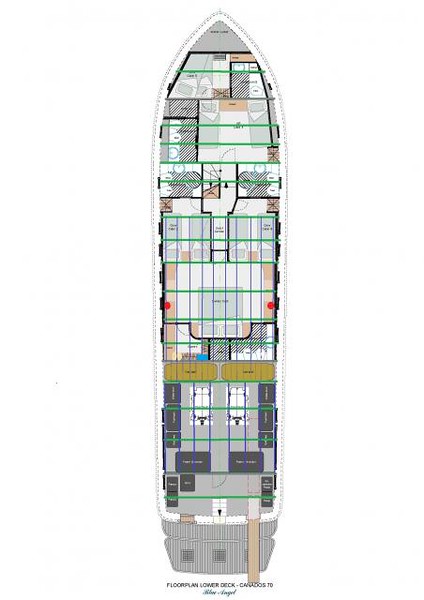
here are the new positions we have in mind for the stabilizers;
red dots are the stabs,
bleu square are the 3 electric control boxes, above each other in the dressing room.

i-QCj6xMk-L.jpg


Fins are 1m more fwd, and 0.5m more towards the side
This decision was made after carefull considerations; it’s the best compromise between: ease of acces for the installation, stable hull / strigers beam structure, enough space, most effective performance, and it is right on the center of the WL (while on plane)

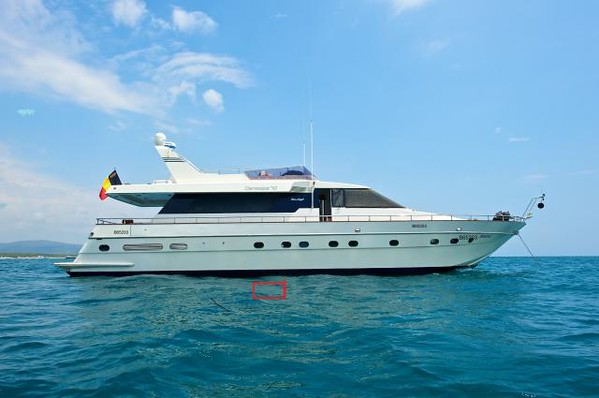
This shows the (approximate) position on the outside:

i-bq5W8H9-L.jpg


i-jCNKTPm-L.jpg


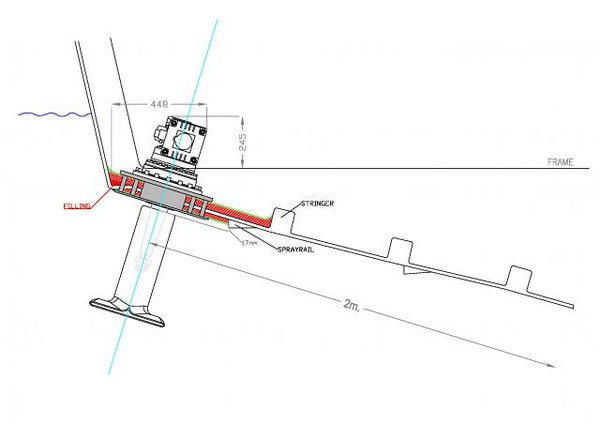
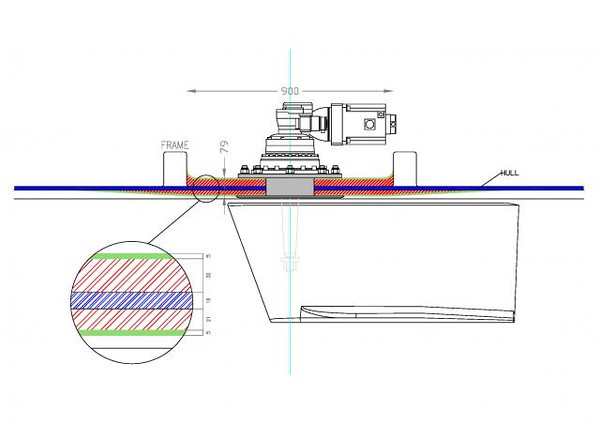
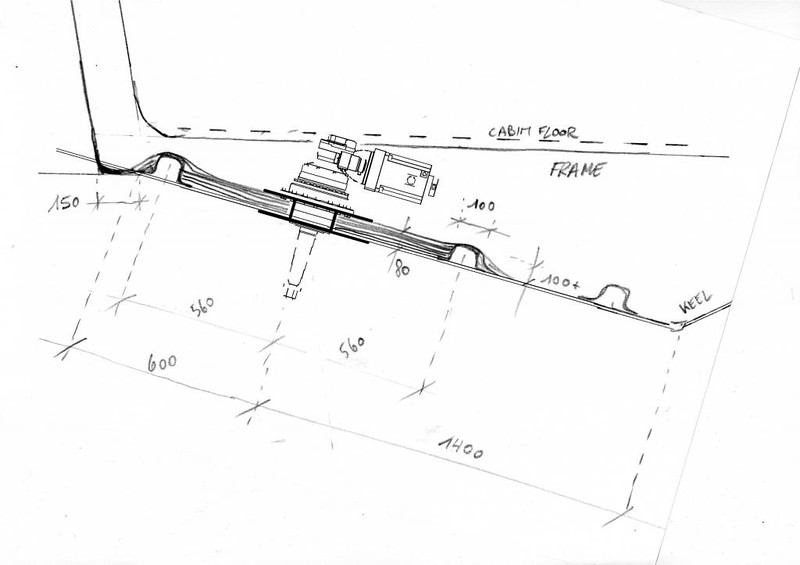
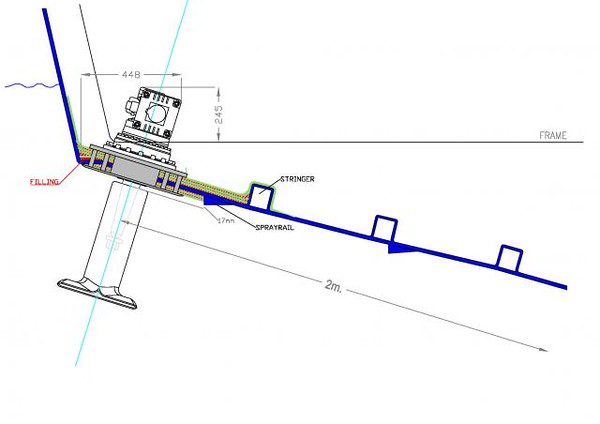
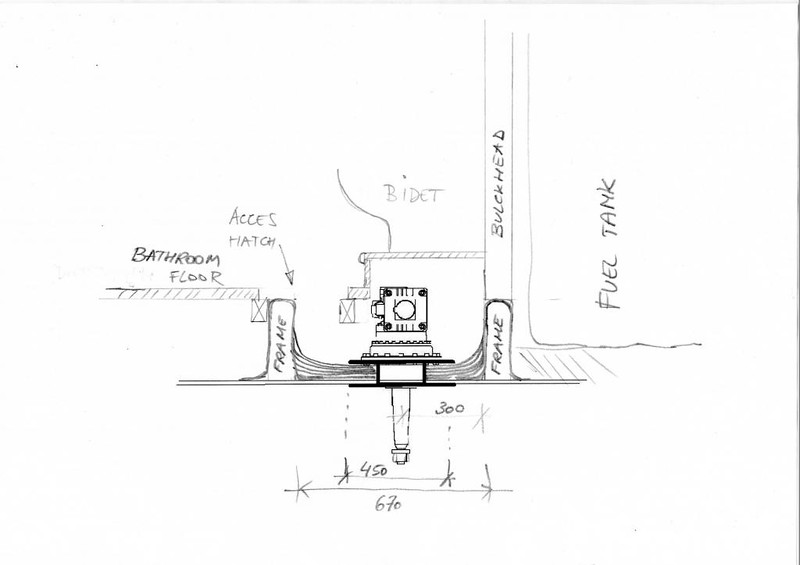
These are the detailed drawings for the mounting in the hull,
This is similar to installations done by some Italian Boat builders.

i-bz2gdHs-L.jpg


i-7T9sWC4-L.jpg


These boat builders and also my French yard use / propose to use a core material for this kind of reinforcement,
(airex for the soft , and a “monolytique” for the hard parts)
some use marine ply

Outside its about 25mm extra, inside approx. 35mm. in total
What do you mates believe is the best method to make this reinforcement ?
the naval architect is also working on this,
but I like to hear others opnions.
 
Last edited:
Hello Bart, BA is a beautiful but also heavy lady. What worries me about this project is that over time a bit of local reinforcement is not going to be enough to absorb the force needed to cancel out the motion of the boat. I'm no naval engineer, it's just that I would be afraid to put so much load on an area of the hull not originally designed for stabilizers. I love what you did to BA, you gave her a complete make over and turned her into a beautiful yacht, but like I said before I'm just not sure about this project.
 
Hi Bart
Thoughts on this:

1. I can't comment without data but you need to be very sure that they will not lift the bow, if placed so far forward. I am not saying they will. You just need the calculations to have been done properly. (Also, check they will not lift the bow with 0.8 m2 rather than 0.6, because in my book they need to be 0.8m anyway!)

2. The more outward placement will help at anchor. Just make sure no-one on board turns them on in at anchor mode while you are in harbour!

3. I don't like the coring idea at all. Airex is a brand name, top quality, but why bother when you are working in such a small area? The monolytique is just solid sheet material, so will be bonded into the general structure only by resin adhesion to its surfaces rather than being integrated into the matrix, and worse still it is flat and will be placed on a rough hull so there will be resin or Crestomer bonding to fill voids, yuk. Also it and will have a different stiffness from GRP hence induce cracking. I would be 100% firm with the shipyard that there must be no coring and the reinf should be done with solid laid up GRP incl woven rovings. It's not exactly a big deal to achieve that, perhaps 20 layers of glass, so why cut a corner?

4. I hate the design in the picture below. The frame creates no stiffness in the direction of hull bend caused by fin drag, so they are creating a MAJOR stiffness change at the end of the reinforcement. You go from 900mm of 65mm thick GRP to 15mm (or whatever -I cant remember the exact numbers and they don't matter) in a step, with no feathering, in a place subject to high bending loads (from drag of the fins) in a hull that we already know isn't very thick (though, i accept the chine, now closer, helps of course). I cannot believe they are doing that. The GRP reinforcement must, in my book, be feathered to avoid a step change in hull thickness. Eg by wrapping over the frame or better still cutting the frame away to let the feahtering pass through (on that last point I know Mapis disagrees but my strong view is to cut it away. It's only foam ffs and after glassing the whole thing up and remaking the frame above the 65mm section you have more than repaired the "damage" of cutting the frame away). If you look at my installation, designed and specced by Olesinski incidentally, and for 1.0m2 fins of course, the difference between the 65mm hull and 15mm hull (or whatever the dimensions are) is feathered over some distance with no step changes.

BlueAngelhullcrosssection-CROSSSECTIONlongV2.jpg


All just imho - feel free to form a different view, but you did ask :D Is all this the work of CMC or the shipyard? Best wishes with the project
 
You go from 900mm of 65mm thick GRP to 15mm (or whatever -I cant remember the exact numbers and they don't matter) in a step, with no feathering, in a place subject to high bending loads (from drag of the fins) in a hull that we already know isn't very thick (though, i accept the chine, now closer, helps of course).

I see what you mean, but
is there much difference with our first drawing then ?

i-5tnR45d-L.jpg


also here was a step in the hull thickness going from 78mm to 16mm along the frames
in the new drawing this step is smaller, going from 79 to 42 something... and then gradually to 16mm
 
Last edited:
Is all this the work of CMC or the shipyard?

CMC isn't involved in the hull reinforcement,
they only showed me several drawings from other installations, and a few installations in real.

The Yard proposed a solution (and scetch) of a cored reinforcement
these are my own drawings, (drawn in Autocad by one of my people) to be corrected / improved by the specialists...
 
Last edited:
I see what you mean, but
is there much difference with our first drawing then ?

On reflection perhaps no, but i'm not sure. I cant remember my thoughts on your first drawing. Maybe I read your first drawing to mean you'd do something under the fuel tank as marked, but perhaps I misunderstood. Alternatively or as well, in your first drawing the foam frame abaft of the fin is supported by a bulkhead pressing down on it, which helps a lot in resisting the upward force of the fin drag twisting the hull skin, so in that repsect your first drawing is better. But on reflection your first drawing also contains quite a lot of the "step-change" that I'm complaining about

I might be worrying about something small. I gotta run now but we could work out the newtons force quite easily, and if it is small you can ignore my comments and file them under "OCD perfectionist". To calc the force, you have the 900mm dim and if you assume the fins abosrb say 130Kw at 20knots you will be nicely on the safe side. That's 20mins of calculation - for my old brain at least, and I gotta run (to my boat!) now...
 
Bart, I'll agree fully with J, (err, edited to say, JFMs first post in the line not the one above mine :D )
J I also think disagreed on cutting the frame at the time...

From a structural view point, the existing setup is thin skin (whatever 15-18mm) and forces out of this skin are distributed in a framework (on two directions) of stringers and frames, or however you call all that, it makes no difference.
Now, that is development stemming from the old frame on frame skinned with planks sort of thing. Each bit transfers loads to the next one up the structural ladder all the way to the keel and chines.
This thing works for the last few thousand years.

When you start introducing local forces, it stops working as it should. Namely, you create local peaks that may crack something. No idea what (although I can guess that frame may be disconnected from the hull skin as this is going to be a weakish link) but you are pushing your luck for no apparent reason.

So to stress and repeat if I may what J says, introducing larger localised stresses in a unified system means that you take bloody good care that you span and distribute these forces to a LARGE area, ffs not to the two neighbouring frames ONLY!
Honestly I cannot believe that this is what the yard or whoever recommends!

Maybe a FEA tool could be used, if the guys designing the stabs have any idea on what sort of forces it introduces to the hull at set size, speed and conditions?

Continuity and even distribution are the key words (all IMHO)

V.
 
Last edited:
I cant remember my thoughts on your first drawing.

well actually I will never forget your comment on that :D :D

I reckon what BartW has drawn is pretty much perfect. ...................... Great drawings Bart

now seriously,
I have numbers of the forces on the fins
for calculations, if you have some time left between your trials, which are ofcause much more exiting
thanks anyway for all your valuable input !!
very much apreciated
 
. Eg by wrapping over the frame or better still cutting the frame away to let the feahtering pass through (on that last point I know Mapis disagrees but my strong view is to cut it away. It's only foam ffs and after glassing the whole thing up and remaking the frame above the 65mm section you have more than repaired the "damage" of cutting the frame away).

I believe the discussion with MapisM was only about removing a cored stringer,

just to clarifie that the system in my new drawings also crosses a stringer which is removed from frame to frame, (was crossing right in the middle of the drive)
and I also believe, that its better to remove that stringer , and make a new homegenious platform for the drive, feathered between neighbouring frames and stringers,
instead of leaving a few remains of that interrupted stringer in place

I don't believe it makes sense to interrupt the neighbouring frames, but better feather the new layers against and over the frames / hull side / stringers

old drawing as a reminder / comparison where the stringer sits what I am talking about
i-gNc9z5M-L.jpg


i-bz2gdHs-L.jpg
 
Last edited:
FORCES:
(this is all for 0.8m2 fins)

maximum momentum when grounding/breaking of the shaft: 42000Nm (in longitunal direction)
maximum momentum hydrodynamic conditions: 12000Nm (this force can be in longitudinal aswell as beam direction)

maximum torque on the shaft for operation at anchor: 6000Nm (this force is in the plane of the mounting surface / the hull)
 
1 N m = 10.20 kgf cm so in a grounding that Equals : 428 280.81 kilogram force centimeters (kgf cm). I don't know but that sounds like a big hole in the side of your boat.

Max force while underway is 12000 N m Equals : 122 365.95 kilogram force centimeters (kgf cm). If those numbers are right you have some tremendous forces at work on your boat.
 
1 N m = 10.20 kgf cm so in a grounding that Equals : 428 280.81 kilogram force centimeters (kgf cm). I don't know but that sounds like a big hole in the side of your boat.

Max force while underway is 12000 N m Equals : 122 365.95 kilogram force centimeters (kgf cm). If those numbers are right you have some tremendous forces at work on your boat.

using different scales you can create any number you like,


for my own understanding,
lets say the shaft is 0.5m sticking out (actually the GRP fin is 0.65m and the steel shaft is 0.4m)

- when grounding there will be a force on the shaft of 8,4 Ton (8400kg) when she breacks
- the max hydrodynamic force while underway is 2.4 Ton (2400kg) on the shaft

this is so many years ago, so stand corrected for a mistake
but if its correct, the underway force is no big deal I think.
don't shoot me if I'm wrong :)
 
LOL, Bart, forgive me if I smiled while I was looking at your latest drawings.
As I said in my very first post of this thread: "After all, the basic rule is very simple: transversally, the fins should be placed as far as possible from the centerline, and longitudinally, as near as possible to the CoG.".
With all due respect for those pros, they must have read that, to come up with their suggestion! :D

Re. the possible strength concerns, cutting the existing structural parts or not, etc., coming to think of it I wouldn't be too worried.
I agree with jfm that it's pointless to use coring, also because the fins flanges work in compression between them.
But overall, I would expect the proposed placement/reinforcements to work just fine with normal hydrodynamic loads.

Otoh, if you look at breaking loads upon grounding and/or hitting big pieces of floating stuff, well, that's an entirely different story.
In theory, the hull reinforcements should be strong enough to withstand a force capable of breaking the shaft, without creating any water ingress.
But actually, I never bought that idea, as much as I laugh when VP claims the same for their IPS stuff.
In practice, if and when a pleasure boat with fin stabs would hit anything big/heavy enough to break a fin shaft, that boat will sink, period.
There are exceptions, but they are restricted to a few steel boats, with double bottom integral tanks, fully w/t compartments for stabs, etc., but they are as I said exceptions.
And to put this in perspective, even Nordhavn boats are NOT among these exceptions - in fact, a rock against a fin did sink one of their boats!
So, bothering to strenghten the hull enough to withstand the fin shafts breaking load is imho overshooting - and probably useless anyway.
 
I agree with jfm that it's pointless to use coring, also because the fins flanges work in compression between them.

I agree that using GRP layers only, without coring, can't be wrong (re my first hand drawing)
but I'm intrigued, I 've drawings here from real installations at SL and Apreamare using coring, (hard coring where the flanges sit, and soft coring around it)
and this is exactly how the french Yard proposed to make it.

I have'nt discussed yet with the yard since the extra layup is split between inside and outside of the hull,
probably now its more easy to use NO coring (no flat surfaces on both sides)
I'm also waiting for the advice from the Naval architect
 
I had the drawings changed slightly,
might look better now

i-rFNbWKz-L.jpg


the upper green layer goes up against the side wall, and over the stringer,
perhaps I should add a green layer in the next drawing on the frame surface, viseable in this vieuw,
but my drawing man has left the office.

i-ZcWXkzM-L.jpg
 
Last edited:
for those still following the plot,
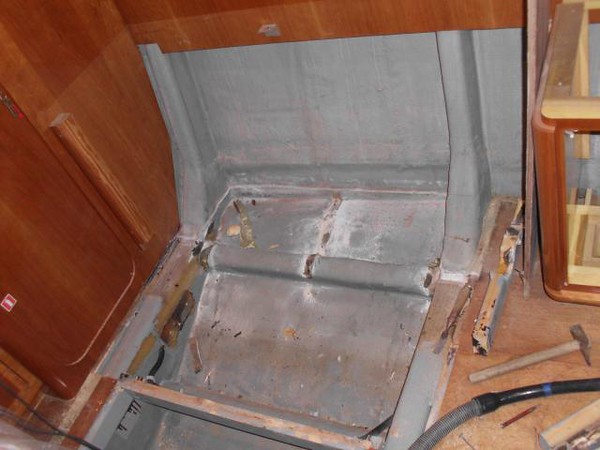
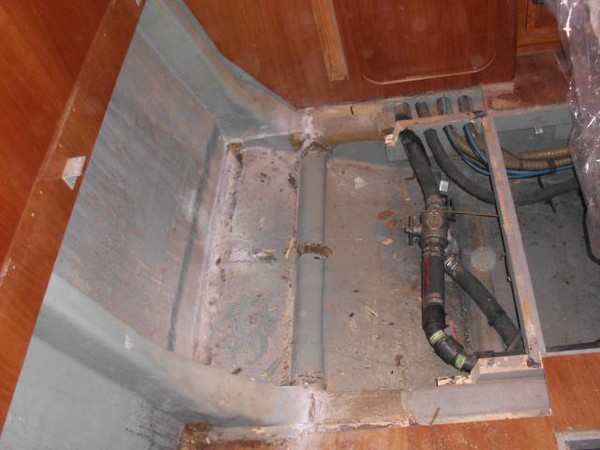
here are the pics from the positions in the boat

the stringers, right in the middle of each photo, are supposed to go out before the lamination starts.

looking at the photo's I realise that the lamination can go partially over the frames,
the innner lamination will cover a surface well over 1m x 1m

i-6mTjDzQ-L.jpg


i-XxJbX9b-L.jpg
 
Last edited:
Top