Stabilizers for Blue Angel, engineering question

Where to mount the CMC control boxes,

There will be: 1 x Electronic Control Unit
Box dimensions are 500 x 400 x 200mm , power is 65W
normally this unit is placed somewhere under the helm dash, but how about placing this in the dressing room ?
the cables to the lower helm take a very long route, and I don't really "need" much accesories there, just a controll panel.

And there will be 2 x Electronic Power Unit’s , one for each drive,
switching 3,5KW peak each, so lets say at 95% efficiency these will produce about 170W of heat. They have a fan,
Box dimensions are 500 x 350 x 300mm
Normally these two boxes would be placed in the engine room,
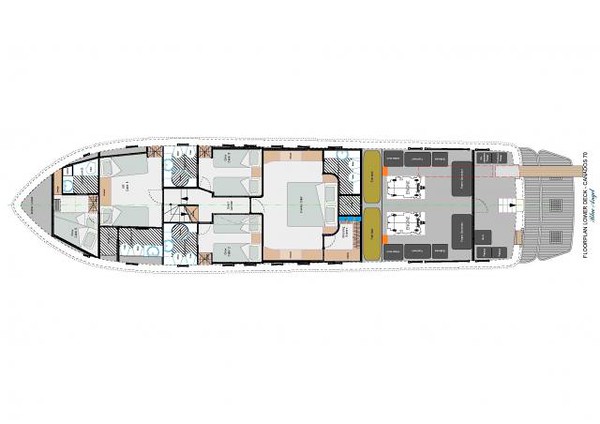
in BA only available space is in the corners near the engines (orange square on the drawing).

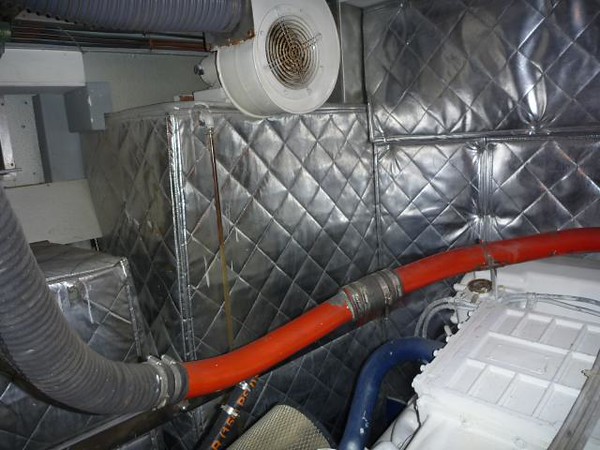
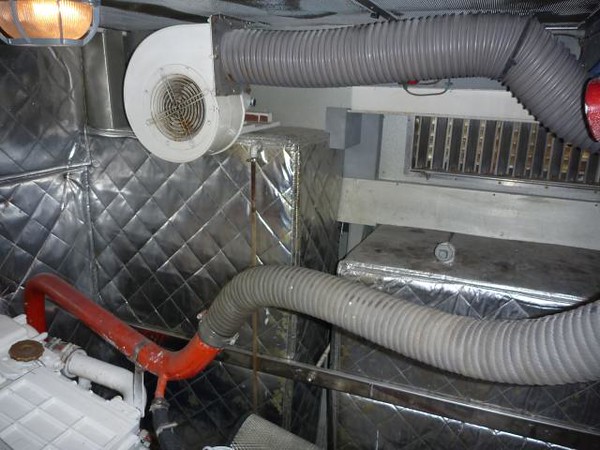
During navigation, (and many hours after), its very hot in the E/R, 60°C or more,
so therefor I’m bit reluctant to place them there,
how about placing them also in the dressing room (bleu squares on the drawing) ?

Except for service or maintenance, we don’t need frequent acces to these boxes,

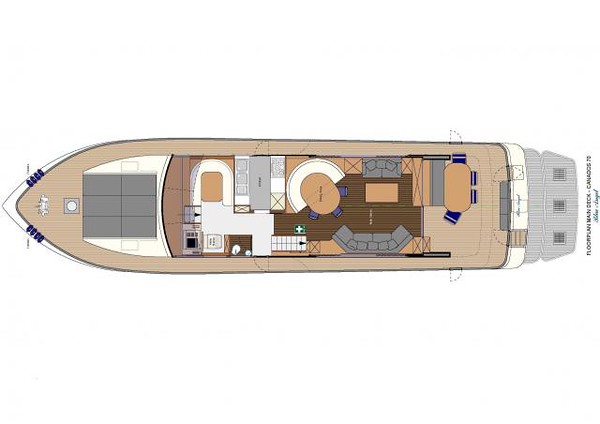
I’ve also posted the other levels of the boat, just to have an idea about cable lenth, routes, etc…
Cables between the boxes (and accessories) are long enough, 10m standard, but longer is possible.

i-9vwWfVL-L.jpg

i-vC6qr4q-L.jpg

i-2PXs3k2-L.jpg


This is the corner in the engine room, showing the wing tanks,
And part of the bulkhead where the boxes are supposed to be mounted,
On SB side
i-RtQG6Fk-L.jpg


And Port side
i-k49v8VD-L.jpg


Where would you fit the ECU and 2 x EPU ?
 
Last edited:
By dressing room, you mean the area where you enter from the new door built on the transom, and from where you access the e/r, right?
If so, I would definitely prefer that placement, rather than inside the e/r.
Just another thought: don't you have some reasonably wide space alongside the stair which goes from the p/house down to the cabins?
I understand that it's a valuable space also for storage, but maybe it would be a better location (far from humidity and from the risk of salty spray from wetsuits etc.) for electronic components...

As an aside, I didn't realise (maybe because by the time we made the FdC the weather wasn't so hot anymore) that the e/r can reach such high temperature.
60+ degrees is indeed a LOT! The rule of thumb for a good e/r ventilation is that it should be able to keep the e/r ideally within 10 (15 max) degrees above the external temperature...
Are you sure that the fans are working as they should?
I mean, you should have both some fans sucking fresh air from outside, and (at a distance within the e/r) some fans extracting the hot air, and blowing it outside.
Sometimes, I've seen fans installed incorrectly, so that all of them were either sucking or blowing, which obviously is less effective in exchanging fresh air inside the e/r.
 
By dressing room, you mean the area where you enter from the new door built on the transom, and from where you access the e/r, right?
If so, I would definitely prefer that placement, rather than inside the e/r.
Just another thought: don't you have some reasonably wide space alongside the stair which goes from the p/house down to the cabins?
I understand that it's a valuable space also for storage, but maybe it would be a better location (far from humidity and from the risk of salty spray from wetsuits etc.) for electronic components...

As an aside, I didn't realise (maybe because by the time we made the FdC the weather wasn't so hot anymore) that the e/r can reach such high temperature.
60+ degrees is indeed a LOT!

Dressing room is the storage room in the master cabin,
where I have drawn the blue squares on the drawing (just above the position where the drives will be)

storage room near the steps (under the lower helm station) is indeed possible, but very far away for the cable routes (difficult acces)


60° is just a guess, and perhaps exagerated, but even in summer when you go in there it feels like a sauna,
maybe more like 45..50°C
I'm sure the fans are running in the right direction, I'm not sure if they are still running at full rpm.
could do a measurement,
what would you accept as a "normal" e/r temp ?
 
Aha, now I see what you mean.
Actually, I was in doubt, because I was looking at the two blue squares of the first drawings, and I didn't see the smaller one in the third drawing.
Anyway, yes, that looks like a good placement for the ECU to me.
Would it be problematic to fit also the EPUs inside the dressing toom (swmbo permitting, of course... :))?
I mean, can they be noisy and/or too warm?
Because if not, it would be nice to have all the stuff together, and also closer to the fins.

Re. the e/r temperature, I don't think there's such thing as a normal temperature, because it depends (mainly) on the temperature of the external air.
As I said, I've always been told that 10 degrees C above the external air temp is fine, and 15 degrees is still acceptable, but not more.
 
Would it be problematic to fit also the EPUs inside the dressing toom (swmbo permitting, of course... :))?
I mean, can they be noisy and/or too warm?

yes thats what I had in mind, to place the 3 boxes in there,
fan noise won't be more then the noise from the drives, moreover I don't plan to use them while we sleep,
temperature in the small room migh rise, but at anker we can open the porthole,
if a problem with temperature going to high in there, I could make a ventilation opening to the saloon, arriving under the sofa / cupboard,
and or extract air from the plenum behind the outside wall covering.

Biggest tasc will be convincing swmbo that she has to bring home some of her dresses :)
 
I think that mounting them in the m/cabin dressing room seems a good idea Bart (subject to any veto from E :D). They won't hold much heat (I mean quantity, in joules, as opposed to degrees of temperature) so when you turn them off say on arrival in marina they will cool quickly. Also it feels like this makes the wiring simpler. The only cable you need to take thru the engine room bulkhead (and fire-seal) is one 230v supply from the genset, I think

Just on the engine room temp, my experience is that during navigation the airflow (from fans plus engine induction) is huge and therefore you have cool air in there, certianly no more than +10deg to the outside temp, despite the hot engine blocks and exhaust. I think but not sure that MapisM's "guideline" of <10deg is during navigation when the engines are running (?).

But when I stop eg to anchor I either have to leave the fans running (too noisy for other boats in a quiet anchorage) or allow the engine room temp to rise to the engine jacket temp, which is prob 70 degC. That's ok in my book. You have 5-7 tonnes of cast iron in there (+ hot fuel, or do you have fuel coolers?) and you'd have to run the fans perhaps 2 hours if you didn't accept, as I do, a rise in engine room temp at anchor. MapisM if you have any further ideas/suggestions on this score I'd be v interested to hear
 
I think that mounting them in the m/cabin dressing room seems a good idea Bart (subject to any veto from E :D). They won't hold much heat (I mean quantity, in joules, as opposed to degrees of temperature) so when you turn them off say on arrival in marina they will cool quickly. Also it feels like this makes the wiring simpler. The only cable you need to take thru the engine room bulkhead (and fire-seal) is one 230v supply from the genset, I think

Just on the engine room temp, my experience is that during navigation the airflow (from fans plus engine induction) is huge and therefore you have cool air in there, certianly no more than +10deg to the outside temp, despite the hot engine blocks and exhaust. I think but not sure that MapisM's "guideline" of <10deg is during navigation when the engines are running (?).

But when I stop eg to anchor I either have to leave the fans running (too noisy for other boats in a quiet anchorage) or allow the engine room temp to rise to the engine jacket temp, which is prob 70 degC. That's ok in my book. You have 5-7 tonnes of cast iron in there (+ hot fuel, or do you have fuel coolers?) and you'd have to run the fans perhaps 2 hours if you didn't accept, as I do, a rise in engine room temp at anchor. MapisM if you have any further ideas/suggestions on this score I'd be v interested to hear

all agreed,
your description of what happens with temp in the e/r is very accurate

mine takes more then 2hrs to bring the temp down, (E likes that to dry towels :) )
in a few occasions I forgot to switch off the fans, and they emptied the engine batt's too much.
 
I think but not sure that MapisM's "guideline" of <10deg is during navigation when the engines are running (?)
...
if you have any further ideas/suggestions on this score I'd be v interested to hear
Actually yes, the +10 degrees rule of thumb (though it actually comes from Cat engineers) was meant as while cruising.
And no, I'm afraid I don't have any brilliant ideas for keeping the temp down after turning off the engines and fans.
Well, I've seen boats with air conditioned E/R, if that can be considered an idea... :)
Another thought for you guys with the luxury of zero speed stabs (which require the genset anyway, whether they are hydraulic or electric) might be to fit AC e/r fans, which are much quieter, AOTBE.
And maybe they could run out of inverters while cruising, though I'm not 100% positive on that.
 
I have been thinking - left of field - If ,I,am correct in that the prime reason for " stabs" to be retro fitted to BA is basically the enhance the experiance of the wife + other none diving guests while conscious at anchor?
Then perhaps the high/ low bathing flatform if modified ( yeah I know just done)
Can be beefed up and the surface area extended - all be it temporary at anchor ( retractable flap things ? ) so that when " down" and extended ,it affectivety act as a uber stab - with the anchor chain to keeps Mrs BA comfortable ?
 
A stationary platform will be way less effective than motorised proper fin stabs though. Plus, a main purpose is to keep the boat flat underway, as opposed to at anchor
 
and also the platform won't be up for the job,
now already when lowering the platform in a swell, we notice what kind of forces appear on the platform surface / hi-lo system arms....
and these arms are way too small to give any reasonable stabilising force on the boat
 
A stationary platform will be way less effective than motorised proper fin stabs though. Plus, a main purpose is to keep the boat flat underway, as opposed to at anchor

Yeah I realise that in the pecking order Fins ( lets forget the electro/ hydraulic debate for a mo) then gyros , then
Dumped bathing platform + bigger chain at t,other end .If its anchor motion prob , primarily as Iundertand the initial reason for the upgrade .?
It's just when anchored in the Lerins July/August 100's of boats all sizes some have factory fit Hi Low bathing platforms
Without going into the engineering detail re " Beef up " some do actually lower them in a swell from the E which can roll through the islands - they seem to work
I,am not talking about playing pool on the fly, merely stoping your plates / drinks / salt- pepper pop sliding all over the table .
I think factory fit might be up to it I dunno, never had one , if there was a risk of straining the arms/ conection , then surely they would come with some sort of disclaimer ( which owners/ skippers as usual ignore) - leading to failures , some in warranty - leading to disputes re correct usage .
How do you quantify a wave? Or Swell?
Who,s got one Factory fit - do they help.
 
Who,s got one Factory fit - do they help.
Nope, they make very little difference., Sure they may look big, but 1/2 the area is so close to boat's roll centre that it contributes pretty much nothing. I bet if you were inside my boat in a rolly anchorage you wouldn't tell the diff if the platform was lowered, whereas you immediately feel the pretty transformational effect of fins or gyros
 
I'm completely missing what a bigger chain could do against the rolling motion :confused:

Was thinking pitch motion not rolling for this , more in smaller boats down the scale eg SS new400 or existing Porto 46 .
Re roll centre on a little boat the end,s are at beam? Also as a % of wetted / submersed area ratio ( not sure of correct term ) then a large - submersed one ( with suitable beefy mounts) may help?
Appreciate as one goes up up in size all the forces increase - prob not linear and the wetted area ratio thingy decreases down to insignificant .
As I said they could design in retractable wider flaps to what ever beam + + , and sink it deeper and work out the size of the " vents" blow holes for damping .
Consider for a moment the fin area ratio/ wetted and submersed area ( rear platform ) / wetted ratios -
This could be massive on a smaller boat?
Due to the Achilles heel being the mounts, - resisting tortional forces ,I would suspect it would work up to a certain size -guessing 50 fter? -depends on the displacement
Like on BA thickening up the hull/ mount pads - they would have to thicken up the transome area to " spread " forces Etc
It's just that I have seen them seem to work to some degree and wondered if if with a bit of re- engineering this secondary function could be improved/ enhanced .,especially more so for little boats .
Dunno ? Theoretically may work
 
Was thinking pitch motion not rolling for this
Well, I actually doubt that the effect could be relevant also against pitching, but at least now I see what you meant.
Point is, while at anchor, pitching is never a problem anyway, particularly with bigger boats.
And also with a 40 footer, if the wind and waves become strong enough to make the boat pitching badly, I don't think there's any practical alternative to the good old solution - namely, moving elsewhere.

Re. your other ideas, I really don't know how feasible they could be.
I'd guess that to make such "static" stabilizers effective enough, you should arrange something so big and complex to become almost as expensive as fin stabs - which obviously have the advantage of being extremely effective while cruising, in the first place...
 
Was thinking pitch motion not rolling for this , more in smaller boats down the scale eg SS new400 or existing Porto 46 .
Re roll centre on a little boat the end,s are at beam? Also as a % of wetted / submersed area ratio ( not sure of correct term ) then a large - submersed one ( with suitable beefy mounts) may help?
Appreciate as one goes up up in size all the forces increase - prob not linear and the wetted area ratio thingy decreases down to insignificant .
As I said they could design in retractable wider flaps to what ever beam + + , and sink it deeper and work out the size of the " vents" blow holes for damping .
Consider for a moment the fin area ratio/ wetted and submersed area ( rear platform ) / wetted ratios -
This could be massive on a smaller boat?
Due to the Achilles heel being the mounts, - resisting tortional forces ,I would suspect it would work up to a certain size -guessing 50 fter? -depends on the displacement
Like on BA thickening up the hull/ mount pads - they would have to thicken up the transome area to " spread " forces Etc
It's just that I have seen them seem to work to some degree and wondered if if with a bit of re- engineering this secondary function could be improved/ enhanced .,especially more so for little boats .
Dunno ? Theoretically may work

Azimut experimented with opening flaps in the hull to stop roll at anchor, which is a bit the same as you're suggesting ( http://features.boats.com/boat-content/2004/03/second-generation-anti-rolling-systems/), and flopper stoppers use broadly the same principle, so a Hi-lo platform must have some effect, but will be modest for reasons JFM mentions, and also because lots of builders have vents in the platform to reduce the load on the lift mechanism. It also intuitively feels as though the water would pour from one side of the platform to the other rather than offering high levels of resistance to rolling, though I don't know if that's correct.
 
It also intuitively feels as though the water would pour from one side of the platform to the other rather than offering high levels of resistance to rolling, though I don't know if that's correct.

+1. I experienced similar effect yesterday when I was returning from a dive and was violently thrown about by waves passing above, even when I was still several meters below the surface. When the whole body of water is in motion, any passive stabilization immediately next to the hull would probably have a very limited effect.
 
have no figures from the acceleration,
but the electric stabs specs say 80°/sec rotation speed,
perhaps you have / know the rot speed specs from the hydraulic stabs ?
BartW I got the above data yesterday on seatrials of my boat. Sleipner hydraulic stabs (which, incidentally, use proportional valves with computer DC current control, not simply open/shut valves) can easily exceed 100 deg/sec. Yesterday at sea in a f3-5 wind with moderate waves (a few waves with white crests) they hit 95deg/sec. Of course, in at-anchor mode they try to do such high speeds only momentarily because if you do full strokes at such speed you "run out of road" too fast, plus at the end of the stroke when you de-celerate the fin (in at-anchor mode) you get negative stabilisation (ie the fin helps the waves to roll the boat instead of fighting the wave).

They logged the data, see below picture that I took of Sleipner's laptop. The +/- 95 at top of column J is the max logged rotational speed at the time of my photo, yesterday (in deg/sec)
ksleipnerdata.jpg
 
Last edited:
interesting stuff,
the sleibner system appears to be very powerfull

some weeks back I've been at CMC and had a thorrow introduction to their company and their systems,
have seen many graphs, measurements / comparison between their electric and hydraulic stab systems.

We have also decided on a slightly different position of the stabs
in the corner in the master cabin, 1m more forward, but still "after" the center of WLL,
and
beam direction, as much as possible to the outside, crossing the first stringer
with a interesting mod on the hull (extra layers of GRP on the inside aswell as on the outside) copyed from the SL72 installation.
the beam on the bottom is smaller then compareable boats (only 4,2m) so this makes sense,
(distance from stab drive shaft to hull center line is approx 1,9m)

due to available timeslot in the yard / booking of guests on the boat in May
the installation of the system in BA is postponed untill June

this delay gives us some extra time for preparing the new drawings
which I will post on here (if time available)
 
Top