Wansworth
Well-Known Member
surely sailers should be able to splice their own ropes instead of relying on a professional service or is the modern sailer too busy on his/her iPhone or screen to have time for mundane things like splicing and whipping?

Lots of changes in Littlehampton,used to work there and sail from Arun yacht club…….looks like it’s gone up marketI do most of mine.
To be fair, if I was unable to maintain our vessel myself, I cant afford to keep it.
The time is not far off when we must downsize to a smaller, easier to look after boat.
We will miss the space and build quality, that is for sure!


It is fortunate that our royals provide a reason to do a bit of splicing at 6pm every day, even if it is only to celebrate the expat status of some.Eventually the order “Splice the mainbrace” came to mean that the crew would receive an extra ration of rum, and was issued on special occasions: after victory in battle, the change of a monarch, a royal birth, a royal wedding or an inspection of the fleet.
Splice the Mainbrace — National Museum of the Royal New Zealand Navy.

OK then. Re splicing itself, I have been able to do splices in 3-ply rope and sailmakers' whipping since I was a child and have sometimes spliced braided line. I have the kit for doing cored rope but for critical jobs like halyards prefer to get it done neatly and professionally. I agree that sailors should be able to do the basics.It was click bait

I learnt to do braid-on-braid, but still need the book next to me. My results are quite tidy. Like you, I learnt splicing laid ropes when knee-high to a grasshopper!OK then. Re splicing itself, I have been able to do splices in 3-ply rope and sailmakers' whipping since I was a child and have sometimes spliced braided line. I have the kit for doing cored rope but for critical jobs like halyards prefer to get it done neatly and professionally. I agree that sailors should be able to do the basics.

Why do you think we don't?surely sailers should be able to splice their own ropes instead of relying on a professional service or is the modern sailer too busy on his/her iPhone or screen to have time for mundane things like splicing and whipping?

There was an article in the latest PBO about people getting pros to do the job!Why do you think we don't?
 I have Splicing Modern Ropes. I think some of these things are probably easier to learn confidently when taught in person, hence my search for a class. There are a few around but I haven't fitted one in yet. I bet I'm not the only person who hasn't acquired a casual mastery of braid-on-braid splicing, I'm not surprised about people ordering things like spliced loops made up - I would for a new really critical one..


It's nothing compared to splicing Marlowbraid, which you'd think would be the same but it's actually completely different and additionally has a very tight sheath. My favourite these days is cruising dyneema because it has an intermediary layer that gets removed so there's plenty of space to work inside the rope.Braid on braid is a tough splice to do
I like the new cover on Ashley - I can do the trick knot the sailor is demonstrating! At least, I haven't done it for a while (it's of no practical use) and might need to practice a little, but I know how it's done! My copy is pretty ancient - I got it in my teens - so it just has plain cloth boards.Brion Toss' The Rigger's Apprentice
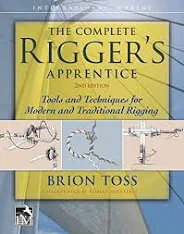
When you're feeling ambitious