Solar panels: records of actual performance

TwoHooter

Well-Known Member
Joined
6 Sep 2014
Messages
1,005
Location
marinetraffic.com MMSI 235116115
Visit site
We need to reduce our boating expenses of which the second biggest is marina fees. I am hopeful that I can obtain a nice sheltered swinging mooring which would save a lot of money even after paying an increased insurance premium. However the mooring is a 3 hour drive from home so the boat will have to be self-supporting most of the time. Here are my numbers:-
  • Anticipated constant current consumption when boat is unattended 12V x 4A = 48 W per hour = 1.15 kWh per day. The reasons for the heavy constant current are that I run a remote monitoring and alarm system with cellular router and cameras always on, also our inverter/charger is 15 years old and I suspect may have a parasitic consumption greater than a more modern one.
  • House bank 3No. x 12V x 255 Ah Lifeline AGMs (very expensive!) = 9.18 kWh
  • Lowest permitted State of Charge to preserve battery cycle life = 50% = 4.59 kWh
  • Therefore the batteries could run the boat unsupported for 4 days, before reaching 50% SoC
Our existing solar panel installation is inadequate. I think I might be able to fit 4No. 250W high quality rigid glass panels on horizontal mountings (because it is a swinging mooring) to produce 1 kWp (peak output in kiloWatts). In the summer these panels should produce far more than I need.

But what about the winter?

The mooring would be in a sheltered river on the south coast, latitude 50.3, where snow is a rare occurrence.

I have studied all the online calculators I can find and I distrust them. They all use the same algorithms so far as I can see and I think those algorithms are based on theoretical calculations not practical experiments. It's hard to use them to estimate how many kWh my proposed installation might actually produce in real life in two situations:
  1. an average English winter day
  2. a bad English winter's day
Does anyone have a record of output of an actual boat pv installation using good quality pv panels on a horizontal mounting in a south coast mooring which might give me a guide towards estimating this information? I suppose what I am looking for is output as a ratio of an installation's Wp. For example, if an installation consisting of a total 500 Wp produces 500 Wh on an average day the ratio would be 1.0. If it produces 1 kWh the ratio would be 2. Does that make sense?

I'm hoping to use this information to estimate how often I might have to visit the boat to run the generator to make up for a shortfall in pv production during a typical winter.

I suppose a wind generator might be a useful adjunct. I haven't looked at those yet. Also it is possible to buy a system for auto-start of our generator but I can't find anyone who has actually installed one in the UK and I'm not willing to be a guinea pig for something so expensive, complex, and critical.

Thanks for reading.

EDIT - the proposed panels are 4No x 250W, not 500W
 
Last edited:
With 4x130W of amorphous solar mounted on an obstruction free narrowboat roof and an mptt - winter's day - 5-10% efficiency and shorter daylight hours, summer maybe 60-70%. Crunched the data at one point, but no longer have it. Cleaning the panels also makes a significant difference, which may be an issue with an unattended boat + cormorants.
 
Last edited:
I can't answer your questions but I do wonder what your insurance company would think about an auto-start generator on an unattended boat on a mooring. I don't think I'd sleep a lot.
 
4 amps seems like quite a lot for a security system. I have an auto-dialling alarm system with motion and hatch opening detection, motion sensing camera, 4G mobile hotspot and a RaspberryPi monitoring environment sensors - all consuming a total of 0.7amps
You might like to investigate If there’s anything else drinking your power.
I have 80W of flat-mounted MPPT solar & 125Ah battery. During the winter this is not enough without charging the battery every week or so - I don’t like dropping below 60% charge. I don’t have winter figures with me, but the last month the panels have generated an average of 250Wh per day.

Edit
Just found figures for January - average 30Wh each day from 6½ hours solar charging - not great.
 
Last edited:
I think this is the most comprehensive data I've seen for anywhere in England.
Solar Panels Real Time Data
You could scale that data for panel size, non-optimum direction and tilt etc.

I think 4A is just excessive. I used to run a security system with cameras and GSM sMS etc off a 20W panel on my lock up garage.
Personally I'm not keen to see boats on swinging moorings that don't get checked frequently. Once a month is not enough in Winter.

When you think about saving money, bear in mind you will get less value from your boat and more wear and tear, so it will depreciate faster and be harder to sell.

If the river is 'sheltered' forget the wind generator for any serious amount of power. If the river is not sheltered, forget the whole thing.
 
TH, i'd agree with MCX, 4A WAY TOO MUCH!!! check system, update what needs to be updated, and get a decent inverter for this kit only. I'd even go a step further and open up the relevant boxes, search what the main 230V powersupply produces and replace (if feasible) with a buck converter feeding the rest of the system with what it needs (off your 12 or 24V service battery bank I mean). Done that in a couple of cases, worked fine.
sorry but 1kW per day is plain silly!

cheers

V.
 
Last edited:
The ratio you suggest is about 0.4 for winter in Scotland near the solstice. You will do much better further south, but 1.15 kwhrs per day is not practical. You will need to look at reducing your consumption.
 
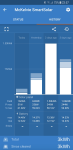
For practical info, I have a Victron SmartSolar Charger, MPPT 100/30 connected to 3x100W panels wired in series on my Bimini.

In my initial phase of testing, on a sunny July day in Bavaria I got this much energy out of them ...

1592479437212.png

So I went ahead and installed 300W of panels on the boat.

In the Adriatic I can get a little bit more but not significantly more - they are mounted on my bimini with almost no shading from my short boom.

1.5 kWh is pretty much the most I can ever expect from this 300W setup on a normal sunny summers day in the Med. After 2 seasons use I have no problem providing my daily energy requirements June to September from solar alone. I have a battery bank which will last 3 days in the event of bad weather.

With the way I use my boat, I need about 0.9 kWh for a 24hr period.

These figures match up reasonably well with what I estimated based on insolation data for the lat/long of my cruising ground, and the fact that they are fixed horizontal panels with little or no shading - panel efficiency was quoted as 20% in ideal conditions, I halved that to account for horizontal installation, moving boat, conversion efficiency, and a fudge factor for a bit of leeway - I also sized the battery bank to survive 3 badly overcast days in a row.

The total area for my panels equates to 1,67 m2 ... Croatia is struck by about 6kWh per day on average in summer, so my panels are getting about 10 kWh of energy, and they manage to harvest about 1 kWh a day. Efficiency of my setup is therefore around 10% which is pretty much what I expected.

For the UK there is some example insolation data here http://www.leidi.ee/wb/media/INSOLATION LEVELS EU.pdf .... this is the energy available from the sun at each geographical location and looks pretty accurate to me. Insolation data is pretty reliable due to plenty of records spanning the last few decades.

... anyway, I worked out my daily energy needs, as you have done, assumed an efficiency of around 10% for my solar setup and worked out how much solar area I needed to cover in panels based on the worst insolation data I would see while using the boat (May/June-Sept).

Hope this helps.

PS: For example, to get an average of 1,15 kWh per day from horizontal panels in London in December based on the data above, you'd need .... 1,15/0,52*10 m2 of panels.

Thats 22 m2 of solar ..... of course, in the height of summer you could reduce that to 1,15/4,74*10 ... or 2,4 m2
 
Last edited:
Thanks everyone. Some very useful responses there.

OK, the principal message is to try and get the consumption down before deciding whether a swinging mooring will work for us. Funny thing really, before I started this exercise I thought I'd done well to get down to 4A x 12V because at night when we are at anchor it's often 38A with fridge and freezer running. It's when you start thinking about pv output that you realise just how much electricity we all use without thinking much about it.

The boat is an American design and they don't think too hard about power consumption, it's not in their nature.

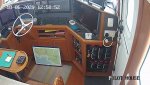
Here's a picture of the distribution panel taken by my pilot house monitoring camera a few minutes ago- spot the parasitic drains! Mostly 12V but the Toughpad is charging from the 230V service. I ned to go through the boat and hunt down every bit of power consumption.
20200618125856294 Pilot House.jpg
 
I would say a 100w panel realistically gives about 3.5 to 4.4a max on the south coast.
I have 210w and see only 0.5a on a drizzly day.
Wind is 24/7 but only when windy and output average will be a few amps.
210W of solar and 20amp turbine I think would not give 96a per day as an average
 
I would say a 100w panel realistically gives about 3.5 to 4.4a max on the south coast.
I have 210w and see only 0.5a on a drizzly day.
Wind is 24/7 but only when windy and output average will be a few amps.
210W of solar and 20amp turbine I think would not give 96a per day as an average
Thanks for your comment and I am sorry if I seem dense but the only way I can think about this is in Watts, and for present purposes Watt hours (Wh), or kWh if we hit the big time (!). Sometimes I express both Amps and Volts instead of going straight to Watts but most of the time Watts is what works for me.
For example, in your post, a 210W panel produces 0.5A but unless we know the volts it doesn't inform us about the current the panel is producing as a percentage of its claimed output.
Putting that to one side, the output is obviously small compared to the claimed (perfect conditions) rating.
 
As the clouds pass over the sun the max solar voltage drops . I have no idea what voltage when overcast but it's around 21v on a sunny day
With wind as in 60 knts my turbine can be outputting over 60v. The output from the charge controler is right for a 12v system but the voltage input constantly varys a lot.
The amps I have stated are based on my own experiences and was just to give you a tiny bit of info regarding your need to maintain 4 amps.
 
As the clouds pass over the sun the max solar voltage drops . I have no idea what voltage when overcast but it's around 21v on a sunny day
With wind as in 60 knts my turbine can be outputting over 60v. The output from the charge controler is right for a 12v system but the voltage input constantly varys a lot.
The amps I have stated are based on my own experiences and was just to give you a tiny bit of info regarding your need to maintain 4 amps.
Thanks, that's helpful.
Of course it emphasises the need to reduce the power consumption as first step.
 
I have nearly 10 years of data from roof mounted panels with perfect orientation in south Devon which consistently give 4MWh/year from 4kW of panels. Scaling this down, a 100W panel gives 100Wh/day in winter and 400Wh/day in summer. You can halve these figures for horizontal orientation and then reduce some more for an overcast period. You might just manage your requirement of 1150kWh with several panels in the summer but no chance in the winter unless you can reduce your demand.
Would it be possible to put some of the equipment on a timer so it is only on for one minute in ten with a motion detector/alarm sensor to turn it on continuously?
 
I have nearly 10 years of data from roof mounted panels with perfect orientation in south Devon which consistently give 4MWh/year from 4kW of panels. Scaling this down, a 100W panel gives 100Wh/day in winter and 400Wh/day in summer. You can halve these figures for horizontal orientation and then reduce some more for an overcast period. You might just manage your requirement of 1150kWh with several panels in the summer but no chance in the winter unless you can reduce your demand.
Would it be possible to put some of the equipment on a timer so it is only on for one minute in ten with a motion detector/alarm sensor to turn it on continuously?
I'm grateful for every reply - all very helpful - but I think for my particular situation this is the one I really needed. Thanks andsarkit.

It sounds as if for every Watt of output claimed by the manufacturer I might get 1Wh per day average in winter with perfect orientation and perhaps 0.5Wh per day average with horizontal mounts?

If that's right my proposed 4No. x 250W panels (there was a typo in my original post, now corrected) might give me an average of 0.5kWh per day. Therefore my consumption needs to be cut by more than half (1.74A x 12V x 24h =0.5kWh). The good news is that if I can reduce consumption to 1.74A the house bank can run the boat for 9 days without any solar input, which should mean that only a prolonged spell of really dark days would take the boat down to 50% SoC.

This emphasises the need to start by going through the boat and re-designing everything to get the power consumption down. I've been thinking about this since the thread started and I have quite a few ideas. For instance, the water and black water tank gauges are both always on and there is no way to turn them off. I'll have to install push-to-make switches for both of them. I think perhaps the inverter will have to come out of circuit, and I suspect this is not as easy as just opening the breaker. Those bright LED gauges on the distribution board will have to go. There's a lot to think about. Not an easy project. But marina fees are now killing us so it's either this or give up the boat. Not without a fight.
 
TH, first of all, buy a Uni-T digital meter with an amp clamp THAT WILL DO DC A measurement (cannot tell you the model, have it on the boat atm) and go around measuring things, I bet you'll be impressed. Not sure the black and fresh water tanks consume a lot, but they could be on a timer with one measurement every 15min, gauge backlit would probably be 4X more in energy...
As you say, go around, check everything and establish what you REALLY need on 24/7 and adjust the rest to occupied vs non-occupied mode of operation!
don't give up a Nordhavn for the el.bill ffs! :-D

V.
 
Thanks Vas. I've got one of those DC clamp meters , saw it on offer in City Electrical a couple of years ago and grabbed it. Quite looking forward to hunting down all those parasitic loads. Individually they may not amount to much but every little helps.
We are hoping not to give up the boat at all but the lockdown has knackered our businesses. We are luckier and better off than many and I don't want sympathy but I have got to get the outgoings down and if we could quit the marina and go on a swinging mooring for 2 or 3 years we should be OK. We are signed up until 31 October so I've got over 4 months to deal with this.
 
Top