Solar panel not giving me the amps - 170w and getting maybe 1.7a in full sun

I have 7 of the same Renogy 175w panels - today each one made 100w max on a flat surface (sika to deck) but we were full by 11 am so spent most of the day in float and thus the 100w max for each (as shown on the Victron app) was at a low angle of sun and on 5 of the panels some shading. So something somewhere is wrong in your set up I think. (South coast of the UK was nice and sunny today)
 
I have 7 of the same Renogy 175w panels - today each one made 100w max on a flat surface (sika to deck) but we were full by 11 am so spent most of the day in float and thus the 100w max for each (as shown on the Victron app) was at a low angle of sun and on 5 of the panels some shading. So something somewhere is wrong in your set up I think. (South coast of the UK was nice and sunny today)
Hm. That is interesting. Do you walk on your panels? Do you have a picture? That has nothing to do with my problem here, but I am curious what it looks like since you have 7(!) glued to the boat.
 
Solar PV panels in Oz on roof tops are always mounted about 10 cms above a sloping roof or on a frame on horizontal roof to give a good angle to sun and to provide for cooling. However loss of efficiency is simply tolerated when they get hot. (and they do) ol'will
 
A simple question.
Is this problem new? Was the panel generating more and then the capacity dropped?
I had the solar panel and controller on my old boat, but I was constantly on shorepower and didn't really get to use them very much (did not go sailing often with them). I did occasionally look at the amps, which always were low, but I always thought it was just because the batteries are obviously topped up or because the irish weather was shite.

Now is the first time I am actually using them properly.

I know the rigid 100w one definitely works, and I'll rig it up as soon as I have the new connectors in the mail.
 
I am aware that I am in NW England during spring and I don't expect the absolute maximal possible output (14.2 amps btw), but I do expect a little more than 1.7 amps.

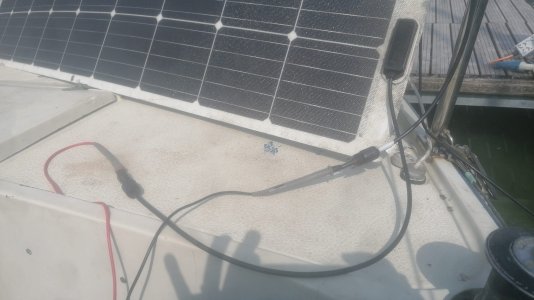
Could my solar panel be faulty? I don't see any faults on the panel, and it's clean as well. One of the connectors sort of broke at the plastic bit that holds the two pieces together, but they are touching well and I taped them so they don't slide apart. I am mentioning it to find a culprit, but I really don't think this should be a big deal as long as the metal inside has good connection.

Panel is a renogy 170w flexi with a renogy voyager PWM charge controller. I know, not MPPT but still shouldn't be that terrible.

I ran the batteries low overnight to get to 12.3 or 12.2 or something like that. That way I could see the amps rise. But no, they don't. I get the same sort of output.

Any clues?

View attachment 192466View attachment 192465

I tried it differently like this as well
View attachment 192467View attachment 192468

The readings, both, were taken BETWEEN clouds when the sky was unobstructed.
In your second photo the panel is very curved. What we have found with flexible panels is that the flex in the panel is its downfall. If you buy a brand new flexible panel and glue it to a slightly curved deck, such that it bends just that once, you can expect reasonable performance from it. If you have that same panel as a roving panel, like you show in your photo, and it gets flexed on a regular basis, they are destroyed in fairly short order. The problem is micro cracking in the panel. This quickly diminishes the output and the more you bend it the worse it gets. I suspect that this is where you are.
We couldn't work out why our 4 Renogy panels failed super quickly. I am certain this was why. We had them mounted on a sun cover in windy conditions and the panels would flex.
I am not a fan of flexible panels and will never go that route again. We now have over 1000w of framed panels that are a far more robust set up
 
Hm. That is interesting. Do you walk on your panels? Do you have a picture? That has nothing to do with my problem here, but I am curious what it looks like since you have 7(!) glued to the boat.
Yes I walk on them occasionally - its a 50 foot cat so lots of space for them - 5 on the coach roof and 2 on the deck (plus 4x360w hard panels that make up the cockpit roof ) - its pi**ing down here currently so I wont venture out for photos. Currently getting 32w each from the front panels and 30 from each of the roof panels - in rain with mid grey skies.(Each of the hard panels is giving 76 w but they are twice the capacity so that suggests the flexi ones are about 15% less efficient but then the big panels are completely unobstructed but I think in actual rain this makes no difference)
 
In your second photo the panel is very curved. What we have found with flexible panels is that the flex in the panel is its downfall. If you buy a brand new flexible panel and glue it to a slightly curved deck, such that it bends just that once, you can expect reasonable performance from it. If you have that same panel as a roving panel, like you show in your photo, and it gets flexed on a regular basis, they are destroyed in fairly short order. The problem is micro cracking in the panel. This quickly diminishes the output and the more you bend it the worse it gets. I suspect that this is where you are.
We couldn't work out why our 4 Renogy panels failed super quickly. I am certain this was why. We had them mounted on a sun cover in windy conditions and the panels would flex.
I am not a fan of flexible panels and will never go that route again. We now have over 1000w of framed panels that are a far more robust set up
Interesting to hear you conclusion to the why your panels don't work .. I've fitted loads of Renogy 50w as I mentioned before but always fitted flat or to a small curve and fixed . I have done a few on the bimini covers of boats for people with magnets but the larger 100 or 175 w panels and they seem to hold a single curve on taught canvas and still work well after 2-3 years (thats the longest I have data for)

I'm glad you have sorted out why the issue occurred and you conclusions make sense. Of course Renogy do supply them to be fitted to a fixed location and not for moving around lots - if roving panels are needed then laminate a foam core panel to fix the flexi solar to and then no issues .
 
Why do solar panels need to be kept cool? I thought I read that it is the IR radiation (not visible light or uv) that makes them work. Is it a very vaguely like the peltier chip ‘idea’?
How detailed do you want to go! When light (of an appropriate wavelength) shines on a panel it moves an electron out of its natural "place" and generates an electron-hole pair. In order to get useful work from the panel "the" electron has to make it to the contact on the panel (and "the" hole has to migrate towards the opposite contact) the current then flows through your circuit between those contacts so that the electron and hole can recombine and "normality" is restored, ready for the next photon to hit the panel and repeat the process. In crude terms when you heat the materials there are more electrons banging around in the panel (at a sub atomic level) and thus increased chance of the positive hole finding an electron which hasn't had to travel all the way through your circuit and therefore achieves nothing useful.

Now which wavelength of light triggers the electron-hole pair in the first place depends on the construction of the panel. The shorter the wavelength (e.g. UV) the more energy so the better at kicking an electron out of its "home" BUT panels are actually a massive set of compromises, we want them to be strong, easy to clean, waterproof, avoid unwanted reflections, perhaps flexible etc - so they are often a sandwich of materials some of which may actually block some wavelengths of light. I would be surprised if panels used on boats had no visible absorbtion though.


*I am aware that the concept here are a gross simplification, but without getting into university level science this should help the understanding.
 
  • Like
Reactions: xcw
In your second photo the panel is very curved. What we have found with flexible panels is that the flex in the panel is its downfall. If you buy a brand new flexible panel and glue it to a slightly curved deck, such that it bends just that once, you can expect reasonable performance from it. If you have that same panel as a roving panel, like you show in your photo, and it gets flexed on a regular basis, they are destroyed in fairly short order. The problem is micro cracking in the panel. This quickly diminishes the output and the more you bend it the worse it gets. I suspect that this is where you are.
We couldn't work out why our 4 Renogy panels failed super quickly. I am certain this was why. We had them mounted on a sun cover in windy conditions and the panels would flex.
I am not a fan of flexible panels and will never go that route again. We now have over 1000w of framed panels that are a far more robust set up
We have a roving flexible panel that is normally dumped over the thwart in the dinghy, taken out every time the dinghy is used and much abused in use. Lasted 7 years before I replaced when we broke the (non solar) corner off entirely.
The ones on the sprayhood also lasted over 7 years before decided to upgrade.
May depend on the quality of the semi flexible solar panels but we would not consider replacing with hard edges fixed panels.

Different if wanted a fixed gantry structure but not for us.
 
In your second photo the panel is very curved. What we have found with flexible panels is that the flex in the panel is its downfall. If you buy a brand new flexible panel and glue it to a slightly curved deck, such that it bends just that once, you can expect reasonable performance from it. If you have that same panel as a roving panel, like you show in your photo, and it gets flexed on a regular basis, they are destroyed in fairly short order. The problem is micro cracking in the panel. This quickly diminishes the output and the more you bend it the worse it gets. I suspect that this is where you are.
We couldn't work out why our 4 Renogy panels failed super quickly. I am certain this was why. We had them mounted on a sun cover in windy conditions and the panels would flex.
I am not a fan of flexible panels and will never go that route again. We now have over 1000w of framed panels that are a far more robust set up
Yes, I curved it to point more towards the sun, it was just a test to see if I get more out of it. I got 1.6a out of it, as you can see in the picture. That's why I took two pictures of the controler. One for each "position".
Yes I walk on them occasionally - its a 50 foot cat so lots of space for them - 5 on the coach roof and 2 on the deck (plus 4x360w hard panels that make up the cockpit roof ) - its pi**ing down here currently so I wont venture out for photos. Currently getting 32w each from the front panels and 30 from each of the roof panels - in rain with mid grey skies.(Each of the hard panels is giving 76 w but they are twice the capacity so that suggests the flexi ones are about 15% less efficient but then the big panels are completely unobstructed but I think in actual rain this makes no difference)
Ah okay, well on a cat you just have so much room. On a monohull this would be very complicated. Hence why I asked, but then I didn't know you had a cat so I guess the question isn't that relevant now.
 
DangerousPirate; it's easy to check whether a PV panel is working properly. Put the panel in the sun and measure both it's open circuit voltage and short circuit current; then see whether these are as specified by the manufacturer.
 
Interesting to hear you conclusion to the why your panels don't work .. I've fitted loads of Renogy 50w as I mentioned before but always fitted flat or to a small curve and fixed . I have done a few on the bimini covers of boats for people with magnets but the larger 100 or 175 w panels and they seem to hold a single curve on taught canvas and still work well after 2-3 years (thats the longest I have data for)

I'm glad you have sorted out why the issue occurred and you conclusions make sense. Of course Renogy do supply them to be fitted to a fixed location and not for moving around lots - if roving panels are needed then laminate a foam core panel to fix the flexi solar to and then no issues .
Is no longer an issue since we built a hardtop to replace the sprayhood. We have 300W of framed panels going on top. They are good quality 24v panels purchased from Germany. Added to the existing 720w of panels mounted on the guardrails, we are pretty maxed out on solar.
 
Rigged up the 100w rigid one now, unfortunately, by the time I was done, the sun was pretty much gone, so we'll see tomorrow morning what the results are like and if I get more than 1.5 watts with that panel.

I wonder what possible causes there are for such a low outcome. If the panel would be shot, it wouldn't work at all. Maybe an issue with the cables? Connections are not loose on the pwm or battery, but as I briefly mentioned earlier, one of the panel plugs was broken (seemingly only the plastic) and I stuck it together and taped it. Maybe that was an issue?.

Or perhaps a faulty pwm?

The renogy pwm doesn't show wattage btw, only voltage and ampere. But tomorrow I'll make sure to take a note of it. Hoping for sun in the afternoon.🤞
 
Rigged up the 100w rigid one now, unfortunately, by the time I was done, the sun was pretty much gone, so we'll see tomorrow morning what the results are like and if I get more than 1.5 watts with that panel.

I wonder what possible causes there are for such a low outcome. If the panel would be shot, it wouldn't work at all. Maybe an issue with the cables? Connections are not loose on the pwm or battery, but as I briefly mentioned earlier, one of the panel plugs was broken (seemingly only the plastic) and I stuck it together and taped it. Maybe that was an issue?.

Or perhaps a faulty pwm?

The renogy pwm doesn't show wattage btw, only voltage and ampere. But tomorrow I'll make sure to take a note of it. Hoping for sun in the afternoon.🤞
voltage and ampere. V X A = W ;) :ROFLMAO:
 
4.5a at 13.4v a couple minutes ago.
And now it's 5.5a at 13.6v .

And IIRC 5.5a is the maximum I can get from the 100w rigid panel.

So it really seems to be a shot flexi, but it's a shame because it looks absolutely fine to me. Not sure why it's faulty. Nothing burnt out, no corrosion or anything else. Realy shame.
 
Panels can have breaks in the cell links ... the overall panel still works - but not all cells delivering. Maybe that's happened with yours ?
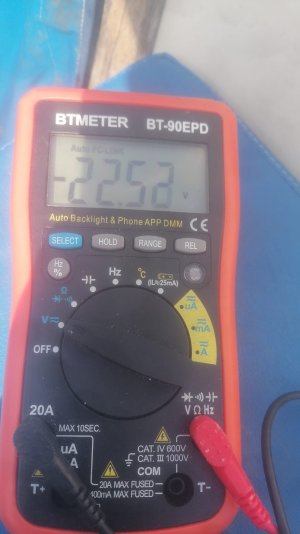
Maybe, but I just measured it and I am getting 22volts or so at the panel.WhatsApp Image 2025-04-29 at 14.42.39.jpeg
WhatsApp Image 2025-04-29 at 14.41.29.jpeg

I'd think the panel is not working but it seemingly is, then I'd think it's the pwm but it works with the 100w.

I resued the same bottom half (pwm to panel) cables and connectors with the 100w, so that works. And by measuring it this way, I know the connectors at the panel are also working.
 
Top