
Small boat heavy weather

Eg Lots of the Contessas, Sigmas, Nicholson’s and Westerly’s (including our own Sealord. Other designs and manufacturers are available.

I appreciate that these are all much bigger boats than the OP is looking for, but I can’t let the old myth about long keels being the best solution go unchallenged.
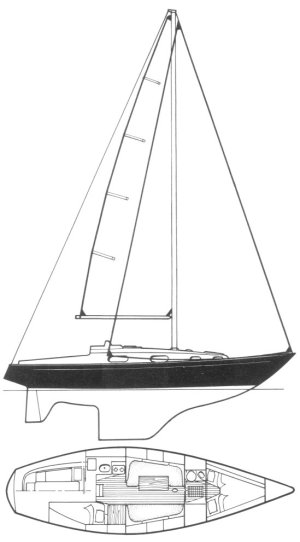
The Contessa, which is possibly nearest the OP's size range from the above, is long keel.
 
The Contessa, which is possibly nearest the OP's size range from the above, is long keel.
I beg to differ. I was referring to a Contessa 32.

IMG_5861.jpeg
Contessa 32 profile = long fin with skeg and rudder.

IMG_5862.jpeg

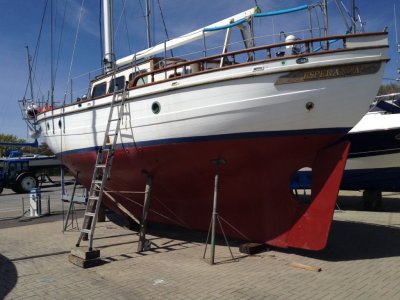
Here’s a long keeled yacht.

I agree the Contessa 26 is long keeled but they have all the drawbacks I’ve mentioned and go to windward like a submarine. (I nearly bought one once!)

(Tally Ho is a long keeled yacht also).
 
I beg to differ. I was referring to a Contessa 32.

View attachment 174126
Contessa 32 profile = long fin with skeg and rudder.

View attachment 174127

Here’s a long keeled yacht.

I agree the Contessa 26 is long keeled but they have all the drawbacks I’ve mentioned and go to windward like a submarine. (I nearly bought one once!)

(Tally Ho is a long keeled yacht also).
Oddly enough I am aware of the profiles & i do acept your comments. But your examples are not in the size range the OP was discussing so are not entirely relevant. Of course there will always be those that break the rules but less than one might expect
You criticised the contessa 26 for being wet, but the 32 is often known as a "submarine with sails" -so the hull configaration does not help with that does it?
 
Last edited:
Oddly enough I am aware of the profiles & i do acept your comments. But your examples are not in the size range the OP was discussing so are not entirely relevant. Of course there will always be those that break the rules but less than one might expect
You criticised the contessa 26 for being wet, but the 32 is often known as a "submarine with sails" -so the hull configaration does not help with that does it?
I completely agree and the Contessa 32 can be a very wet boat too. It’s also got rather cramped accommodation compared to many 32’ boats. They are very pretty and sail beautifully though.
 
The Crabber 24 (1994 version) has a long keel. It was slow though. Nice interior and sturdy hull construction. More room and higher freeboard than a Hurley 22. Though the Hurley 22 might point better upwind. The Crabber 24 (Bermudian version) might well need standing rigging and jib/staysail furler drum changes or upgrades if going well offshore. Also some of the engine options I think were too heavy for the boat.
 
I’ve sailed and owned long keel boats as well as boats with various forms of fin keel and I humbly suggest that stating that long is best is buying into a myth that simply can’t be substantiated.

There are plenty of long keeled boats that plod along but if we’re honest they actually sail like dogs and they manoeuvre under power astern with the grace of an elephant on heat. There are also plenty of lightweight fin keeled boats that are twitchy flyers that don’t track and certainly don’t heave to.

In between there are lots of boats that have moderate fins and which will trounce most any long keeled boat in all points of sailing, sail as comfortably as any other in big seas and heavy weather yet will still heave to reliably and easily. As a big bonus they manoeuvre beautifully and predictably under power.

Eg Lots of the Contessas, Sigmas, Nicholson’s and Westerly’s (including our own Sealord. Other designs and manufacturers are available.

I appreciate that these are all much bigger boats than the OP is looking for, but I can’t let the old myth about long keels being the best solution go unchallenged.
And yet the folk boat fleet go around the island in the same time as the CO32s.
25ft long keel vs 32ft long fin.
 
Post them, I think they would be of interest.

.
I love the round the island race for the data it throws up about various boat types....

In 2023, which was a pretty windy year, if not the most extreme, there were 3 folkboats taking part. The fastest took 9 hours 28 minutes. The slowest 10 hours 23. Although there are other folkboats that aren't in the folkboat class..... Madeline, for example, who've won it on more than 1 occasion. I assume that they have taken them out of class in pursuit of the best rating for the RTI. In this case, they were slightly slower than that fastest folkboat, but corrected out well ahead.

29 Contessa 32s finished the race. The fastest in 9 hours 4 minutes. The slowest in 11 hours 31.

So the best Contessa was ahead, but the worst well behind...

With the fact that the folkboats are well known as an RTI gold roman bowl winning option, the standard of sailor that jumps in one for the race is somewhat high... To be honest I think what you're seeing here is the difference a very good crew, over a good crew, can make to the time.
 
Yes, it's the difference between the general truth and an interesting contrary anecdote.

When they put "Smoking Kills" on a packet of fags people liked to say: "..... well my Grandfather smoked all his life and lived to be 95"

.
 
Bearing in mind that any breaking wave greater than a boats width can capsize her, any sailor in the short seas (thus potetially breaking) around the british isles, would dislike trying to go to windward in an non/sheltered water F7 is a smaller boat and might be in serious danger in a F8.

Its not that it cant be done, its just that the stress of enduring one doesnt broach is wearing particularly single handed.

We sail a 27ft and Navigator refuses to make passage in F7 - (f7 gusts are fine)

Off course with big sea with long interval its fun enough with wind on stern quarter, but prudent passage planning in small yachts says stay in harbour if the only escape option from storm is a wet and tiring beat to windward
 
Last edited:
A
With the fact that the folkboats are well known as an RTI gold roman bowl winning option, the standard of sailor that jumps in one for the race is somewhat high... To be honest I think what you're seeing here is the difference a very good crew, over a good crew, can make to the time.
Although if Folkboats were a good choice to get a win for serious sailors, wouldn't you see more than three entries?
 
For the most recent posts concerning Folkboats, the racing fleets down and about IoW are apparently so very competitive due to the one design criteria being so rigorously enforced, and the crews are razor sharp I believe.
With most modern boats, isn't it the case that heavy weather sailing is what the folks onboard are prepared to put up with?
 
A
Although if Folkboats were a good choice to get a win for serious sailors, wouldn't you see more than three entries?
There was a folkboat class that had 3 entries. Other folkboats were undoubtedly taking part, for example Madeline, but presumably not in class as they’ve been optimised for IRC for the race (probably sail area). I just don’t have enough knowledge about folkboats to pick them out of the results.
 
Top