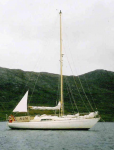
Sits like a duck at anchor

You've picked a boat with one hull missing, I'm afraid. ;)

Richard
That's got to be a wind up. I've had really uncomfortable nights on a cat at anchor. A lightweight cat skates around all over the place in wind over tide.

Our current moderate fin but more than 11 tonnes on 39 ft rarely hasn't ever skated around and snubbed her anchor. In fact I can't ever remember her misbehaving at anchor once in the fifteen years we've had her. And we anchor a lot.
 
Brilliant thanks finding that. I always meant to get the sizes that were on the page as I am intending to make one before setting off on my, now delayed, travels.
There was a thread about it with a lot of detail from Piotaskipper including sizes and materials. I can't find a valid link to it now but I copied it all onto a Word document at the time and I can send you a copy if you like.
 
I‘ve got a 40 foot AWB and anchor for about 120 nights a year. I use a two legged snubber of about 10m length in total. I find that whilst the boat swings at anchor there’s little or no violent movement as the swing reverses until the wind get up to about F7 or so. Even then, it’s not a bang but a rapid reversal of direction. I attribute this to ensuring that there’s enough scope out and the snubber doing its job, as one leg loads as the boat moves one way: as the motion reverses, both legs are more or less equally loaded before the load transfer to the opposite leg.
I’ve sat out some entertaining winds over the past few years and the major worry is the poorly anchored boat upwind....
 
If you're not interested in the possible solutions, (which you are already aware of), why bother asking the question.

I doubt there is a boat you could buy that would do it all on its own :(

Yes, only things left that I could think of were anchor somewhere else, buy a different boat, lay twin anchors, remove headsail or alter scope.

Pretty much just leaves alter scope as laying twin anchors or removing headsail are extra work and OP doesn't seem to want to change anything.

OP pretty much explicitly excluded everything people are suggesting (Riding sails, snubbers etc.).
 
My Moody 31 usually sits quite comfortably at anchor - but I usually anchor in sheltered anchorages, with a consistent tidal flow. With a fin keel and rudder on a skeg, she tends to lie to the current, but of course, if the wind gets up things change! But I won't be anchoring in high winds unless I have no choice.

I have had an uncomfortable night at anchor at Sanda. The anchorage there was well sheltered from the wind at the time, and there isn't a strong current, so she lay to the wind. We were quite comfortable, but during the night she'd suddenly change heading and roll for a minute or two, then go back to lying quietly. This happened about once or twice an hour. All we could imagine was that once in a while a wave train made it into the anchorage, which is pretty open to the north.
 
Wully

All saily boats zig-zag as a function of their design; you can't have it any other way.

The ones with reduced zigzagging usually have a doghouse or stern cabin with increased windage aft. Which is why a V sail (Piota style) works well. Would his Lordship's fine chentleman's yot be a good example ?

One alternative is to put a spring out to the anchor. Use the chain hook about 15ft away from the bow, and lead the line to a main genny winch aft and tighten. This puts an assymetric sheer on the anchoring forces and reduces (not eliminates) the zig and zag.
 
There was a thread about it with a lot of detail from Piotaskipper including sizes and materials. I can't find a valid link to it now but I copied it all onto a Word document at the time and I can send you a copy if you like.

I think I did similar Poignard, see below.

I have a boat with a deep forefoot, skeg and fair displacement but was miffed one day when I started sheering whilst a nearby flat bottomed boat was sitting solid on the water. I was a couple of hundred metres further out and I think that was the key. So the point may be that many boats will get lively in the right(wrong) conditions.

I didn't have Piota's sail at the time but I did knock one up later. These are notes taken from Piota's skipper's advice, in memory of that gentleman a very accomplished yachtsman:

Piota – Riding sail


SETTING :
The following sequence presets it before hoisting. (the main halyard is used to support the boom to release the topping lift for the riding sail)
1 The tack has a D-ring for a strop to the mainsheet track, or two spliced lines, pre-set to length, angled forward and outboard to strongpoints (in Piota's case, cleats on the coamings).
2 The clews are spread apart by a light spar poked into the cringles (or D-rings): permanently spliced sheets are doubled under the sternrail inboard of its stanchions, and back to the
clews; secured by eye-splices over the spar or clips to the D-rings.
3 The topping-lift is clipped to the head: a rapid hoist & tension on a winch: sail set!
The trick, at the design stage is to make a mock-up of the sail edges in 'string' and adjust dimensions (sail and spar) so that when fully hoisted and tensioned the luff is clear of the boom,
the sheets bisect the clew angles (with the spar in place), and the spar is clear of the backstay, (either ahead or abaft). Contrary to what might be expected, it is neither necessary nor desirable to attach anything to the backstay. When the dimensions are all compatible and the sail is set flying it is stable; and silent!

Specification of the sail for Piota:
Dimensions: (Hollows in brackets): Luff, 8ft (1.5in.) : Leech, 9ft.8in (1. 75in) : Foot, 5ft.6in (1.0in) Cloth: a light polyester (dinghy) sailcloth. (Preferred to spinnaker nylon, which distorts too much underload)
To join the twins: lay one on top of the other, corners corresponding, then turn the top one over like a page of a book to leave the luffs edge-to-edge: Join with 2" flat webbing: (it stiffens and rounds the luff: no eddies, no turbulence!)
Tabling: I had lee-lines and foot-lines put in to deal with any flutter, but there is none. Fittings: D-rings (or cringles large enough to accept a spliced sheet and tapered end of the spar) .§QM : I use a boathook with a plastic fitting at both ends (to avoid having to stow an extra spar).
Read more at Backstay sail


Only used it once in anger and can't really comment on how well mine works yet.
 
Last edited:
My interpretation of the OP is that he cannot be bothered with solutions that might suit his yacht - he simply wants to buy one which will be stable at anchor, no matter what, and developing his skills is not something that he wants to entertain.

I'm with Duncan on this - use a bridle.

I do find it odd that the OP prioritises stability at anchor over sailing performance, accomodation etc etc - as anchoring is really quite simple - if you ignore the fear merchants.

In case the OP decides buying a new, another, yacht might be expensive and more trouble than its worth, for the eventual returns (as Sarabande points out in his opening sentence) here is a short reading list.

How to: Dealing with Snatch Loads in an Anchorage

Anchor Snubber Tips

Know how: Expanding your Anchoring Repertoire

The art of snubbing, in the nicest possible way - MySailing.com.au

Jonathan
 
Ive got to agree with Richard S. The solution is to use a bridle attached to both bows, in my case 6.5m apart, not an option for mono's. Add to this a hull length/beam ratio of 13:1 you have a situation that's very unlikely to sheer about. Of course the anchor may be ahead or behind or anywhere in between.
 
I'm not sure that I should be bothering to reply, since the OP has stated that he doesn't want to take any remedial action, but here goes. It's fairly obvious why a ketch should lie quieter at anchor, with having the extra windage aft with the mizzen mast and all its gear. I note that the OP also suggests that cutters also lie quieter. That one mystifies me, and frankly sounds like rubbish.

I have a 36 ft ketch, which lies quite quietly at anchor. I have 10mm chain, which some will claim to be excessive, but it works. I don't need to use a snubber for elasticity, but do take the load off the windlass with a chain stopper, on a short strop. I do have an anchor sail, which I use occasionally, if I can be bothered. It is a vee sail, with slides to fit the track on the mizzen mast, and each clew is sheeted to the aft quarters of the taffrail (pushpit). I have found that a spreader bar (boathook) between the two clews, helps to stabilise the sail. The sail significantly reduces the amount of yawing at anchor, but as already stated, a ketch doesn't yaw as much as a sloop anyway.

In case anyone is interested, the dimensions of the sail are:
Luff. 3.25m
Leach. 3.9m
Foot. 1.83m
The sail is made of heavy material, the same as my storm jib.
 
I haven't really thought much about this but decided to write a few random thoughts.

Reason for behaviour:
Wind and perhaps waves will exert a sideways push which increases with angle of whatever is pushing.
Hull will pivot around the point of maximum resistance as it move to the side.
Unstable if point where the push is applied is in front of the point of maximum resistance.

How to increase stability:
1) Buy a hull & rig with low windage forward, high windage aft, shallow forefoot etc.
Changing boat simply for behaviour at anchor might be a bit extreme.

2) Reduce windage at bows (remove foresail)
Removal or foresail is a lot of effort with a furling headsail on a larger boat

3) Increase windage aft (steadying sail)
Steadying sail should work well with the correct design and size

4) Increase resistance to sideways movement at bows (2 anchors, short scope, bridle, drogue)
Using 2 anchors should work if you can put up with the hassle
Short scope might help but only really viable with something like a mooring
Bridles should help and work well on a cat. because of the distance between hulls
Drogues would probably need to be large and the amount of slack would limit the effect

A bridle should help to some extent, even on a mono-hull. I guess a more extreme variant on a bridle might help more.
i.e. Tie a line to the anchor chain about 10-15m before the normal scope being used. Lead the line outside of everything and tie at the stern. Put out remaining amount of chain and adjust tension on the stern line to sit at a comfortable angle.

I have done this in light wind to bring the bows into swell and it does work. I have never tried it to reduce amount of shearing at anchor.
 
What about the effect of dodgers and spray hoods?

Or the fully enclosed cockpit marquees?

They provide semi permanent windage aft.
 
Sometimes it's unavoidable but here are a few things I do to avoid too much shearing about.
Try to choose a weather shore so the wind is off the bank. We don't have to worry much about katabatic winds here in Essex.
Try to avoid anchorages where the wind is likely to be directly contra to the tide. This can mean moving round a bend.
Tie the helm over to give a positive shear [or is that sheer?] Usually best to arrange so you point towards the wind.
Try to add some drag, even a bucket on a string helps.
Add some weight to the anchor rode. I use a rope anchor warp and tie a 5kg kettle bell to the warp about 2-3metres below the surfavce.
Usually these tricks work, sometimes we have to move.
I've never tried a riding sail, I suspect that would involve too much flapping [& faffing].
 
Wully, in what depth were you anchored in and how much scope did you have out?
Anywhere from 5 to 20 meters and as much 8 mm chain as I can get on the bottom. Used the anchor plait with a chum in deeper water a few times. All four boats I’ve owned were not pleasant at anchor in a good breeze.

I have noticed long keelers seem better at anchor - and two masters of various flavours.

Not at all keen on a cat.
 
Top