Should I anti-foul my prop?

mikefleetwood

Well-Known Member
Joined
19 Dec 2005
Messages
3,778
Location
In my shed
Visit site
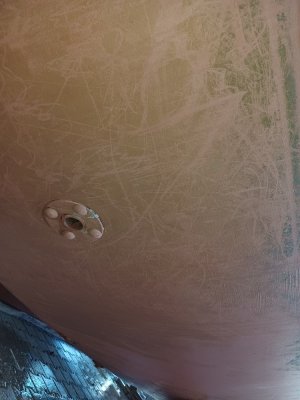
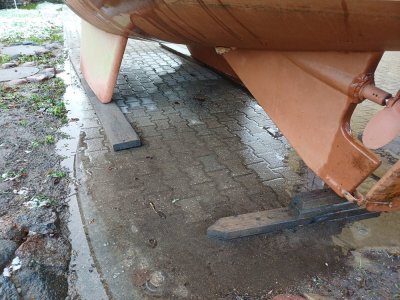
After haul-out, the yard gave musketeer a much-needed scrub. Definitely looking much better!

In the spring she will get a dose of Hempel Cruising, which should hopefully keep her clean for the season.

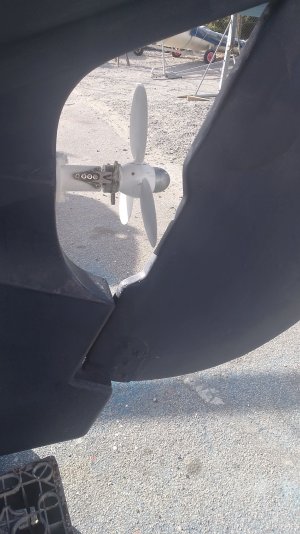
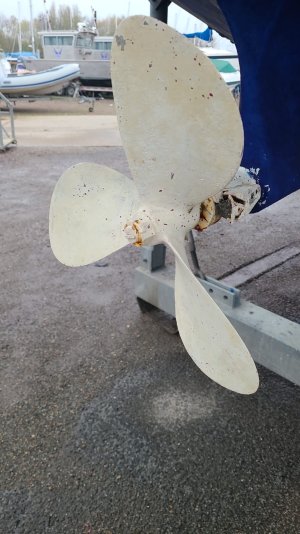
Question is - what should I do with the prop?

Obviously I need to take a wire-brush to the worm-casts. Should I clean it all back to the bronze (a look around the yard says quite a few do that - but maybe only mobos?). Or, what is the best AF to use? It was clearly a different colour the hull.
20251113_134443703.JPG
 
If you leave it "native" it needs to be spotlessly clean and polished to a mirror finish.
 
I posted on here about Crystal Prop, but no feedback good or bad yet. Haven't tried it.

Also I have a 'Marlin Yacht Paints Velox Sil kit'. Didn't use this as I think you need to strip back to metal and I couldn't face it.

Instead used Hempel Prop Primer and A/F. Four coats of each. Splashed around May and prop came out a disappointing mess of growth end Oct, swinging mooring Southampton Water.

Will try the Sil kit next. Did actually end up totally stripping to apply the Hempel and it wasn't too bad with Nitromors (must have forgotten I had the Sil I could have used). Be interesting to see if there's any feedback on the Sil system...
 
If you leave it "native" it needs to be spotlessly clean and polished to a mirror finish.
...and probably on a high speed motorboat and used regularly. I have tried this on a typical regularly used sailing yacht and it was a major fail. Then I tried coating with lanolin, even worse, actually fouled even faster.

Ready for next year I have a newly fitted (not quite mirror finish) shiny new prop. I'm going to lightly wet and dry abrade it, give it a coat of high-zinc primer, then 2 thin coats of Seajet 33 AF. This is the regime that has worked best for me over the last 16+ years since I gave up on polishing/lanolin etc. A polished prop just might give 5% more speed when clean, but my experience is that that really doesn't last. When both engine and original prop were new, I could get 8.3 knots at full throttle when newly launched, with a very clean smooth hull.

Last spring with 18 years of eroding AF on the hull, very lightly sanded wet every year but now far from super smooth, and a primed and AF-ed prop, launch gave 7.9 at full throttle. Shortly befor the bent/cracked blade prop damage, in August after 5 months afloat in a high fouling area, I could get 7.7 knots.

I'm sure fancy "prop AFs" work, but so does what I'm doing at much less cost. And the new prop is not because of dezincification: it's one cracked blade root damage from someone clouting something hard - not me!
 
Last edited:
General, over the years, I've found it very hard to get a satisfactory antifouling paint for a prop'
My current statergy is to polish the prop' to an almost mirror finish. It's not that hard to do. I use an electric drill with a right angle drive. A bit like an angle grinder but not a harsh. I use a flexible backing pad and thick soft foam interface, with a mesh sanding disks. I run the disk quite slowly so the the mesh disk can conform to the contours of the prop'
Start with a fine 'ish grade, say P200. You can always switch something course if your not making progress. But the last thing you want to do is scratch the prop'. Work to finer grades, P800 or finer.
Finish with Autosol, I do it by hand but a lambs wool buff works well.
I find that last for my 6 month season.
It's useless for longer than that.
In the past I've used Hammerite special metal primer hard racing AF with some success, but its never been perfect.
 
Our expectations are too high for the available technology. We can antifoul the hull using a variety of AFs and if you pay decent money for the AF and apply liberally you can achieve an AF effective life of 12 months. Our anodes last 12 months so we expect, or hope, a 12 month life from the prop treatment.

These are exceptions but if you just read this thread a life of prop AF is about 6 months. But you need to use the prop, ie the yacht regularly. Leave the yacht idle for a month or 2 and you are at the top of a very slippery slope.

2 AFs, and variants, seem to work for (6 months), silicones or Velox. You need to follow the application instructions meticulously - don't think you know best - do what the instructions say, and/or for Velox - follow Vyv's instructions, see earlier post. After 6 months you either lift, remove prop, re-coat properly or have a fouled prop. For many who only use their yacht for a bit more than 6 months - a 6 month life is actually acceptable, yacht in the Med, only used in the summer, or yacht on the hard over winter. If you leave the yacht in the water you might not find the weather suitable to use the yacht - Dec through to early March - your prop will foul when the boat is left idle.

All AFs work in whole or in part on movement of water against the AF.

Beware of stories of an AF life for a prop of 12 months - this might include 6 months on the hard.

Silicone coatings, like Prop Speed, are very delicate and are easily damaged. Hit something hard in the water, bit of wood, part of seaweed frond - damaged Prop Speed simply offers a point for the fouling to attach and Prop Speed is difficult to repair.


I had wondered about making a receptacle for the prop, a sort of semi sealed bucket or a big easily removed bag, adding American bleach and having the prop in bleached water - too much of a hassle, the idea did not run (but maybe someone else can devise something). My idea was a bag, flexible bucket you pulled tight to the hull, with drawstring that you fitted round both prop and saildrive, pour bleach down a pipe into bag, remove bag when you want to use yacht. My idea is hardly original, you can buy boat sized bags, they are commonly attached to a swing mooring. You house your yacht in the bag, the entry is tied off (and sort of semi sealed) and you add bleach. Good for Etchells, Flying 15s. May need authorisation to deploy.

Jonathan.
 
Last edited:
Echo Vyv's suggestion in post#2. Really not difficult to get the prop back to clean metal, particularly if you remove it and do it on the bench. Velox does work, both in adhesion and antifoul properties. I have used it with success on both bronze blades on a saildrive Flexofold and just done my Featherstream with bronze body and stainless blades. Did it without removing the prop. Couple of hours removing the old PropODev and cleaning/abrading. 3 coats of Hammerite and 3 coats of Velox.
 

Attachments

  • IMG_20250715_180159.jpg
    IMG_20250715_180159.jpg
    565.4 KB · Views: 15
I put new blades on this year without a coating and the whole prop/shaft/rope cutter was like a forest come October. I will not be leaving it bare again.
 
I've never put anything on my prop or shaft. I find that the shaft can actually have the worst fouling.
Do any of these paint systems last more than a season? We live aboard and only haul out every few years. We clean the hull ourselves in the water.

One thing about not using AF on the prop/shaft is that it serves as a reminder that AF, for all our complaints, actually does work. You just have to look at the difference between the hull and the prop...
 
Echo Vyv's suggestion in post#2. Really not difficult to get the prop back to clean metal, particularly if you remove it and do it on the bench. Velox does work, both in adhesion and antifoul properties. I have used it with success on both bronze blades on a saildrive Flexofold and just done my Featherstream with bronze body and stainless blades. Did it without removing the prop. Couple of hours removing the old PropODev and cleaning/abrading. 3 coats of Hammerite and 3 coats of Velox.
Another vote for Velox. Need to be meticulous in preparing and priming.
 
a coat of high-zinc primer, then 2 thin coats of Seajet 33 AF. This is the regime that has worked best for me over the last 16+ years since
Same here, Shogun 033 for both hull and propeller.
It worked very well until a few years ago (I could not lift out during Covid and after two years everything was still decent), I think they must have changed the composition as from 2022/23 on the results have definitely been worse.
 
The white stuff looks like evil nasty Coral Worm to me which is not 'normal' fouling IMHO. Coral Worm is one of the few things that is actually deterred by modern AF.

That may be a factor in the OP's decision.
 
My prop was taken back to bare then a couple of coats of epoxy then trilux but that soon disappeared. Thinking of a few coats of coppercoat I think I had some left in the shed. Certainly got the copper dust maybe mix that with fresh epoxy. But that might be to hard.
 
My prop was taken back to bare then a couple of coats of epoxy then trilux but that soon disappeared. Thinking of a few coats of coppercoat I think I had some left in the shed. Certainly got the copper dust maybe mix that with fresh epoxy. But that might be to hard.
Coppercoat will not adhere to brass/bronze. It needs a primer that should be etching, satisfying the requirement for solvent free. I believe that Hammerite SMP would work well although I have not tried it.
 
Coppercoat will not adhere to brass/bronze. It needs a primer that should be etching, satisfying the requirement for solvent free. I believe that Hammerite SMP would work well although I have not tried it.
Not tried it on a prop, but I’ve had good results with SMP in other marine applications. Well worth a go, I’d say.
 
Not tried it on a prop, but I’ve had good results with SMP in other marine applications. Well worth a go, I’d say.
Yes, I have used it in many applications but not beneath Copper coat. I advised recently that I thought it would be good, being water based. Epoxies don't go well over alkyds, although Coppercoat advised in that case that waiting three weeks for all the solvent to evaporate should be OK.
 
Gonna make some of you envious now ....

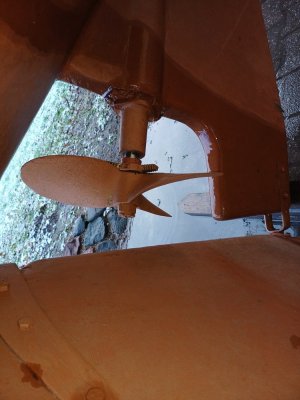
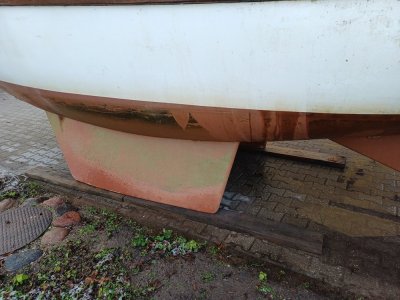
Just lifted my 25ft'r and she sat for most of the time unused ... which is usually death to props and AF ... but Wey Hey ... look at this ... and I have not pressure washed or doner anything at all ... this is straight from water :

SA propb.jpgSA propb.jpgSA propb.jpg

hull 3b.jpghull 3b.jpg

hull 4b.jpg

underhull 1b.jpg

underhull 2b.jpg

The AF is not available over counter before you ask ... no good PM'g me either ...

My point in showing is to illustrate how the rules on AF have made what you get over the counter = 'rubbish' .....
 
Top