
Ships' anchors

The windlass will hold the chain once the anchor is set-----a bit like putting your auto gearbox in "park" but the brake is used to stop too much chain running out while anchoring. One potential problem is overheating and brake fade which can result in the entire chain running out. If there is too much energy built up it can pull our the stopping bar in the chain locker and you lose it.

The Ships windlass has a dog clutch that is only used when retrieving or walking out the anchor. It is never left engaged when anchored. Therefore the windlass never holds the chain for anchoring. The brake performs that function.

Incident Irish Sea - gale force conditions on a 20,000 ton tanker, ST Partula, in ballast ...
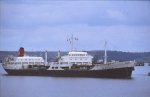
ST Partula.jpg

I was 3rd Officer and sent forward with Bosun and AB to anchor ... (I did question the Master if such an act was suitable in the conditions - but was instructed to do it ...) The pilot service into Mersey was suspended due weather ... usual practice was to steam / drift near Isle Of Man but this Master was new and TBH - a complete blithering fool ..
I was told to 'let go' the anchor to 6 in the water ... a rather daft order - but I complied. This means the act of walking out under power of windlass to the waterline and then brake on. Unclutch the windlass and then on order of Bridge to release brake and let her 'run out'. Normally this is no problem and chain will often stop running after short length out ... ship moves and pulls next length out ... When you get to desired schackle ... you set in water or on deck as ordered. Screw up brake and wait for chain to show she's brought up and steady. Deadman on ... check brake is secured and that's it.
But this time as feared - ship was under influence of gale force winds and that chain flew out the locker throwing s**t and rust everywhere, no way could brake be used to hold it - in fact flames were coming of the gypsy. Master failed to hold vessel on engines ...
What to do ? You have to think quick because 11 shackles soon gets out !! I shouted at Bosun to let her run as free as possible but as soon as chain slacked to get that brake on as hard as possible. We managed to stop the chain just before bitter end ... which would have meant chain locker damage. The gypsy was hot even with the rain and wind ... it was winter ...
I called via Walkie Talkie to bridge advising that chain was finally under control - but we had at least ten and half shackles out ... to be shouted at and ordered to heave back to 6.

Imagine this ... me - young guy nearly killed by this along with Bosun and AB in blinding rain and wind ... middle of the night ... freezing cold ...

We eventually got back to 6 in water ... and all secure. I reported to bridge that I was afraid the anchor was not holding - to be told we were to stand down and I was to report to bridge.
I went up to the bridge to be shouted at and reprimanded for 'my' nearly losing anchor and chain ....... Everyone else on the bridge were dumbfounded ... even the 2nd Officer tried to tell Master that in fact I saved the anchor and chain from breaking out.
Needless to say within less than an hour - I was in my cabin trying to get to terms with it ... when I felt the unmistakable vibration of ships engines and her moving. She had dragged so bad - there was no way to arrest her and she had to apply half ahead to even get anchor up ...
 
Last edited:
Incident Irish Sea - gale force conditions on a 20,000 ton tanker, ST Partula, in ballast ...


It is nice to hear what happens on big ships. From a distance they look sedate and serene. Somehow it’s reassuring that they face the same problems as we do, and also make bad decisions from time to time, once again just like we do.

I am currently at anchor watching the wind slowly rise, but if we did drag and need to raise and re-drop anchor my impression from your post is that the process would actually be easier and less dangerous than on a large ship despite the lack of trained professional crew and heavy duty commercial equipment. Surprising, but once again it is somehow comforting to know, so thanks for sharing.
 
It is nice to hear what happens on big ships. From a distance they look sedate and serene. Somehow it’s reassuring that they face the same problems as we do, and also make bad decisions from time to time, once again just like we do.

I am currently at anchor watching the wind slowly rise, but if we did drag and need to raise and re-drop anchor my impression from your post is that the process would actually be easier and less dangerous than on a large ship despite the lack of trained professional crew and heavy duty commercial equipment. Surprising, but once again it is somehow comforting to know, so thanks for sharing.

It was only one of a number of incidents involving myself with that Master ... a contract that I would have preferred to avoid.

Ardrossan ... cargo of Fuel Oil to the Cargo Ship berth... same vessel Partula. As you can see from the photo above - she was of old school with a flared upper bow bulwarks. Built in 1950's ...

We are approaching the dock and I'm up on focsle with fwd mooring crew ... I have Walkie Talkie in hand and standing on the small veiwing step looking over bow - reporting the approx distance as we approach ... 200yds ... 150yds ... 100yds ...
Ships not slowing ... I call to bridge advising that we are closing a bit 'quick' ... I'm told to do my job and report how far off with regard to the crane ...

Honest - my reply was >>>>>

"TOO F******** LATE PAL ..."

As the flared bow hit the gantry crane forcing it to lean against its rail stops ... with shore gang running like f*** for cover ....

One shore guy stops and shouts back - last f****** tanker than came in here did the same !!

So I shouted back - So why didn't you move it then ????

I of course got mauled out by Master again ...

I had approx 3 months with that Master and after I left the vessel for vacation - I received Letter ordering me to attend DTI Marine Court to answer for Conduct on Partula. This is a serious matter and usually means loss of Certificates. I asked my Father who was a very senior Official in the DTI Civil Aviation part for advice. He just said - tell the truth.
I attended and was found Not Guilty but advised that my Conduct thereafter would be watched. Its the least they can do as they must justify having the case - in effect it exonerated me. The Master involved was held to account for his general running and mismanagement of the vessel. He kept his Position but was never given a 'prime vessel' in the fleet. My next vessels in the fleet were all prime vessels .... but my promotion was stifled till I left that Company and went Foreign Flag where I received promotions in short time.
 
This video shows how the anchor is 'walked out' - and how it can so easily go terribly beserk very quickly.


Just to be correct ... that is not WALKING out the anchor ... that is LETTING GO the anchor ... the only control you have there is the brake.

Anchors are generally not WALKED OUT - unless in deep water. In shallow or typical anchorage areas - anchors are LET GO under their own weight. The anchor is lowered to waterline and then readied on brake.

Its a serious juggling match and is why only usually a good AB or OS in on the brake with Bosun ... to judge brake use.

If the guy uses too much brake - we can see the guy winding that brake on / off a lot ... then a lot of weight comes on .. the brake often binds when you release ... the weight then drags out the chain at a faster rate and its easy to lose control as they did. Often when chain doesn't run - foscle will advise bridge and a short burst of astern engine given .. you can then easily imagine a combo of engine astern - brake binding ... and suddenly that chain flies.

If you go back to my Irish Sea incident ... and maybe if the Officer had made decision to let run the chain as I did till slack - they may have been able to stop it. But they kept trying to stop it resulting in flames and brake failing to hold.
Watch carefully the last link go out - that's the bitter end ripped out of chain locker.
 
The sheer weight of a ships anchor means they penetrate well, however that does not scale down well for small anchors on yachts which is why a heavy 45lb anchor used to be the advised anchor for quite small craft. Modern yacht anchors are therefore designed to cut into the seabed in order to limit their size and are much more complex in design than ships anchors. More modern anchors similar to the Bruce were devised to hold oil rigs in place as clearly unlike cruise ships or tankers dragging, moving and setting is not appropriate.

Clearly on big ships their longer scope helps, but on a yacht like mine 50m chain is pretty well the max I can manage and that limits me to 5:1 when in 10m at high tide so I need an anchor that works at 5:1 or even 3:1.

Storing a giant Rocna on a cruise ship would be an issue, so they just stick with simpler solutions
 
The factor of weight and digging in has been a matter I have bleated on about in past .... too many people make mistake of thinking small anchor for small boat. The Sales people will sell you what ever and love you to the bank. But it doesn't work that way.

Regardless of design - weight is still a very important factor in an anchors armoury. We all read about 'Flying anchors ... Plastic jobs ... Alloy jobs .... ' all relying on dragging and cutting in to work. Trouble is once they start to drag - you are ****** !
A regaulr anchor on the other hand although setting it is still using the fact of it dragging to cut in - the weight also works to make sure it gets set. Once you start dragging - you can often cure that by adding scope to the rode ... anchor bites and your set again.
 
Ships seem to lose anchors quite regularly. There are a number of anchorages off the Belgian coast, notably at the Westhinder, which do not offer any shelter. Notices to Mariners regularly mention ‘anchor lost in position dye’
 
The Ships windlass has a dog clutch that is only used when retrieving or walking out the anchor. It is never left engaged when anchored. Therefore the windlass never holds the chain for anchoring. The brake performs that function.

Incident Irish Sea - gale force conditions on a 20,000 ton tanker, ST Partula, in ballast ...

View attachment 83549

I was 3rd Officer and sent forward with Bosun and AB to anchor ... (I did question the Master if such an act was suitable in the conditions - but was instructed to do it ...) The pilot service into Mersey was suspended due weather ... usual practice was to steam / drift near Isle Of Man but this Master was new and TBH - a complete blithering fool ..
I was told to 'let go' the anchor to 6 in the water ... a rather daft order - but I complied. This means the act of walking out under power of windlass to the waterline and then brake on. Unclutch the windlass and then on order of Bridge to release brake and let her 'run out'. Normally this is no problem and chain will often stop running after short length out ... ship moves and pulls next length out ... When you get to desired schackle ... you set in water or on deck as ordered. Screw up brake and wait for chain to show she's brought up and steady. Deadman on ... check brake is secured and that's it.
But this time as feared - ship was under influence of gale force winds and that chain flew out the locker throwing s**t and rust everywhere, no way could brake be used to hold it - in fact flames were coming of the gypsy. Master failed to hold vessel on engines ...
What to do ? You have to think quick because 11 shackles soon gets out !! I shouted at Bosun to let her run as free as possible but as soon as chain slacked to get that brake on as hard as possible. We managed to stop the chain just before bitter end ... which would have meant chain locker damage. The gypsy was hot even with the rain and wind ... it was winter ...
I called via Walkie Talkie to bridge advising that chain was finally under control - but we had at least ten and half shackles out ... to be shouted at and ordered to heave back to 6.

Imagine this ... me - young guy nearly killed by this along with Bosun and AB in blinding rain and wind ... middle of the night ... freezing cold ...

We eventually got back to 6 in water ... and all secure. I reported to bridge that I was afraid the anchor was not holding - to be told we were to stand down and I was to report to bridge.
I went up to the bridge to be shouted at and reprimanded for 'my' nearly losing anchor and chain ....... Everyone else on the bridge were dumbfounded ... even the 2nd Officer tried to tell Master that in fact I saved the anchor and chain from breaking out.
Needless to say within less than an hour - I was in my cabin trying to get to terms with it ... when I felt the unmistakable vibration of ships engines and her moving. She had dragged so bad - there was no way to arrest her and she had to apply half ahead to even get anchor up ...

You guys at Shell managed to squeeze 20 000 T into that wee three island thing? :)
Back in the dark ages of open loading, sand bags, gauze, ulage tapes, sticks, a heliograph and your ear on the valve spindle.

Done the same in the German-bight. Off the Elbe. Anchoring in near gale. Several times.
Our S.O.P. Walk the anchor out to the water. Out of gear on the Brake. Which was kind of worn, but the old 69 shuttle. was up for sale and due for scrap, could meet the New IG requirement. No parts supplied.

In position, let go when told. Control the drop with the brake,
On the bottom,
Dropping back to the desired six or seven in the water.
Screw up the brake as hard as we could with a capstan bar
Bugger off.
Hope it held, when it got to the end.
It always did.:)
I used to use the “Dead Man” to lead lines from the fair lead to the drum end.
And The ”Guiloteen” on the cable. :)

I had to draw a picture with labels for the whole kit an kaboodle for the correspondence course. It was forty years ago though. So I could be wrong.

I remember when being examined for my EDH the instructor telling us to be sure.
When the examiner asked us to explain “how you would anchor your last ship”?
Just Give him the answer out of “Danton’s “

One lad from Shell didn’t or wouldn’t, quite understand the point. He insisted in telling the D.O.T examiner, Shells SOP for anchoring a VLCC.

He was the only one who failed. Even though his procedure was identical to the the BP SOP. :)
 
Last edited:
Do ships' anchors work in the exact same as cruiser anchors? I ask, out of pure curiosity, because proportionately they seem much smaller to boat size than what cruisers use.

If you asked me.
Yes the theory is pretty much the same.
Of course. On the inter web the theory for cruiser yacht has changed. Now you need a new age anchor and a snubber or you will die a horrible death.:)

Old theory for ships.
The Anchor doesn’t hold the ship.
The Anchor holds the end of the cable in place and the weight of the cable and the catenary holds the ship..

Once upon a time, and occasionally even on some small ships today.
The anchor, was stowed on deck, hoisted over the side or raised back on board with a small davit block and tackle.
I’m not sure when exactly but by around the turn of the last century. Battleships and the required anchors and cables were just to big for this practice.
So the Admiralty pattern stockless anchor was developed and came into use. Along with the powered capstan, winch, windlass, gypsy and self stowing cable. advantage of being self stowing far outweighed the loss of holding. Solved by just using bigger anchors.

The procedure for picking an anchorage is much the same. With obvious limitations, small sheltered anchorages out of the running. Yet many harbours became harbours because of thier sheltered locations and good holding ground for anchorages.
Today the sheer size means many of today’s ships have out grown even the largest sheltered harbours and anchor in relatively open anchorage’s.

Most ships will keep a deck watch on duty at all times, on the bridge while underway and at anchor. The concerns the same.

Specialist vessels may have different priorities and use more modern anchors. Wire instead of cable, or other systems instead such as dynamic positioning.
But anchors are still required.
Some like the local ferry I ride regularly. Have a tiny wee anchor on a wire reel with a davit. Or the brand new bigger one with LNG fuel systems, Sholttle drives at both ends. Has a self stowing anchor on a wire drum. The only time it was ever used, it got caught on the shottle drive system and buggered it.
It’s a ferry it won’t anchor unless it breaks down anyway.

Do they hold.?

Yes well enough for most situations. I can only think of a couple of occasions wen I dragged a properly deployed anchor.
Weather was extreme. Location poor.

If you wonder?
Check the Viking cruise ship, last winter in Norway. One might wonder WTF they were out there at the time or WTF they were running on below OEM requirements for lube oil.

But the Anchors held the ship off the rocks. Or As per the theory the Anchors held the cable in place and the cables held the ship off the rocks with the catenary taking the shock loads from the storm and 7m sea trying to drive her ashore. G only knows how they would have got people off it they had failed to hold.

I guess it proved the old theory still has some worth.
 
The snatch is a function of the square of speed and mass. Big ships are not going to accelerate, much, so the snatch is going to be very much a function of the mass - which is not going to vary much (at anchor).

I imagine there is a safety factor incorporated into the choice of anchor - accepting that the anchor is there as a 'lunch pick' not the ultimate refuge - so there s wriggle room - and the chain lock is designed, or rated, as such. I suspect failure occurs when the concept of the lunch pick is forgotten in favour off the bastion of last resort.

Jonathan
 
"Uricanejack" .....

Yes sorry ... Guillotine is the block that drops over the cable ... Deadman of course is the roller to change direction of mooring lines.

Danton !! You must have been a Plymouth Cadet ... (my brother nicked my copy of Danton's ... )

My worst memory of Plymouth was Capt Braid ... chief examiner DTI.

Memories flooding back now ... Signals : Chiefy Tozer ... Admin : Capt McKelvie .... Capt Nelson ....
 
"Uricanejack" .....

Yes sorry ... Guillotine is the block that drops over the cable ... Deadman of course is the roller to change direction of mooring lines.

Danton !! You must have been a Plymouth Cadet ... (my brother nicked my copy of Danton's ... )

My worst memory of Plymouth was Capt Braid ... chief examiner DTI.

Memories flooding back now ... Signals : Chiefy Tozer ... Admin : Capt McKelvie .... Capt Nelson ....
Snap:)
 
The factor of weight and digging in has been a matter I have bleated on about in past .... too many people make mistake of thinking small anchor for small boat. The Sales people will sell you what ever and love you to the bank. But it doesn't work that way.

Regardless of design - weight is still a very important factor in an anchors armoury.
I don't remember the exact figures but I could buy, say, a 50kg Delta for roughly the price of a 25kg Rocna. So which is better? It's more weight on the bow, but purely in terms of performance which would be better?
 
I don't remember the exact figures but I could buy, say, a 50kg Delta for roughly the price of a 25kg Rocna. So which is better? It's more weight on the bow, but purely in terms of performance which would be better?

If you asked 10 people - you would probably get a 25 - 25 - 25 - 25 split ... 25% for the Delta ... 25% for the Rocna ... 25% for some other bit of kit and 25% talking total rubbish ! ;)
 
If you asked 10 people - you would probably get a 25 - 25 - 25 - 25 split ... 25% for the Delta ... 25% for the Rocna ... 25% for some other bit of kit and 25% talking total rubbish ! ;)

Yes but... When people or magazines are comparing anchors they are generally in the same weight bracket, but what if you based it on what you could buy at a certain price point. Is a MUCH heavier Delta better, worse or the same as a smaller new wave anchor. What factor to apply to weight versus shape?
 
I don't remember the exact figures but I could buy, say, a 50kg Delta for roughly the price of a 25kg Rocna. So which is better? It's more weight on the bow, but purely in terms of performance which would be better?
I changed from a 15kg Delta to a 15 kg Rocna. In many respects I would say there is little difference between them . Where the Delta let me down was in a soft mud seabed and very strong wind. I would expect the Rocna to hold in such conditions.

I would think that doubling the weight of the Delta, or more probably increasing its area by a good deal, would improve its holding considerably, maybe to be as good as that of the smaller Rocna.
 
Top