She's Arrived

jcwads

Well-Known Member
Joined
20 Jun 2016
Messages
673
Location
Antibes
Visit site
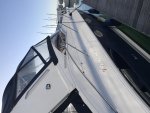
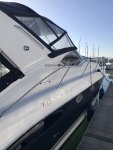
Picked up the new boat yesterday. Couldn't have had a better day for it! F1 and blazing sun. Nice and warm in the cockpit with the covers up.

Really chuffed with the boat. Can't believe how the twin screws handle but I do need loads of practice. That Hamble tide is a nightmare and even the T40 likes to push around with it... Berthing it stern to whilst trying to get the sticks right and not automatically thinking I was in my single screw boat was a challenge... If anyone is down that way on Saturday and fancies a play around whilst giving me some tips just say so!

Attached a couple of pics.

Now down to all the works that are needed. The list is massively long, but I will be starting this week with a deep clean all round.

One thing that is apparent - the cockpit drivers seat is wobbling all over the place.. Not sure if the bearings are shot? Anyone had experience of this or adjusting it?

Also the steering seems less responsive than it should, so could be a power steering problem?

I am sure this is the start of 20,000 questions so apologies in advance and thanks to all on here for help and advice so far!
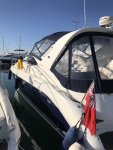
Boat 1.jpg

Boat 2.jpg
 

Attachments

  • IMG_0041.jpg
    IMG_0041.jpg
    489.9 KB · Views: 1
Good choice of boat - i am of course biased!

Get an hour of instruction and you will be fine.

Remember if you turn the wheel you have a stern thruster ( well 2) so compensating for tide etc is quite possible with bursts on the bow thruster.

Seat will remove and you can look at the rails. The set up is pretty crude!

Steering -- try topping up first - undo the bolt on top of wheel. Pour in fluid and turn wheel. Stop when it over flows. A rag on the floor will save the teak.
 
Could be an issue with steering , remember I pointed out the steering fluid leak info on top of the starboard engine .
Don't top up at the wheel without disconnecting the bleed pipe first from the reservoir
 
Could be an issue with steering , remember I pointed out the steering fluid leak info on top of the starboard engine .
Don't top up at the wheel without disconnecting the bleed pipe first from the reservoir

I looked yesterday and couldnt see any more fluid. But will take an extensive look at the weekend.

So just to make sure I do this right - remove bleed pipe (assume I need something to collect any fluid?) and then put some fluid in the steering wheel, and turning it full lock port and starboard to get rid of any air?

Cheers
 
With the steering, do you mean it is heavy, notchy, or different? Twin screws can take a little adjusting too, so it may be OK, but you are not yet used to it? Is there someone nearby with a similar boat or set-up? We are at Deacons, so will also wave (if we see you) when we go by.
 
I looked yesterday and couldnt see any more fluid. But will take an extensive look at the weekend.

So just to make sure I do this right - remove bleed pipe (assume I need something to collect any fluid?) and then put some fluid in the steering wheel, and turning it full lock port and starboard to get rid of any air?

Cheers

Just a rag under it , pipe has a non return valve in end , top up without engine running.
Call me Sunday if your struggling can't talk Saturday as I'm throwing the Escort around in the Forest of Dean
 
Remember that at slow speeds, the rudders can mostly be ignored. (I often teach beginners at twin screw handling to put the rudders dead ahead and put one hand in your pocket.) Steering is done 100% through the engines. One stick at a time and you might do well to remember that one hand on each stick can be a recipe for disaster. At slow speeds, its often just a nudge of the gear and back into neutral.

Two tips.

Go as fast as you want to hit something...

or

As fast as you have to, as slow as you can. (In other words the slower the better, so long as you maintain control over wind and tide.)

Enjoy your new boat!

If I had time and hadn't just gone back to full time work, I would offer you an hour or two's instruction but there are plenty of other Instructors and Examiners like me about if you are interested.
 
Congratulations.

Re getting the hang of it.

Go where you have good space to maneuver and not on a windy day or with a fast flow or tide.

Set the rudder(s) amidships.

Then using the engines go through these manouvers:
- one engine ahead (not too fast) other in neutral. See what happens and how boat reacts, repeat with other engine.
- one engine astern (not too fast) other in neutral. See what happens and how boat reacts, repeat with other engine.
- both engines astern (not too fast). See what happens and how boat reacts, repeat with other engine.
- both engines ahead (not too fast). See what happens and how boat reacts to confirm she goes dead ahead.
Thy these giving the throttle(s) a little 'burst' to learn what happens.

Then with the rudder(s) half to port repeat the above.
Then with the rudder(s) half to starboard repeat the above.

Then with the rudder(s) full to port repeat the above.
Then with the rudder(s) fullfull to starboard repeat the above.

These will also demonstrate the paddle effect on the boat.

Good to have a rubber dinghy anchored on a short rode (bow and stern) to show up your maneuvers more clearly. IE doesn't result in damage if you hit the dinghy.

The do it a couple times more so it will become second nature when you are operating it (esp crowded conditions).

Last item - enjoy it. :encouragement:
 
Rudders???
Can someone show me where these are on a Targa 40???

It’s true that with twin outdrives in reverse, you might as well leave the steering centred, unless you particularly want to be crabbing backwards at some strange angle. Just use one engine or the other to get lined up, then short bursts of both to get in, with a little bit of thruster if needed to keep things pointing the right way.

Going forwards, you need to crank the wheel over and use the “outside” engine to help you around a tight turn.
A bit of reverse on the “inside” engine makes the turn tighter.
Again, if the thruster is going to help lower your stress levels, then use it. It’s fitted to large outdrive boats for a reason. But a thruster won’t push the bow into a Force 6 coming from the side - there are limits.

The thruster is particularly useful if you are in a very narrow fairway, and you need to push the bow around without the stern kicking out the other way, which is very hard to do using just engines.

Hope this makes some sort of sense.

.
 
Last edited:
Rudders???
Can someone show me where these are on a Targa 40???

It’s true that with twin outdrives in reverse, you might as well leave the steering centred, unless you particularly want to be crabbing backwards at some strange angle. Just use one engine or the other to get lined up, then short bursts of both to get in, with a little bit of thruster if needed to keep things pointing the right way.

Going forwards, you need to crank the wheel over and use the “outside” engine to help you around a tight turn.
A bit of reverse on the “inside” engine makes the turn tighter.
Again, if the thruster is going to help lower your stress levels, then use it. It’s fitted to large outdrive boats for a reason. But a thruster won’t push the bow into a Force 6 coming from the side - there are limits.

The thruster is particularly useful if you are in a very narrow fairway, and you need to push the bow around without the stern kicking out the other way, which is very hard to do using just engines.

Hope this makes some sort of sense.

.

My bad, I forgot to check what propulsion was fitted. (Which is a bit embarrassing as I've driven a Targa 40...! Problem with driving too many boats; you forget which ones got what.)

I had obviously assumed it had conventional shafts with rudders.

Different technique with stern drives and in some ways even easier once you get the hang of things.
 
Rudders???
Can someone show me where these are on a Targa 40???

It’s true that with twin outdrives in reverse, you might as well leave the steering centred, unless you particularly want to be crabbing backwards at some strange angle. Just use one engine or the other to get lined up, then short bursts of both to get in, with a little bit of thruster if needed to keep things pointing the right way.

Going forwards, you need to crank the wheel over and use the “outside” engine to help you around a tight turn.
A bit of reverse on the “inside” engine makes the turn tighter.
Again, if the thruster is going to help lower your stress levels, then use it. It’s fitted to large outdrive boats for a reason. But a thruster won’t push the bow into a Force 6 coming from the side - there are limits.

The thruster is particularly useful if you are in a very narrow fairway, and you need to push the bow around without the stern kicking out the other way, which is very hard to do using just engines.

Hope this makes some sort of sense.

.

Thanks for all tips. I plan on just getting out and practicing everything. Just getting use to the twin sticks, and using them in the right situation. Hopefully I will be a pro in no time :cool:
 
Congratulations on the new boat.

I am not sure what it will be like in your marina, but in ours I can see the hard filling up with boats that have been craned out for the winter. If its the same in yours, that may give you access to a few empty double berths to practice berthing on both sides.

Hope you have many years of enjoyment with her.
 
Top