
Seacock Connection Broken - Pink - Dezinkification

CaptainBob

Well-Known Member
Joined
7 Nov 2007
Messages
1,477
Location
North Yorkshire
www.yacht-forum.co.uk
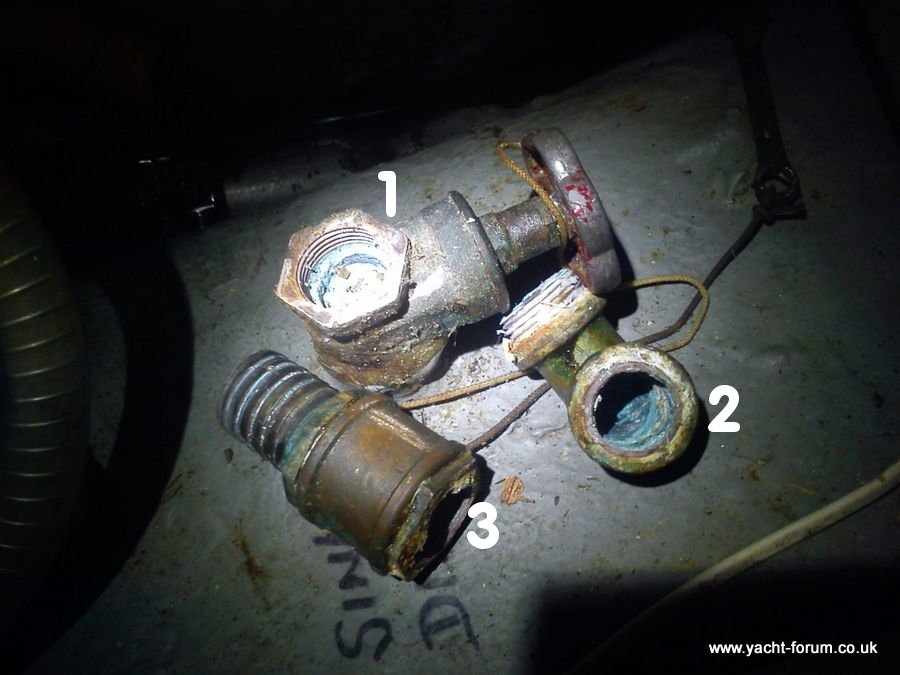
One of my seacocks is pictured below. A bit of weight on the elbow caused it to break off.

In the picture it was connected 1 -> 2 -> 3 with the broken part snapped off part 3, with its threads remaining screwed into section 2.

Part 3 is actually in two parts - it looks like it's an adaptor to take the hose attachment down to the correct thread size... and I _think_ it's a different metal to the other parts.

When I scratch at the metal of all parts, inside and outside, it all looks lovely and yellow except for:

Part 3 and it's snapped off bit, in the vicinity of the break, which looks like copper pink and shiny when I get through the top surface.

_Some_ of the threads (female) in Part 1 (the skin fitting/seacock), but not the metal deeper inside, and not the seacock 'door' etc etc.

All investigation of the skin fittings on the outside shows nice shiny yellow metal.

Here's the picture:
seacock.jpg


So what to do? Each of the seacocks on the boat is different, no two are alike. Some are more substantial and silver in colour.

Boat is a 1978 Nauticat 38. Perhaps the skin fittings are original, they mostly look glassed in place, so I assume at least those ones are.

Do you think I need to replace the lot? Or just the broken one? Or just the broken part of the broken one?

Is the dezincification which I assume is what has happened likely down to a bad choice of part (two different metals), or poor connections to the anode (which is present and does look wasted) or just time?

Thank you!! Sorry for the essay!
 
Replace the whole lot. That is a gate valve which should never be anywhere near a boat. If the skin fitting is still sound, then use a DZR Ball Valve with a bronze tail and a 90 degree adaptor if you need it. Most decent chandlers stock them or you can get from ASAP on line. Make sure you order DZR for the valve. The fittings will be either DZR or bronze.
 
If you find any part where the pink colouration is more than just a surface effect then that part is suffering from dezincification

Examine everything critically and replace anything suspect with bronze/gunmetal or DZR brass preferably bronze or gunmetal ( gunmetal is a bronze)


Vyv Cox will be along shortly.
 
TFT(Quick)R!

So I could potentially just unscrew that seacock from the skin fitting and replace every above it, if it looks like the skin fitting is still OK? It looks like the seacock is glassed in place, so has been there for 33 years or so. If I cut the glass back to reveal the join, I'd no doubt have to apply a heck of a lot of welly to get the thing to unscrew. I'd be worried I'd twist the skin fitting relative to the hull.

And Tranona, do you mean replace ALL of my seacocks, or just the ones that look dodgy. Hard to know if they look dodgy without some quite destructive work I think.
 
Don't know about the others. Doubt that particuler one is an original fitting, but you should check the rest.

You should be able to unscrew the valve from the skin fitting without damaging it. I expect there is a lock nut on the skin fitting and then the whole lot glassed over.
 
Brilliant, thank you.

Any tips on what exactly to look for? Looking at the damaged part closely, if I scratch the outside it looks absolutely fine, so even if I took the others apart, I might simply not scratch in the right place to locate where it has dezinc'ed.

Do surface corrosion deposits (looks like white 'salts') (which are present on this one and one other in the boat) indicate that something untoward is going on?
 
Not easy to tell externally. The salts are just that and not an indicator of corrosion. If the boat is out of the water, then clean up all the fittings and pull at the tails. Failure is usually where you have found it - in the threads of poor quality (brass) tails, rather than the valves themselves. Gate valves like the one you have there are prone to corrosion of the spindle and they can seize more easily than the preferred balve valves. Not always possible to tell if the gate valve is operating fully, whereas a ball valve has a 90 degree lever so easy to tell if it is open or shut.
 
Just replaced virtually the same setup on our boat albeit with an old ball valve not a gate valve. As already mentioned, lose the gate valve as they are ****. The other parts have been assembled to provide a 90 degree bend that is full bore, ie not restricting water flow through the setup. Is it an engine cooling valve? You can get the bits to remake the setup you have from the chandlers, as long as they stock bronze or dzr. A 90 degree hose tail will cause water flow restriction as they are often not full bore. If the skin fitting is shiny yellow when scraped then it should be ok. The rest of the bits are for the skip. If you have any more gate valves, get rid as they are prone to seizing and you can't tell if they are open or shut.
 
The pink colour is caused when the zinc is lost from brass, or a brass based alloy like manganese bronze, Admiralty bronze, etc. what you are seeing in the pink bits is porous copper, which has very poor strength. So your first course of action might be to lean fairly heavily on every hose, close to the fitting, to see if they break off. Obviously if you are afloat you need to take precautions to ensure that incoming water does not sink the boat.

If you see any pinkness on external flange faces, and bearing in mind the age of them, I would change the lot. Those that resist your heavy leaning can wait a bit, others are obviously urgent.

You infer that there is a bonding circuit, with anodes, on your seacocks. This practice was common but is now not recommended as it is impossible to achieve the same potential at every seacock. One seacock will be corroding at the expense of another. Using bronze or DZR is sufficient protection: they will last indefinitely with no other protection.

answers to your questions. The cause is poor materials choice, probably not a bad combination although there could be galvanic effects there also. Anode should not be there and yes, it is a function of time. In your case a very long one, but it will occur eventually to all of them (assuming similar metallurgy).
 
Top