Sail ties

Wansworth

Well-Known Member
Joined
8 May 2003
Messages
39,528
Location
SPAIN,Galicia
Visit site
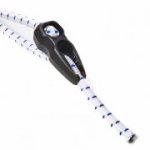
Should I buy traditional sail tie material and tie a reef knot or should I go for straps with clicks joiny ends;even yacht owners have difficult problems to solve

 
You use whatever you prefer, I use the traditional ones and a reef knot, but that’s really because it’s what I have always used rather than any technical preference.
 
Buy 3/4" or 1" webbing and put a small loop in one end. Personally I'd sew them (with a half-twist in the loop so it doesn't lie flat and hence stays open) because it looks neater, but an overhand knot with the doubled tape will work just as well.

Pass the tie round the sail, put the end through the hole, cinch up tight and tie a slipped half-hitch around the standing part.

I don't see any benefit to buckles - they don't provide the gathering-together that pulling the end through the loop does, unless you manually overhaul the tape through the open buckle first, and it always feels like there's a possibility of them popping apart if you pull too hard.

Pete
 
I think the sail ties from Jimmy Green already have the loop formed.

If they don't, then they're just odd lengths of webbing :)

When we've bought new sails, they've always come with ties with sewn loops (though we don't use them, having a stack-pack). I've never sailed on a boat that used anything else, though I'm aware they exist.

Pete
 
Buy 3/4" or 1" webbing and put a small loop in one end. Personally I'd sew them (with a half-twist in the loop so it doesn't lie flat and hence stays open) because it looks neater, but an overhand knot with the doubled tape will work just as well.

Pass the tie round the sail, put the end through the hole, cinch up tight and tie a slipped half-hitch around the standing part.

I don't see any benefit to buckles - they don't provide the gathering-together that pulling the end through the loop does, unless you manually overhaul the tape through the open buckle first, and it always feels like there's a possibility of them popping apart if you pull too hard.

Pete

+1 I bought some snazzy soft premade ones from West Marine USA offered in various lengths found lots of other uses for them too since I bulk purchased
 
Should I buy traditional sail tie material and tie a reef knot or should I go for straps with clicks joiny ends;even yacht owners have difficult problems to solve

When you want to use them in a hurry, you won't want fo faff about with clicky things. Sail ties can also be useful for 9other stuff besides sails, so stick to traditional ( 2 sizes, long & shorter).
 
Yup done that - nearly lost a eye ( cut the surface of the eye - just off centre ) in the days before plastic lense in glasses
 
found lots of other uses for them too since I bulk purchased

That's true - the only sail tie I have on board is actually used to secure the cruising-chute tack block to the anchor roller. It happened to be to hand when we first tried out the sail, and I haven't had any reason to replace it.

Pete
 
Buy? Go to a boat show and talk nicely to a sailmaker. They usually have loads to give away because so many people have stack-packs and don't use ties any more.
 
Buy 3/4" or 1" webbing and put a small loop in one end. Personally I'd sew them (with a half-twist in the loop so it doesn't lie flat and hence stays open) because it looks neater, but an overhand knot with the doubled tape will work just as well.

Pass the tie round the sail, put the end through the hole, cinch up tight and tie a slipped half-hitch around the standing part.

I don't see any benefit to buckles - they don't provide the gathering-together that pulling the end through the loop does, unless you manually overhaul the tape through the open buckle first, and it always feels like there's a possibility of them popping apart if you pull too hard.

Pete

+ 1
 
I believe that I am the last person left on earth to still use a single continuous line for tying down the mainsail. I tie the aft end from the cockpit when the sail comes down to stop it flopping past the lazyjacks and then continue the tie at my leisure. I have a simple technique involving a slip-knot at each node and have chosen a shiny line to enable this. I make no claims to this being any better than ties, but it's just what I have always done.
 
I believe that I am the last person left on earth to still use a single continuous line for tying down the mainsail. I tie the aft end from the cockpit when the sail comes down to stop it flopping past the lazyjacks and then continue the tie at my leisure. I have a simple technique involving a slip-knot at each node and have chosen a shiny line to enable this. I make no claims to this being any better than ties, but it's just what I have always done.

I'm sorry to burst your bubble, but I do this as well.
 
I use webbing with a loop in one end and secure with a slipped half hitch. I never use an ordinary half hitch since I tried to haul up the sail with a tie still on and found the hitch had jammed solid. Sometimes I will use it without the loop and tie it with a slipped reef knot. I like the softer webbing not the stiff webbing that some sailmakers supply.

David MH
 
I use webbing with a loop in one end and secure with a slipped half hitch. I never use an ordinary half hitch since I tried to haul up the sail with a tie still on and found the hitch had jammed solid. Sometimes I will use it without the loop and tie it with a slipped reef knot. I like the softer webbing not the stiff webbing that some sailmakers supply.


David MH

I usually do much the same, but form the half-hitch round the loop, so it forms a sheet bend.
 
On the 19ft dayboats that used to be used on the, now sadly defunct, Glenans base in Baltimore, we used to drop the boom down onto the cockpit bench, (no topping lift), overhaul the entire mainsheet and use it to tie the sail, by taking the working end through bights, six or seven times, finishing off by taking a turn around the mast and tying off with a RT&2HHs.
A useful byproduct of dropping the boom into the cockpit is that it is immobilised, thereby cutting out unnecessary wear to the gooseneck.
 
Last edited:
Top