
Safety Harnesses--What Would You Actually Wear?

thinwater

Well-Known Member
Joined
12 Dec 2013
Messages
5,434
Location
Deale, MD, USA
sail-delmarva.blogspot.com
With all this talk of broken snap hooks (Spinlok), we haven't talked about what the catch must have felt like. Forensic evidence suggests that the impact force was 800-1200 pounds. If it didn't separate ribs, it sure caused some muscle spasms.

Would you be willing to take a short drop on your current harness, with your current tether? How about just 1-foot. Go out in the garage and try it. We'll wait. (Please, don't actually try this.)

I bet that was horrible. I hope you not seriously hurt (you probably are--go to the ER). In fact, I bet none of you would willing hang from the harness for more than 30 seconds. Now imagine that with 3-4 of your mates hanging on your back.

Folks have suggested industrial harnesses, but generally these are cumbersome and the attachment point is nearly always in the back, which is not acceptable to sailors. There are tower harnesses with the attachment on the front, but they are really cumbersome on land.

What about an alpine climbing harness? They are barely heavier than a sailing harness, fast to go on fast once adjusted, the attachment is on the chest, and you could take a fall without injury. Though at first blush you might say "how is that different from adding leg loops?", a second look will reveal the geometry is very different. Leg loops as currently designed are only for holding a PFD down, are not load rated, and are not positioned to transfer load from the tie-in point. You could take a whipper and enjoy the view with this. You could also use it up the mast in a pinch ( a seat harness will be more comfortable, although this is available in a more padded version). ONly a few ounces heavier than a sailing harness.

By Petzl. I'm sure it could be lightened up a bit for sailing; the webbing width is mostly for comfort. That is really what I would envision; this geometry, but lighter and integrated with a PFD. It would no look much different than a harness with leg loops, but it would actually work.
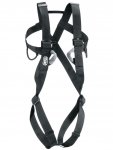
petzl full body.jpg

It also strikes me as feasible that separate leg loops could work, they just need to be redesigned and attached in the proper positions.

I wouldn't wear this on a nice day, but on the bow in a really nasty place... sure I would. This is also what I would want if I was tasked with being rescue swimmer, which sometimes happens; neither a sailing harness nor a seat harness are remotely suitable for that. No different than leg loops, except it would actually work It is all in the geometry.

BTW, I'm not trying to pitch this as a great idea. There's not much point in something folks won't use. I'm just trying to trigger discussion.
 
Last edited:
I would not want to wear a body harness, I wear them frequently in my line of work. The current chest harness is fine as far as I am concerned. I also think that it is possible to reduce fall impact loads on boats with mostly smaller tethers and better jackstay / tether points. So fpe me body harness is out.
 
I think there is scope for improving the design of harnesses/LJs/Oilies.
Perhaps a more joined-up approach.

I used to have some LJs with built in harnesses that worked really well. But the main buckle was below the ribcage. This is apparently not good for a fall harness. Most modern LJs have the harness point higher. This tends to mean they don't always work as LJs without crutch straps.
What I mostly want is not a fall harness, but something which is convenient to hold me at the mast if I need to use both hands.
I would look at the whole issue. What jobs need doing on the boat in what conditions?, what kit do you need for that?

The singlehanders race harder and faster and don't fall on their harnesses in the same way.

In some sailing, I'd rather fall in the water (maybe with a PLb) than fall a long way on an inappropriate harness.
Sailing is quite a varied thing. I have completely different kit for different boats.
 
I made some personal ones out of webbing, the attachment point is somewhat higher than the sternum bone, they are kept closed by a soft shackle; to me it s a good compromise between ease of wearing/unwearing it and not break one's spine in case of fall. Made to measure, not adjustable.
I keep one almost permanently on the jacket, another tighter one is for tropical weather/t-shirts :)

IIRC, there was a French manufacturer which once developed a sailing harness whose attachment point would "jump" on top of the head in case of fall, though I cannot remember the precise geometry.
 
I would look at the whole issue. What jobs need doing on the boat in what conditions?, what kit do you need for that?

I agree with that.

A lot of the safety gear has evolved without, IMHO, sufficient consideration of how it'll be used.

C'mon, let's face it, if you go over the side wearing a typical harness and tether in the real world you stand a good chance of drowning anyway as you're pulled along if your crew don't react quickly enough. q.v. the MAIB report on Lion. And I've noticed that those who say they run the jackstays to prevent that don't post photos, on monohulls anyway, where the biggest challenge in non-standard jackstay positioning is.

And there are other failings, like no clear and obvious way to lift a casualty in the water who has an inflated lifejacket on. I know you use the lifting strop not the D ring (I suspect many don't) but I find it hard to believe that that was not retrofit to the design.

I think this is a real opportunity for MAIB to trigger a though review of safety gear, especially as they've recently reported on major inadequacies of SOLAS lifejackets.

Re the OP's question. It's quite common for racing bowmen to wear the Spinlock mast climbing harnesses (mainly so they can go up the rig at short notice) but a harness or lifejacket of that type of design might be well worth thinking about. You'd have to consider how the leg straps can be comfortably worn with sailing gear but it would get around the issue with lifejacket crotch straps being insufficient to take the wearers weight.
 
My son works at height in the curtain walling part of building industry. He tells me that in safety training it is often stated that the survival time for someone in a full body harness, suspended in a fall from height, is around 20 minutes. If that is true then full body harnesses are not necessarily the answer one might expect.
 
The key thing in my opinion is to keep tethers short

People keep on about short tethers but I find the standard tether so restrictive that I have had to make my jacklines slack so they lift at least a foot off the deck. This allows me to flip the clip past obstructions ( Genoa car , shroud base etc) as I move forward. It also means that I can step on to the cabin to access the mast to gather the sail or to move to the other side of the boat without unclipping.
. Once I stand up & it starts to drag behind me it becomes a danger so I have to make sure it does not snag, Hence I have the slack jacklines so i can lift the hook above the snags.
I had a crew who came on board once with a shorter line & soon realised that it was so restrictive as to be dangerous & asked for a longer one. I have fixed points in the cockpit & he was constantly held in a stooped position if he wanted to stand up, move forward a bit, or move outboard to use a winch
I am 6ft 6 so that does have a bearing on my thoughts
 
My son works at height in the curtain walling part of building industry. He tells me that in safety training it is often stated that the survival time for someone in a full body harness, suspended in a fall from height, is around 20 minutes. If that is true then full body harnesses are not necessarily the answer one might expect.

The problem is associated with hanging in free air, not being dragged alongside a yacht in the water. The cause of the trauma is due to gravity acting on the blood the heart not being able to pump the blood out the legs. Apparently when vertical we need to be standing on our feet to help the blood. The crotch straps which compress the arteries around the groin area significantly contribute to this, even in a properly designed body harness. Body harnesses now have adjustable straps in small bags that can be used by a suspended person. They are unwound, connected together to form a loop and the feet inserted into the loop. The loop is then adjusted so that the knees are bent. Every 5 minutes or so the suspended person stands up in the loop to take the weight off the body off the groin area of the body harness to allow the blood flow to continue. There have been a few deaths over the years which resulted in this modification to full body harnesses and the need for rescue plans. It is not applicable to yachts except if someone was suspended from mast and they have groin straps.
 
People keep on about short tethers but I find the standard tether so restrictive that I have had to make my jacklines slack so they lift at least a foot off the deck. This allows me to flip the clip past obstructions ( Genoa car , shroud base etc) as I move forward. It also means that I can step on to the cabin to access the mast to gather the sail or to move to the other side of the boat without unclipping.
. Once I stand up & it starts to drag behind me it becomes a danger so I have to make sure it does not snag, Hence I have the slack jacklines so i can lift the hook above the snags.
I had a crew who came on board once with a shorter line & soon realised that it was so restrictive as to be dangerous & asked for a longer one. I have fixed points in the cockpit & he was constantly held in a stooped position if he wanted to stand up, move forward a bit, or move outboard to use a winch
I am 6ft 6 so that does have a bearing on my thoughts

I have found on a few yachts that moving forward on the jackstay keeps one hand fairly busy manipulating the tether past obstructions.
That's one hand that isn't holding on.
Short tethers are good for securing yourself at a workstation, e.g. Helm, mast, pulpit. When you need two hands to do the work.
 
The problem is associated with hanging in free air, not being dragged alongside a yacht in the water. The cause of the trauma is due to gravity acting on the blood the heart not being able to pump the blood out the legs. Apparently when vertical we need to be standing on our feet to help the blood. The crotch straps which compress the arteries around the groin area significantly contribute to this, even in a properly designed body harness. ---omit for clarity--- It is not applicable to yachts except if someone was suspended from mast and they have groin straps.

Point taken. But if one is being dragged along there is as much weight being placed on the straps as there would be by gravity; perhaps more. 20 Mins is not long in such an event: so I would imagine a similar situation might- I say might as I can only surmise a risk - exist.
Rescuers should also be aware of recommendation to lower the casualty back on deck with care & to release the load on the body carefully to prevent sudden blood rush to the heart as tension is released on the various lifting points of the straps
 
Last edited:
Good conversation.

This is not instead of proper hard points or staying on the boat. Remember, if you are wearing thigh straps with your PFD or harness (recommended) you are already wearing a full body harness, just not an effective one. My suggestion is that small changes in geometry can make it much better without adding weight or complexity.

If I were 6'6" I might want custom tethers. On my last boat (catamaran) I did just that, with one leg longer than 2 meters (very wide deck) and one leg shorter than 1 meter. I also added some hard points where needed for work stations. For me it is all about matching the geometry to the boat.

If the tether is snagging on obstructions that is a design problem. I moved mine twice before I found the correct routing. This is one reason why going cleat-to-cleat is often myoptic. Determine the correct path, test it, and then do what is required to make it happen. Really, the builder should be responsible for this, just as car manufacturers install seat belts and air bags, but that is a fantasy... unless we as sailors demand it. But from what I see, boats are sold based on dock appeal, and that is where most of them stay.

Obviously this would ordinarily be incorporated with a PFD. When in rescue swimmer role, the PFD is manual trigger and not inflated, since the probable drysuit covers that. In warm water, I would prefer a non-inflatable PFD, since inflatable PDFs are awkward.

Survival time in a harness is an interesting topic. In a nutshell, the blood in the legs becomes trapped (in a chest harness it is other things, which happen even faster.). I've spent a lot of time in a harness, up in the air, and the time is dependent on the design. I think it should be obvious that riggers up the mast spend a lot more than 20 minutes without harm. I use a well padded harness up the mast and 20 minutes is nothing special. But no, there is probably nothing you would want to wear sailing that would be very good.

For comparison, the UIAA (climbing gear standards) has taken a long look at chest harness, since that is what climbers started in 50-100 years ago. And they stopped wearing them 50 years ago. They are also banned in all working environments. Note that they state that hanging causes perminant damage in one minute. They didn't even mension what falling does.

UIAA 105, EN 12277. 3.1.4
chest harness (type D)
harness which fits around the upper part of the body around the chest and under the armpits.
NOTE 1
This type of harness alone cannot support a person in the hanging position without permanent injury in less
than one minute
 
Last edited:
The reason that climbing, working at height and sailing went their separate ways for harnesses could well be that in general the requirements are really quite different?
 
So this morning I tied a pair of modified leg loops based on the alpine harness. Dead easy using some 2" webbing I had lying about. They slide right on to my sailing chest harness, attaching at the center of the back and at the tether attachment. Through my climbing harness is more comfortable to hang in, this was not bad at all. Your head stays up and the tie-in doesn't smack you in the chin. I can imagine taking a fall on a climbing rope without harm.

There is also the issue of being dragged through the water. While this won't help you keep your head up, it will prevent rib injury, eliminates an tendency for the harness to lift, and it takes a lot of pressure off the chest, making climbing and maneuvering in the water far more feasible. It would be a huge improvement if you had to go in the water to help someone.

I wonder whether 1" or 2" webbing makes sense. The former is lighter, for something that will hopefully never be used. It's strong enough and would prevent chest injury. But 2" is much kinder on the legs. 43 mm is the minimum required by EN 12277 and UIAA 105, and is a proven compromise.

Try it. Maybe we'll figure something out.
 
Last edited:
The reason that climbing, working at height and sailing went their separate ways for harnesses could well be that in general the requirements are really quite different?

They didn't go separate ways, not exactly. Working at height and climbing evolved, sailing fall systems did not. Note the continued market acceptance of now-obviously-obsolete Gibb and Spinlock snap hooks. No evolution in 40 years.

No question there are different needs. There are many different styles of climbing and work harness to fill many different niches. I have 5 (sport climbing, trad climbing, winter climbing, general construction, and tower). Sailing requires different harness for up the mast and deck wear. Maybe there are more categories (bow work and rescue) that we have not considered.
 
Back in the days of my youth when my main hobby was sport parachuting, I often spent 20 minutes plus under canopy if doing canopy relative stuff.
14 grand exit and lots of time playing. My harness was leg straps and chest strap, all very comfy, never a problem. Also never a problem with terminal openings, which were from about 150mph if jumping skinny, probably 120 with a jump suit.
All grist to the mill.
 
Last edited:
This gave me a chuckle...

with one leg longer than 2 metres...... and one leg shorter than 1 metre.

Now that made me picture 'Thinwater' as a sometimes-aquatic haggis! With Burns Night approaching, and for those who don't know the age-old explanation - the male haggi could galumph around the mountain clockwise, while the females could only run anti-clockwise.... and you catch them by scaring them into turning round, when they fall over and tumble into catch-nets slung around the bottom of the slope.....

Seriously, this is excellent stuff and we need to give support to 'Thinwater' by telling our retailers and their suppliers that the old kit is inadequate when needed, and something much better is wanted now.

Maybe there are more categories (bow work and rescue) that we have not considered.

I'm thinking of, for example, the harness and kit developed for and used by the winchmen of various helicopter rescue services. The RAF had a full harness; the Coastguard guys now seem to use a harness with bosun's-chair seat. Different nationalities have plumped for different solutions.... for example, the US use 'swimmers' and a basket, the UK uses a winchman-on-a-cable together with a NATO Strop ( on which the Lifesling is modeled ). I'm told the Noggies and Danes use a harpoon with an big 'ook.....

I'm looking for something for deck work - a full lightweight harness like a modified Petzl alpine harness - that can be worn loose over one's foulie jacket, then clipped shut when one wants to clip on while in the cockpit at night, say.... and the leg straps can be clipped in when one needs to go forward. The task is to keep me in the boat in event of a tumble or knockdown.

Going up the mast is a different task, but the clip-on addition of a bosuns-seat and Jumars/ascendeurs needn't create a problem or a wholly-different requirement.

There are part-answers out there already. Businesses are already in the field of designing and producing such kit for specific client-groups. An inspection of what's around can be done via Google Images. We don't need to reinvent the wheel - merely adapt and develop from existing.
 
This gave me a chuckle...


Now that made me picture 'Thinwater' as a sometimes-aquatic haggis! With Burns Night approaching, and for those who don't know the age-old explanation - the male haggi could galumph around the mountain clockwise, while the females could only run anti-clockwise.... and you catch them by scaring them into turning round, when they fall over and tumble into catch-nets slung around the bottom of the slope.....

Seriously, this is excellent stuff and we need to give support to 'Thinwater' by telling our retailers and their suppliers that the old kit is inadequate when needed, and something much better is wanted now.


I'm thinking of, for example, the harness and kit developed for and used by the winchmen of various helicopter rescue services. The RAF had a full harness; the Coastguard guys now seem to use a harness with bosun's-chair seat. Different nationalities have plumped for different solutions.... for example, the US use 'swimmers' and a basket, the UK uses a winchman-on-a-cable together with a NATO Strop ( on which the Lifesling is modeled ). I'm told the Noggies and Danes use a harpoon with an big 'ook.....

I'm looking for something for deck work - a full lightweight harness like a modified Petzl alpine harness - that can be worn loose over one's foulie jacket, then clipped shut when one wants to clip on while in the cockpit at night, say.... and the leg straps can be clipped in when one needs to go forward. The task is to keep me in the boat in event of a tumble or knockdown.

Going up the mast is a different task, but the clip-on addition of a bosuns-seat and Jumars/ascendeurs needn't create a problem or a wholly-different requirement.

There are part-answers out there already. Businesses are already in the field of designing and producing such kit for specific client-groups. An inspection of what's around can be done via Google Images. We don't need to reinvent the wheel - merely adapt and develop from existing.

+1

I like the idea that the harness can have leg straps that be quickly tightened up when needed and like the idea that it might also suit mast work (as well as deck work) It has to be easy to put on - or people simply will not use it.

Taking the Spinlock Volvo harness/LJ and adding leg straps (maybe it needs a bit more of an addition) looks to use an existing product.

All credit to Thinwater for going off and doing something - rather than simply pontificating here.

How we browbeat a manufacturer to actually do something is the biggest hurdle.

Jonathan
 
Zoidberg seemed to be suggesting something truly modular. An interesting thought. On nice days in hot weather I'd just use the chest harness, probably worn too loose. It can be 95 and humid on the Chesapeake, and the water is generally over 27C in the summer. In the winter leg loops would make sense. For me, the times I have thought the most about tethers were when I was doing a bunch of drogue testing for PS in the fall, some of it in gale conditions. I would deploy drogues one after the other, working on the transom with the gates open. I fell against the tether dozens of times I'm sure, and often leaned on it as a third leg. Most of the testing was while single handing, generally under bare poles. These weren't really accidents, just the nature of the work. I had a good hard point anchor to the hard top, the tether was climbing rope, and I was using screw gate locking carabiners, so zero chance of gear failure. Good leg loops would have just made it more comfortable, not less.

The point is that different conditions and job may have different solutions. And there is lots of good stuff out there. We just need the right synthesis.

The trouble with having one long leg and one short leg is that I can only go forward on starboard tack. We have to jibe before I can return to the cockpit.;)
 
Top