Running engine out of the water

eddystone

Well-Known Member
Joined
18 Aug 2013
Messages
1,936
Location
North West Devon
Visit site
Just looking for some idea of level of water flow needed for a 30hp diesel. I’ll be pouring it into the strainer with a hose or a 5L water container - I understand the full flow of a hose might be too much which is why told not to coneys hose to the hull water intake
 
Just looking for some idea of level of water flow needed for a 30hp diesel. I’ll be pouring it into the strainer with a hose or a 5L water container - I understand the full flow of a hose might be too much which is why told not to coneys hose to the hull water intake

Have the raw water hose take water from a bucket and a hose with flow controlable (at the bucket end) for you to feed the bucket. Less stressful.
 
I stand over the strainer with the hose and crimp/uncrimp as necessary. It’s a pain but presumably you won’t be running it for hours.
I’ve got a tap attachment for the hose so can control flow; probably only run for 5 mins. Apart from checking I won’t be embarrassed on the launching pontoon will also (hopefully) eliminate fuel in diagnosing what is wrong with Erberspacher
 
I take the top off this inlet strainer, open the seacock below it, and let the hose keep the strainer body full. Any excess water runs away down through the open seacock.

bukh engine cooling water strainer.jpg
 
If you made a strainer lid with a hose attachment on the cover would that work? Just thinking aloud really. Would hose left on constant rate ‘over power’ the inlet strainer and/or salt water circuit?
 
If you made a strainer lid with a hose attachment on the cover would that work? Just thinking aloud really. Would hose left on constant rate ‘over power’ the inlet strainer and/or salt water circuit?
If you're asking me about my installation Fred, I would say it would; provided the sea cock is left open so that surplus water runs away. You would need to have something to close off the hose attachment when not in use, of course.
 
I disconnect the engine-to-strainer hose at the strainer end and stick it in a bucket of water so the engine takes what it needs, and use a hose to keep the bucket filled.
 
I poke the shower hose in the bucket & turn that on. Provided the boat tank has enough water & with the engine on low revs the bucket remains full enough to feed the engine cooling system. I have another couple of full buckets on stand by in case I get it slightly wrong. Do not have to bother with hoses then, until tank fill up time.
 
I open my filter top of seacock ... remove filter ... stick funnel in ... and then pour from 5l cans into funnel ...

This is how I put Antifreeze through my Perkins 43HP 4-107 ... it means the engine then controls the flow as it should do.

I just keep an eye on the level in the seacock body and pour accordingly ... its surprisingly less required than you think ...

One of the reasons it is not good idea to have pressure from a hose - is that you could transfer some of that pressure to the exhaust side .. not so much problem when engine running - but as it stops ?? The engine itself controls the water pump and therefore pressure in system ... a pressure water hose can be greater and is not controlled by engine.
 
Just looking for some idea of level of water flow needed for a 30hp diesel. I’ll be pouring it into the strainer with a hose or a 5L water container - I understand the full flow of a hose might be too much which is why told not to coneys hose to the hull water intake


The big problem using a coupled hose is when you connect up turn the tap on and then get on board and start the engine things go KAPUT . The engine must not receive a supply till it is running so that the exhaust can clear it back overside. I have a few people do this and usually they have been lucky and realised when water started coming out of places it shouldn t something was wrong and after draining and refilling the sump there was no significant damage. If they had turned the key it would have been a different matter resulting in possibly a bent con rod.

It is safest to let the engine pump draw from a bucket as others have said .

The water
 
If the hose from strainer to water pump is long enough to reach a bucket I’ll do it that way otherwise external hose into strainer; in reconnecting hoses are you supposed to use some jointing distance or just rely on jubilee clip tightness?
I am surprised by idea of leaving seacock open - doesn’t water just run out of seacock leaving engine starved?
 
The big problem using a coupled hose is when you connect up turn the tap on and then get on board and start the engine things go KAPUT . The engine must not receive a supply till it is running so that the exhaust can clear it back overside. I have a few people do this and usually they have been lucky and realised when water started coming out of places it shouldn t something was wrong and after draining and refilling the sump there was no significant damage. If they had turned the key it would have been a different matter resulting in possibly a bent con rod.

It is safest to let the engine pump draw from a bucket as others have said .

The water

Thank you for confirming what I said as well .... never use a pressure system to feed the engine water ...
 
So just to clear, looks like easy to disconnect the hose to the raw water pump at its strainer end and stick it in a bucket of water fed by a hose - but just to be clear why would I leave the seacock open because my water supply is now downstream from the strainer?
 
I am surprised by idea of leaving seacock open - doesn’t water just run out of seacock leaving engine starved?
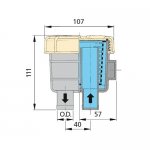
Not if it's the type shown in my post #5

vetus water strainer.jpg
The left hand outlet tube is connected to the engine pump. The right hand tube is connected to the seacock.

With the top cover off, and the seacock open, and water pouring in from a hose, the water level in the chamber cannot rise above the top of the right hand tube.

All you have to do is ensure that supply from the hose exceeds what the engine draws. The excess runs down the right hand tube, through the seacock (and into the box of tools you carelessly left underneath the seacock ? )
 
Not if it's the type shown in my post #5

View attachment 86822
The left hand outlet tube is connected to the engine pump. The right hand tube is connected to the seacock.

With the top cover off, and the seacock open, and water pouring in from a hose, the water level in the chamber cannot rise above the top of the right hand tube.

All you have to do is ensure that supply from the hose exceeds what the engine draws. The excess runs down the right hand tube, through the seacock (and into the box of tools you carelessly left underneath the seacock ? )
Actually now I think about it that’s simpler than disconnecting hoses
 
I used to take the engine inlet pipe off at the Sea cock and connect another piece of pipe and put the end in a bucket of water. The engine can take what it wants, you don't want to flood it with a hose, and my 30 hp would run for about 5 mins on tick over
 
Top