Rookie out of his depth in need of help from veterans

Lodos157

New Member
Joined
6 Dec 2021
Messages
5
Visit site
Hello everyone,
I have recently acquired a Phantom 28 for the incredible prize of 500 Euros (the seller needed to get rid of it, the boat is in good shape and thus far no Osmosis, will need a new coat at the end of summer).

Specifications: SailboatData.com - PHANTOM 28 (STREUER) Sailboat
Pictures are at the bottom of my post

The purchase was made shortly before winter, and it is anchored at a lake in Berlin. Since months now I have been teaching myself everything about boats from scratch. Now I stand before you in dire need for some answers I couldn’t find. I hope my mistakes will be entertaining and you guys can help me. Here we go:

1) I understand winterizing a boat in freshwater where weather goes down to -3celcius (26,6 fahrenheit) is not the smartest thing to do. I know I need to use antifreeze for my motor, but do I also need to pour some into the cockpit drain? (My boat has no plumbing, the WC is a portable camping toilet)

2) A couple of weeks ago the cabin started getting humid. The boat came with an old solarvent that Im not sure if it works (we have dark winters in Berlin, I doubt even if it works that it will go on). I have placed cat litter all around on a tip that it soaks the humidity. I do have a standard companionway door as well as one that lets air through (designed for summer). Naturally I keep the standard one. Would it make sense to change it to the one that lets air through and just cover my boat? (it doesn’t snow too much in Berlin)

3) This is going to be the dumbest question. Way down the road after getting my licence, it is my dream to sail this boat from Hamburg down to Spain and just keep at the shore. I don’t have the desire to go in to the ocean or be in danger since I am a damned rookie. Do you think with necessary preparation my boat could handle such a journey If I just stuck to the shoreline and went from bay to bay?

Pictures: Screenshot-20211206-163806-com-instagram-android
Screenshot-20211206-163758-com-instagram-android
57-1
57-2
57-3
57-4
57


Screenshot_20211206_163806_com.instagram.android.jpgScreenshot_20211206_163758_com.instagram.android.jpgScreenshot_20211206_163806_com.instagram.android.jpgScreenshot_20211206_163758_com.instagram.android.jpgScreenshot_20211206_163806_com.instagram.android.jpgScreenshot_20211206_163758_com.instagram.android.jpg
 
Your boat could probable handle it -but it seems sadly unready for an ocean voyage. If you were going by canal plus lorry that might be different.

However there is no liferaft and I expect there is no inboard engine, and you dont really want an outboard engine in big seas. Even if by canal part of way then diesel inboard is best

I expect vhf radio is old or missing as is the chart plotter. To manage paper charts is a slowly learned skill and you would need lots and lots between Germany and Spain if on the sea route. Chart plotter plus a few large are charts is more reasonoble

I doubt there is an autopilot either and some of the voyages you will need to make if going via the ocean may be well over 24 hours so you will need some ability to leaver the tiller. The sails dont seem well protected so are probably weather damaged. Does it have nav lights?

A experienced yachtsman might manage as she stands but I for one would not want to try. North Brittany and The Bay of Biscay are no places to learn
 
Hi, welcome and I like your boat!
As for keeping her protected over Winter, I would suggest, since the mast is down, you arrange a tarpaulin over the cockpit. This will keep rain and snow out then there will be no problem of the drains icing up. Pouring antifreeze down them won't help anyway - it will just get washed away. For the motor, It depends what type you have. Outboard motor - just take it home! In board with direct cooling ( water from the lake circulates around the cylinders) - drain the water out. If you have indirect cooling ( heat exchanger) antifreeze should be in the cylinder circuit and again, drain out the primary circuit.
For the cabin, I use the Kontrol damp absorbing crystals. These work well to keep the air inside dry and they also absorb nasty smells. You need to block up all the ventilators.
This time next year, you won't be a rookie!
 
Thank you all for the replys, I was studying now for 2 hours sailboats and I started to feel a bit grim, your answers lifted my mood.

Your boat could probable handle it -but it seems sadly unready for an ocean voyage. If you were going by canal plus lorry that might be different.

However there is no liferaft and I expect there is no inboard engine, and you dont really want an outboard engine in big seas. Even if by canal part of way then diesel inboard is best

I expect vhf radio is old or missing as is the chart plotter. To manage paper charts is a slowly learned skill and you would need lots and lots between Germany and Spain if on the sea route. Chart plotter plus a few large are charts is more reasonoble

I doubt there is an autopilot either and some of the voyages you will need to make if going via the ocean may be well over 24 hours so you will need some ability to leaver the tiller. The sails dont seem well protected so are probably weather damaged. Does it have nav lights?

A experienced yachtsman might manage as she stands but I for one would not want to try. North Brittany and The Bay of Biscay are no places to learn

Cheers for the reply!!
VHF, liferaft are all in the bucketlist. ( in fact will be getting a licence on operating the VHF) and nav lights present. I will be definitely relying in the beginning to a chart plotter, looking for one that wont bankrupt me.

As for autopilot I am conflicted. I really just want to stick as much as I can to the coast and not leave it out of my sight as naive as that sounds, but I dont believe the winds or currents will agree with me.

Sails are already at a dry place and will be inspected in spring while I am getting my licence. I hope that one of my teachers will help me with that.
If sails are alright, necessary equipment are acquired and I get a nod of encouragement from my teacher, I wish to have my first experience in sailing across the East German coast to get a taste of it. I heard that the Baltic is relatively calm and easy to sail for rookies.


Hi, welcome and I like your boat!
As for keeping her protected over Winter, I would suggest, since the mast is down, you arrange a tarpaulin over the cockpit. This will keep rain and snow out then there will be no problem of the drains icing up. Pouring antifreeze down them won't help anyway - it will just get washed away. For the motor, It depends what type you have. Outboard motor - just take it home! In board with direct cooling ( water from the lake circulates around the cylinders) - drain the water out. If you have indirect cooling ( heat exchanger) antifreeze should be in the cylinder circuit and again, drain out the primary circuit.
For the cabin, I use the Kontrol damp absorbing crystals. These work well to keep the air inside dry and they also absorb nasty smells. You need to block up all the ventilators.
This time next year, you won't be a rookie!

Thanks for the supporting words! I have a diesel 15ps inboard motor but definitely will get a 10ps outboard in spring for a backup. My inboard motor has direct cooling but a minor defect that will be repaired soon (apparently it has problem draining the water in to cool the motor, a friend will repair it).

The Kontrol damp absorbing crystals are going to be a massive game changer!! Already ordering them.
I do have a tarpaulin but I am slightly worried, Berlin does get nasty winds and I wonder if the tarpaulin wont make the boat more unstable when a gust hits.

Attached are 2 pictures of the solarvent (which I assume is defect) and the the damage on the companionway door (which I managed to seal with silicone).
How would I go with sealing the solarvent? Simply replace it?

Cheers!
 

Attachments

  • Screenshot_20211206_180442_com.whatsapp.jpg
    Screenshot_20211206_180442_com.whatsapp.jpg
    714.1 KB · Views: 33
  • Screenshot_20211206_180450_com.whatsapp.jpg
    Screenshot_20211206_180450_com.whatsapp.jpg
    953.4 KB · Views: 34
If you are using crystals, which is what I did with a 28’ boat, it is really necessary to remove all soft furnishings first and take them home, otherwise the moisture they harbour will quickly swamp the crystals. It may help to divide the crystals into two for each end of the cabin, and then they can be reasonably effective, if not quite as good as a dehumidifier or indoor storage.

I don’t think that you should suppose that sailing along the coast is easier or safer than going a bit offshore, often the opposite is the case. For such a long trek as your ambition entails, it would be a good idea to get some sea sailing experience once you have learned boat-handling. I have met boats from Berlin in the Baltic, and that would be a good place to start, with plenty of 30-50 mile voyages to hand. If you still want to go south, then coping with the tides and the implications of salt water will need to be faced. There is no mystery about tides and even idiots like most of us here can cope with them, usually, but my experience is that they present something of a psychological block to sailors from inland. Mooching around in tidal waters, such as those off the Dutch coast, for a season will bring you up to speed on this, with the need to predict the depth of water and likely currents.
 
I would not bother to get a 10hp outboard if the inboard proves reliable. The 2hp or 2,5hp one you get for your dinghy will move the big boat at maybe 1.5kt in still water and get you through a harbour entrance if your main engine fails.

As johnalison says a few seasons in the baltic will give you the practical skill you need in reading depth gauge and chart and coping with contrary tides or hiding from them. Get radio with inbuilt GPS and AIS whatever you do, as then you can request advice, know where you are and see what big ships are heading straight at you. You can even delay getting chart plotter if you have local chart for your fist home harbour.

You may not need a tiller autopilot at first for shorter passages, as you will see how steady she is with tiller lashed while you cook or go to use the heads. Some boats can even manage with improvised self steering using jib sheet tied to tiller and opposed by elastic cord. Ours wont - yours might
 
Hello, welcome to the forum and congratulations on the boat.

By the time you've got the tickets the German government requires you to have, you will feel a lot more confident.

At this time, and as you are new to the game, I would hold back buying equipment and especially electronics (depth sounder excluded), until you have a better picture of what you need. You can very well navigate using a smart phone for a starters.

With an inboard and (hopefully) functioning diesel, you definitely do not need a 10hp outboard as well. Save yourself the money, the added weight, the unnecessary complexity of multiple fuels and the extra maintenance. Better bet is to have your diesel serviced, if you are at all worried.

Irregardless of boat size or condition, I would be extremely cautious of underestimating coastal hopping along the North Sea, Channel, Breton and Biscay coasts. Particularly in the North, many of the See - Gatts may not be passable if the weather should turn and what you thought was just a short hop, can turn into an exhausting ordeal, 3 or more times longer than you had ever anticipated, while trapped in sea conditions you may not be prepared for.
The suggestion to cut your teeth in the Baltic has much merit.

Regardless, it should be noted that it is quite possible to reach Mediterranean Spain from Berlin, via the German, Dutch, Belgian and French canals, without ever having to touch open water (near enough at least). Your boat's shoal draft should have absolutely no problems doing this. You could even do a stopover in Holland and enjoy some safe sailing on the Isselmeer and the other meers.

As far as humidity in the boat is concerned: remove all upholstery, curtains, carpets or other fabrics and store them ashore, if possible. Now you have two options: Close the boat up bung-tight and use some form of desiccator/dehumidifier or, alternatively, do all you can to maximize ventilation.

Best of luck and enjoy.
 
Just for information, my 25 foot Folkboat moves at 3.5kts with a 2.3hp Honda on the back, which is great in flat water, but is almost no real use in any wind or sea.
Welcome to the forum; the knowledge here is very broad and can be 'intense'.
 
As implied it is not the boat that is the concern but rather the skipper. You need to get experience locally with the boat but perhaps more importantly get to know if you like sailing and the challenges involved. My favorite saying "it is all about crisis management" Not something everyone enjoys. You may find you really don't love it as much as you hoped. Worse your spouse children or friends don't like it either. Just come at it all slowly and carefully. (Especially as regards weather) ol'will
 
Though Laminar flow is correct in that you should avoid buying too much equipment until you can confirm that sailing is for you and that boat suits your needs, I would still advise you get a good vhf radio with modern facilities ie GPS and AIS, as it is not possible upgrade except by buying a new one, the old one is locked to the boat except by factory reset at unknown cost therefore almost unsellable, and the difference in cost is moderate at initial purchase.

If going to Spain by canal not sea then maybe a handheld VHF would do to talk to lock keepers, swing bridge operators and harbour masters but they cost nearly as much
 
There are two ways of dealing with damp in a boat. One is a dehumidifier, but that needs mains voltage; the other is ventilation. I'd put the ventilated washboards in. The crystals will gather an impressive amount of water, but won't really make much difference to the overall humidity, because no small boat is airtight, and you're really just trying to dry out the atmosphere above the lake. A leaky window - lots of boats have them means nothing will work. Take the sails and all the cushions and bedding home and store them in a dry place, and get out onto the boat on sunny days, even if it's cold, to air everything out. That's also a good time to check for wear on mooring lines and, if anchored, that she hasn't moved. Take compass bearings of two or three landmarks and make a note of them, and if they've changed significantly next time you're down, the boat's dragging her anchor.

Unless your anchorage is in a very sheltered spot, I would try and find somewhere where you can tie up to a pontoon for the winter. Not only will the boat be safer from the weather, it will make inspection visits a lot easier.

Finally, take any rechargeable batteries home and give them a top up charge every couple of months
 
Lodos - You have a good point regarding covers in the Winter. A £10 blue plastic draped over the mast won't work. You would need a heavy weight sheet well tied down with lots of chafe protection over pointed items. Looking at your photos, you would also need stronger support for the mast. I am a firm believer in boat covers, though, my own boat gets covered every Winter and it pays off in much reduced wear and tear. It also insulates to some extent, minimising condensation in the boat - it all happens on the tarpaulin! I don't remove the cushions, carpets or sails when I set the Kontrol crystals, but you do need to block up all the ventilation. For things like your Solar vent, I just stick a piece of plastic bag over it with sticky tape. You do need to visit every 2-3 weeks to empty the trays, too. Just one other point, if you have suspicions about the integrity of the under-water fittings, a lift out and store ashore would be top of my list, That would make it a lot easier to fit a good cover and you could prepare the bottom ready for next Summer!
 
Hello everyone,
I have recently acquired a Phantom 28 for the incredible prize of 500 Euros (the seller needed to get rid of it, the boat is in good shape and thus far no Osmosis, will need a new coat at the end of summer).

Specifications: SailboatData.com - PHANTOM 28 (STREUER) Sailboat
Pictures are at the bottom of my post

The purchase was made shortly before winter, and it is anchored at a lake in Berlin. Since months now I have been teaching myself everything about boats from scratch. Now I stand before you in dire need for some answers I couldn’t find. I hope my mistakes will be entertaining and you guys can help me. Here we go:

1) I understand winterizing a boat in freshwater where weather goes down to -3celcius (26,6 fahrenheit) is not the smartest thing to do. I know I need to use antifreeze for my motor, but do I also need to pour some into the cockpit drain? (My boat has no plumbing, the WC is a portable camping toilet)

2) A couple of weeks ago the cabin started getting humid. The boat came with an old solarvent that Im not sure if it works (we have dark winters in Berlin, I doubt even if it works that it will go on). I have placed cat litter all around on a tip that it soaks the humidity. I do have a standard companionway door as well as one that lets air through (designed for summer). Naturally I keep the standard one. Would it make sense to change it to the one that lets air through and just cover my boat? (it doesn’t snow too much in Berlin)

3) This is going to be the dumbest question. Way down the road after getting my licence, it is my dream to sail this boat from Hamburg down to Spain and just keep at the shore. I don’t have the desire to go in to the ocean or be in danger since I am a damned rookie. Do you think with necessary preparation my boat could handle such a journey If I just stuck to the shoreline and went from bay to bay?

Pictures: Screenshot-20211206-163806-com-instagram-android
Screenshot-20211206-163758-com-instagram-android
57-1
57-2
57-3
57-4
57


View attachment 126909View attachment 126910View attachment 126909View attachment 126910View attachment 126909View attachment 126910
The most hazardous place to sail is near the coast. It is the rocks that do the damage!
Travelling through the canal system and then day-sailing town the Biscay and Portugese coast to Spain can be done, but yuo would need to gain a considerable amount of experience first. My advice is to find a training school .
In the meantime here is a video showing the basics of sailing
Your boat looks to be designed for use in sheltered waters. If it is young enough to have a CE mark it will be "C" Category, thus your voyage south would take a long time as you would always be waiting for favourable weather windows for each leg of the journey.
(You need to pull your outboard bracket up out of the water).
 
Willkommen, an ambitious post, good luck.
3) This is going to be the dumbest question. Way down the road after getting my licence, it is my dream to sail this boat from Hamburg down to Spain and just keep at the shore. I don’t have the desire to go in to the ocean or be in danger since I am a damned rookie. Do you think with necessary preparation my boat could handle such a journey If I just stuck to the shoreline and went from bay to bay?
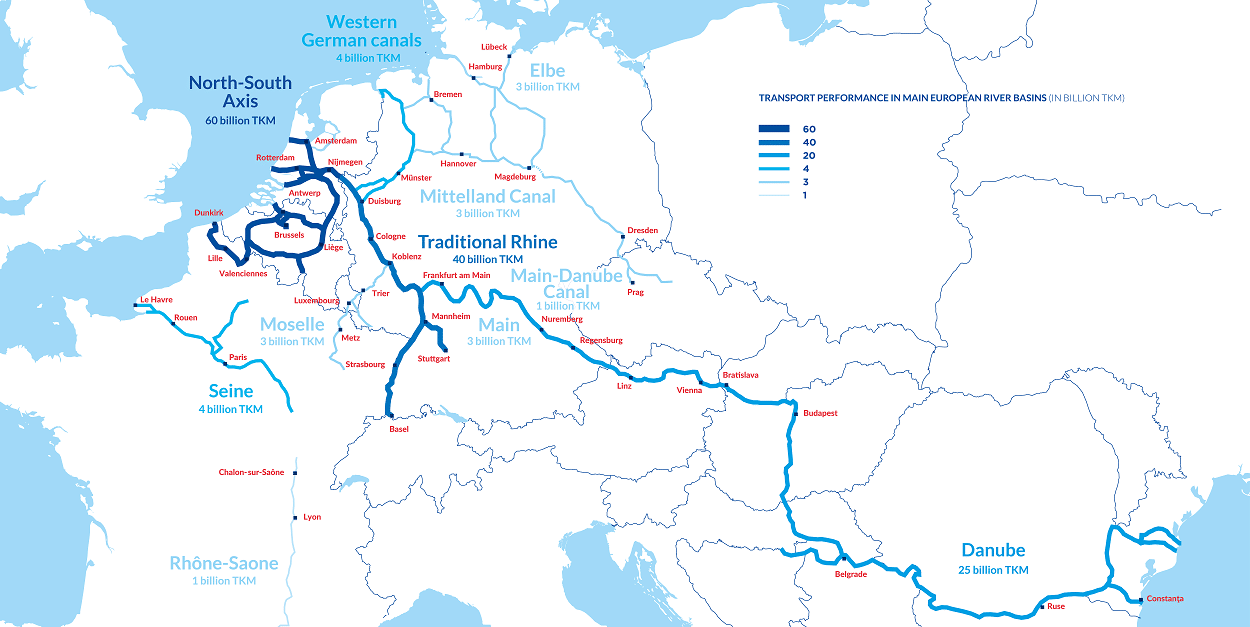
Have you thought of this route to Holland? Then coast hop or back into the Seine - Saone - Rhone to the Med, or even down the Danube?

EN_Chap2_Carte2-2.png


This will give you some idea of Distance / Time for the Seine - Saone - Rhone to the Med

France-%E2%80%98Circumnavigation%E2%80%99-Log.png
 
Come to think of it, my experience of Berlin boats is not without a little horror. In one case a small boat arrived in Dzywnow too drunk in mid morning to stand up and in another case the boat struck the harbour wall in Kolobrzeg on his way out and holed the hull. Even the Baltic has its hazards (though no longer mines).
 
OP Dont worry about licences or indeed paper qualifications, worry about experience. Experience on your getting the basics and then after that maybe training courses.

We hope you will take to sailing and it is when you do that you must decide if your new boat is the one for you to invest in.

It is a light boat so faster but heaviness can be better at sea in turbulent weather. My 27ft LM27 is for instance 50% heavier than the Phantom. So will you cruise or race and where?

Getting a boat to best cruising or racing spec is expensive. For instance we bought the LM27 cheapish (well £12.000) as the wife really liked the layout. But it had poor engine, old sails, rigging of unknown year and broken electronics. Engine was not poor but useless £6000, sails ripped £2500, rigging needs changing for insurance requirements£2000 plus of course the electronics. Say £12 thousand total.

Hopefully much of your boat is better, but even if it is not you would be very unwise the spend that much as a beginner. My first boat cost £700 in 1985 and I certainly didnt spend those ammounts but made do with radio, tiller pilot and compass for 4 years. When I realised I loved sailing and wanted to go further I bought a different boat and invested in that instead. 28 foot is a good length for cruising so maybe it is The ONE ! I certainly wish I had bough bigger earlier
 
Last edited:
Hello, Lodos157, and welcome.

There's lots of experience and knowledge here.... and encouragement. Your boat, prudently prepared, is certainly capable of being sailed to the Mediterranean and perhaps beyond. Many lesser boats have done that.

The other half of the equation is the judgement you bring to each day's sailing. That is crucial. You need to bring 'prudent preparation' so that the decisions you make are cautious and prudent.

"Look after the boat and the boat will look after you."

First, let me encourage you to lower your mast considerably. The tall and spindly gantry which supports the after end is weak, and will not manage to resist the very considerable side-loads which wind will exert on your tarpaulin. An X-shape made of 10 x 5cm wood ( or stronger) which is strapped/lashed to your stern rails/'pushpit' will do the job cheaply..... and reduce by more than half the wind-loads.
The centre of your mast also needs similar support to prevent the possibility of the mast bending and to give proper support to your tarpaulin. The mast can be rotated so your mast-front lights are not 'loaded'.

It is natural but not prudent to follow the coastline closely - as others have advised you.

"The land claims more ships than the sea"

It is prudent to plan and maintain a course which keeps you well clear of rocks, reefs and shallow areas. You need to allow enough distance - which translates into 'time' - between you and the obstacles/hazards so that you have time both to attempt to resolve any breakdowns ( they WILL occur ) AND for assistance/rescue services to get to you, should you need help. Consider that a 'flexible/expanding safety buffer' - like the changing safe distance between you and the car in front on the autobahn - and consider as you progress the 'distance/time' to the nearest safe harbour you can be certain of entering as the weather conditions change. Sometimes that will be behind you....

Navigation - which sailors have been doing for centuries before electronics - is 6 parts common sense, 2 parts caution, and 1 parts knowhow.
There's always a small element of luck in there, too, but as one maximises the other parts, luck can be managed.

It is valuable to have AIS with built-in GPS connected to a VHF radio. That assists good decision-making. However, a sound and reliable 'lookout' linked to prudent decision-making has served competent sailors for centuries. That's essential.

Also, a device to steer the boat, by wind or by compass, is close to essential. You will very often want/need to leave the tiller and being 'slaved' to steering by hand when you don't want to is the fastest way to start to hate sailing. There are quite cheap 'wind vane' tiller steering devices, some of which can be home-built for little money. You do need to learn how to adapt the use of them to your own boat.

It is my view that a singlehander, no matter how many 'self-steering devices' he has on board, MUST understand how to arrange for the boat to self-steer using simple means such as jib sheets and rubber tubing. Here's a link https://jesterchallenge.files.wordp...-sailing-craft-by-john-s-letcher-jr-small.pdf
There's more, much more, but that is a good place to start.

As an aside, a singlehander arrived at my club at Plymouth some years ago, from the Nederlands, in a boat he'd refurbished and with a self-steering device he'd built himself. It didn't work. His hands were blistered and abraded deep into the flesh from hours, days, steering by hand. We took him to hospital, had his deep wounds dressed and, in the three weeks he remained tied to our club pontoon while his hands healed, we were able to teach him several techniques to get his boat to steer itself, in different conditions.

Last we heard, he'd got into the Pacific....

So, 'Yes you can.'
 
Good evening Captains!
I have read every comment at least twice and am really thankful for every bit of advice. (had to reply late due to being overworked today).
Tomorrow I will take my dingy early in the morning to my sailboat (Farfara) to deliver the damp absorbing crystals. I will also take some photos and share them tomorrow. Thus far Im amazed by your responses, so much help. Cheers!
 
OP Dont worry about licences or indeed paper qualifications, worry about experience. Experience on your getting the basics and then after that maybe training courses.
I'm afraid you may not be familiar with German licensing requirements. To legally operate his boat the OP will need an "Inshore License, Motor" to even move it on the Berlin lakes or canals, a sailing license, if he want's to actually sail it, a coastal license once he reaches open water and a radio operator's license if you want to say hello to him on the VHF you are recommending.

All the licenses comprise theoretical and practical aspects, including sailing theory and practice, boat handling under power, knots, seamanship, terrestrial navigation and a surfeit of legal and environmental regulations etc, etc.

As I said, the OP will be a lot less green once he's got his legally required tickets.
 
Top