Rookie out of his depth in need of help from veterans

I'm afraid you may not be familiar with German licensing requirements. To legally operate his boat the OP will need an "Inshore License, Motor" to even move it on the Berlin lakes or canals, a sailing license, if he want's to actually sail it, a coastal license once he reaches open water and a radio operator's license if you want to say hello to him on the VHF you are recommending.

All the licenses comprise theoretical and practical aspects, including sailing theory and practice, boat handling under power, knots, seamanship, terrestrial navigation and a surfeit of legal and environmental regulations etc, etc.

As I said, the OP will be a lot less green once he's got his legally required tickets.
In that case there will be a plentiful supply of sailing schools who will put him on the right track.
 
All the licenses comprise theoretical and practical aspects, including sailing theory and practice, boat handling under power, knots, seamanship, terrestrial navigation and a surfeit of legal and environmental regulations etc, etc.


Perhaps the simplest answer - possibly the cheapest - would be for Lodos 157 to truck his boat to Northern France, launch it near Calais, pick a gentle summer's day - and sail it to England.

No rules, no regs, no bother....

:cool:
 
Hello Captains! I have shot a video today for you to show how damp it is inside and also some fun trivia about Berlin/rummelsburg
Link:
A friend who takes care of the boat had it on the dock today so I didn't need to paddle. The video ends abruptly because I had a quick visit.
Attached are two pictures. One shows the tarpaulin for the boat that I could probably use.

And the second one that shows a hole needs abit more explanation. The picture was shot from the cockpit port side and what you see there is a hole and that is where the seating area is inside the living space. So I am pretty sure the air from the outside is heavily getting in there.

I guess as one of you has suggested, the smartest would be to place the cover underneath the mast and have.

A shitty thing that happened is that someone apparently stole my white fenders. An older captain I befriended assured me they will find out who and that they probably already know who it is. For now I borrowed my friends Fender.Screenshot_20211208_165225_com.android.gallery3d.jpgScreenshot_20211208_165216_com.android.gallery3d.jpgScreenshot_20211208_165212_com.android.gallery3d.jpg
 
Get a copy of this book, it's very comprehensive & covers all the basics. In the spring yopu can start to do some gentle sailing and take things from there, enjoy your new boat...
That book looks like a gem, and definitely going in to the list!
The most hazardous place to sail is near the coast. It is the rocks that do the damage!
Travelling through the canal system and then day-sailing town the Biscay and Portugese coast to Spain can be done, but yuo would need to gain a considerable amount of experience first. My advice is to find a training school .
In the meantime here is a video showing the basics of sailing
Your boat looks to be designed for use in sheltered waters. If it is young enough to have a CE mark it will be "C" Category, thus your voyage south would take a long time as you would always be waiting for favourable weather windows for each leg of the journey.
(You need to pull your outboard bracket up out of the water).
As another Captain here also pointed out, the sailing school will definitely boost my courage, cheers for the video also!
Willkommen, an ambitious post, good luck.

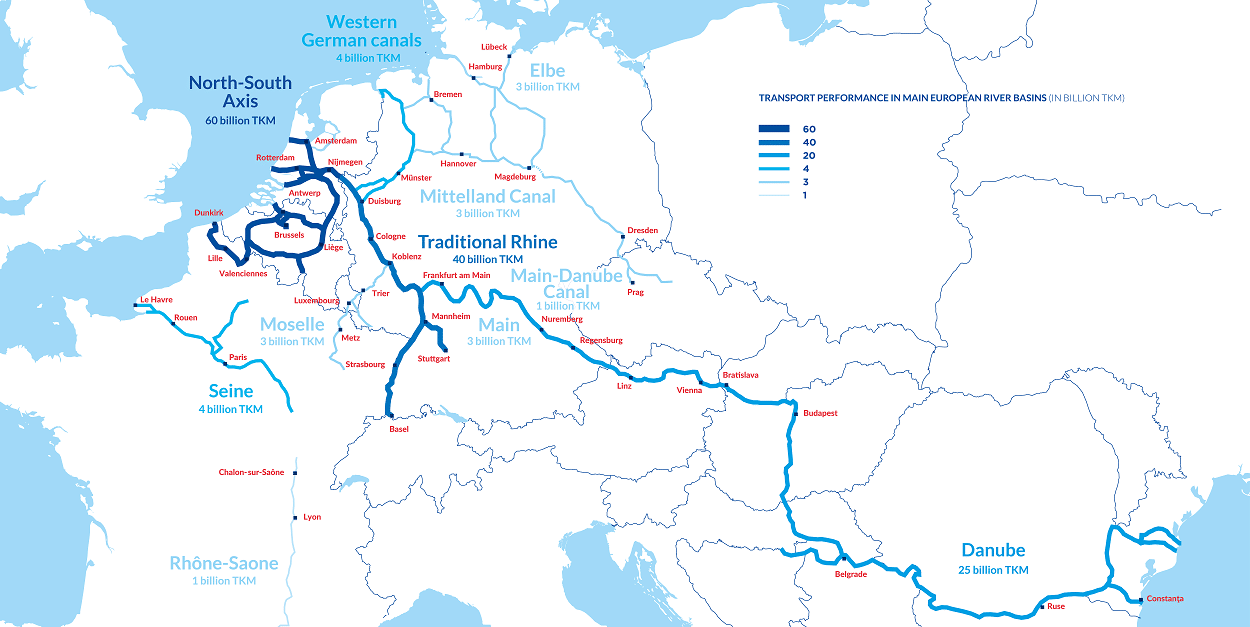
Have you thought of this route to Holland? Then coast hop or back into the Seine - Saone - Rhone to the Med, or even down the Danube?

EN_Chap2_Carte2-2.png


This will give you some idea of Distance / Time for the Seine - Saone - Rhone to the Med

France-%E2%80%98Circumnavigation%E2%80%99-Log.png
I read your answer yesterday and today I was sitting in the cozy cabin of a local veteran Captain who sailed the mediterranean, he also pointed these canals as well as the Danube and suggested a route down to the Black Sea and from there to Turkish and Greek Aegean sea where I grew up. Certainly a ambitious plan but after having a little training in baltics, I could dare it with adequate preparation. Thanks for the advice
Come to think of it, my experience of Berlin boats is not without a little horror. In one case a small boat arrived in Dzywnow too drunk in mid morning to stand up and in another case the boat struck the harbour wall in Kolobrzeg on his way out and holed the hull. Even the Baltic has its hazards (though no longer mines).
Berliners are notorious for debauchery, by law it is forbidding to be drunk even while anchored but the Berlin Water Police definitely turns a blind eye on it since there are so many drunk sailors everywhere.
Hello, Lodos157, and welcome.

There's lots of experience and knowledge here.... and encouragement. Your boat, prudently prepared, is certainly capable of being sailed to the Mediterranean and perhaps beyond. Many lesser boats have done that.

The other half of the equation is the judgement you bring to each day's sailing. That is crucial. You need to bring 'prudent preparation' so that the decisions you make are cautious and prudent.

"Look after the boat and the boat will look after you."

First, let me encourage you to lower your mast considerably. The tall and spindly gantry which supports the after end is weak, and will not manage to resist the very considerable side-loads which wind will exert on your tarpaulin. An X-shape made of 10 x 5cm wood ( or stronger) which is strapped/lashed to your stern rails/'pushpit' will do the job cheaply..... and reduce by more than half the wind-loads.
The centre of your mast also needs similar support to prevent the possibility of the mast bending and to give proper support to your tarpaulin. The mast can be rotated so your mast-front lights are not 'loaded'.

It is natural but not prudent to follow the coastline closely - as others have advised you.

"The land claims more ships than the sea"

It is prudent to plan and maintain a course which keeps you well clear of rocks, reefs and shallow areas. You need to allow enough distance - which translates into 'time' - between you and the obstacles/hazards so that you have time both to attempt to resolve any breakdowns ( they WILL occur ) AND for assistance/rescue services to get to you, should you need help. Consider that a 'flexible/expanding safety buffer' - like the changing safe distance between you and the car in front on the autobahn - and consider as you progress the 'distance/time' to the nearest safe harbour you can be certain of entering as the weather conditions change. Sometimes that will be behind you....

Navigation - which sailors have been doing for centuries before electronics - is 6 parts common sense, 2 parts caution, and 1 parts knowhow.
There's always a small element of luck in there, too, but as one maximises the other parts, luck can be managed.

It is valuable to have AIS with built-in GPS connected to a VHF radio. That assists good decision-making. However, a sound and reliable 'lookout' linked to prudent decision-making has served competent sailors for centuries. That's essential.

Also, a device to steer the boat, by wind or by compass, is close to essential. You will very often want/need to leave the tiller and being 'slaved' to steering by hand when you don't want to is the fastest way to start to hate sailing. There are quite cheap 'wind vane' tiller steering devices, some of which can be home-built for little money. You do need to learn how to adapt the use of them to your own boat.

It is my view that a singlehander, no matter how many 'self-steering devices' he has on board, MUST understand how to arrange for the boat to self-steer using simple means such as jib sheets and rubber tubing. Here's a link https://jesterchallenge.files.wordp...-sailing-craft-by-john-s-letcher-jr-small.pdf
There's more, much more, but that is a good place to start.

As an aside, a singlehander arrived at my club at Plymouth some years ago, from the Nederlands, in a boat he'd refurbished and with a self-steering device he'd built himself. It didn't work. His hands were blistered and abraded deep into the flesh from hours, days, steering by hand. We took him to hospital, had his deep wounds dressed and, in the three weeks he remained tied to our club pontoon while his hands healed, we were able to teach him several techniques to get his boat to steer itself, in different conditions.

Last we heard, he'd got into the Pacific....

So, 'Yes you can.'
I will definitely keep these wise quotes close to my heart. And the story with the Dutch sailor is incredibly inspiring. Some good lessons to be learned there.

As I see it, this winter I will just try to keep this boat alive till late February and try to mitigate the damage. By March will be lots of repairs combined with my classes for licence. Once Summer comes up I will start considering buying the necessary equipment for having a first try in a safe harbour near Stettin Poland.
 
Thank you all for the replys, I was studying now for 2 hours sailboats and I started to feel a bit grim, your answers lifted my mood.


Cheers for the reply!!
VHF, liferaft are all in the bucketlist. ( in fact will be getting a licence on operating the VHF) and nav lights present. I will be definitely relying in the beginning to a chart plotter, looking for one that wont bankrupt me.

As for autopilot I am conflicted. I really just want to stick as much as I can to the coast and not leave it out of my sight as naive as that sounds, but I dont believe the winds or currents will agree with me.

Sails are already at a dry place and will be inspected in spring while I am getting my licence. I hope that one of my teachers will help me with that.
If sails are alright, necessary equipment are acquired and I get a nod of encouragement from my teacher, I wish to have my first experience in sailing across the East German coast to get a taste of it. I heard that the Baltic is relatively calm and easy to sail for rookies.


Thanks for the supporting words! I have a diesel 15ps inboard motor but definitely will get a 10ps outboard in spring for a backup. My inboard motor has direct cooling but a minor defect that will be repaired soon (apparently it has problem draining the water in to cool the motor, a friend will repair it).

The Kontrol damp absorbing crystals are going to be a massive game changer!! Already ordering them.
I do have a tarpaulin but I am slightly worried, Berlin does get nasty winds and I wonder if the tarpaulin wont make the boat more unstable when a gust hits.

Attached are 2 pictures of the solarvent (which I assume is defect) and the the damage on the companionway door (which I managed to seal with silicone).
How would I go with sealing the solarvent? Simply replace it?

Cheers!
Silicone is not a good sealant to use on a boat. It's better to use something like Sikaflex . Other suitable sealing products are available:
marine sealant - Google Search
Silicone tends to prevent other products, such as paints and varnishes sticking .
In order to prevent the dampness and condensation you are experiencing, the first job you will need to do is to trace and seal all rainwater leaks. This means removing many of the fittings that are screwed through the deck, cleaning up the mating surfaces and then re-fitting them, using the correct sealing techniques. You will find tips, advice and "how-to" articles on the PBO website: Boat maintenance advice, sailing and motor boats, practical advice | PBO
There are also many threads on this forum that you should be able to access using the"Search" facility. Some members say it does not work very well, but if you ask the correct question in Google, it will lead you to some relevant threads on this forum.
 
Last edited:
Thank you all for the replys, I was studying now for 2 hours sailboats and I started to feel a bit grim, your answers lifted my mood.


Cheers for the reply!!
VHF, liferaft are all in the bucketlist. ( in fact will be getting a licence on operating the VHF) and nav lights present. I will be definitely relying in the beginning to a chart plotter, looking for one that wont bankrupt me.

As for autopilot I am conflicted. I really just want to stick as much as I can to the coast and not leave it out of my sight as naive as that sounds, but I dont believe the winds or currents will agree with me.

Sails are already at a dry place and will be inspected in spring while I am getting my licence. I hope that one of my teachers will help me with that.
If sails are alright, necessary equipment are acquired and I get a nod of encouragement from my teacher, I wish to have my first experience in sailing across the East German coast to get a taste of it. I heard that the Baltic is relatively calm and easy to sail for rookies.


Thanks for the supporting words! I have a diesel 15ps inboard motor but definitely will get a 10ps outboard in spring for a backup. My inboard motor has direct cooling but a minor defect that will be repaired soon (apparently it has problem draining the water in to cool the motor, a friend will repair it).

The Kontrol damp absorbing crystals are going to be a massive game changer!! Already ordering them.
I do have a tarpaulin but I am slightly worried, Berlin does get nasty winds and I wonder if the tarpaulin wont make the boat more unstable when a gust hits.

Attached are 2 pictures of the solarvent (which I assume is defect) and the the damage on the companionway door (which I managed to seal with silicone).
How would I go with sealing the solarvent? Simply replace it?

Cheers!
A 10HPmotor will cost you twice what you paid for the boat and is hard to use while motoring with a medium sized tiller yacht as controls are behind the boat and low down. Diesel is easier to obtain from marinas while travelling also, though petrol can usually be obtained from roadside facilities. If you leave motor attached when moored some one might steal it, but it is heavy and thus hard to bring aboard to store in the cabin. If your 15hp inboard motor can be got going for something like the same money that is a much better solution
 
First, congrats on a boat!
Regarding next season, I would consider East Germany lakes (if those are connected to Berlin) and if you want to try saltwater, try Szczecin Lagoon and maybe waters around Wismar and Luebeck. Baltic is the serious sea, well except lack of tides, so you don't need to worry too much about those aspects. But it's open sea and to get somewhere you need often a long time. I would say Bornholm is within reach of your boat if you take it carefully. Baltic ports on the south (Poland coast) are very narrow and if winds are high and northerly, you have to be very brave to enter them. Bornholm ports are even worse, but at least you can easily shelter behind the island.
If I would live local, I would look for better yacht in Sweden - Albin Vega or Albin Ballad are both excellent and relatively easy buys there. You can learn to sail on your yacht and then sell it (if you want I can recommend you ads pages in Poland, as I believe some people there might be interested).

As an encouragement of sailing on Baltic, there is viral video:
 
As an encouragement of sailing on Baltic, there is viral video:
That looks entertaining. It's not one of the Bornholm harbours that I know, from Allinge to Nexo. I was wondering where it was but comments have been turned off on the YouTube version. I am no hero and my wife perhaps even less so, but we have had no problems getting into Baltic harbours in summer weather, including most of the Polish ones, though it is some years since I have had the chance to go that way.
 
Willkommen, an ambitious post, good luck.
Have you thought of this route to Holland? Then coast hop or back into the Seine - Saone - Rhone to the Med, or even down the Danube?

I used to know a chap who did the route though the canals from the UK to the Med and back in his 19 foot Seawych, took him ages but he had great fun. So much in fact he was going to do it again, shame he never got the chance.....
 
Last edited:
Top