Replacing standing rigging on a Tamarisk 29

Captain Sillyboxes

Active Member
Joined
29 Aug 2017
Messages
55
Visit site
I need to replace my standing rigging as it is 10 years old. The mast is keel stepped and the previous owner assured me that it could stand up perfectly well with no standing rigging (so long as you don't raise the sails).

So I made a plan to remove the standing rigging myself, get replacements made up professionally, and fit them myself. As as cost saving measure mainly - the boat is in storage in a canal rather than hauled out. I attached the halyards to the points on deck where the standing rigging normally goes as a failsafe in case of strong winds while the standing rigging was not there.

So today I attempted to enact this plan, we unfasten the rigging at the bottom and I ascended the mast. But I discovered that with this sort of gaff cutter rig, it's not like a modern yacht where you can just unbolt a shackle to remove the stays at the top end. Instead tops of the stays are formed into loops which loop around the mast and sit on a sort of ledge to prevent them from slipping down. So the only way they can come off is to be lifted over the top of the mast (well, they could be removed by hacksaw but the replacement would need to be lifted over the top of the mast).

It doesn't seem possible to do this while sitting in a bosun's chain suspended by a halyard because you'd need either remove all the halyards above the stays, or thread them through, in order to lift these loops over the top of the mast.

My initial thought was that this means the mast needs to be removed. However, there is a crane where she is moored, it's mainly a mast lifting crane but can also lift people in a bosun's chair to fix things on their mast. I think it may be possible to do this whist sitting in a bosun's chain, if the chair was being lifted by crane rather than halyard. But it will be somewhat complicated due to the various other bits of rigging above the stays (halyards, topping lift etc).

I'm just wondering if anyone else has done this on a boat which has this way of attaching standing rigging to mast?


I have a video clip taken where the stays meet the mast in case it helps to visualize what I'm talking about. I can't upload it here because the file is too large but you can access it for the next 7 days on this url VID_20230205_124049.mp4. Please forgive the narration I was excited and repeatedly said 'halyard' when I meant to say 'stay'
 
You have the traditional method of placing standing rigging on a gaff rig mast, only in the past the eyes would have been spliced. Nice video explaining the situation but sorry, my experience of replacing rigging with the mast up is all on alloy masts.

You suggest using halyards to stay the mast while working, but most of these are going to have to come off to take the standing rigging off, so you would be more secure with some other support rather than leave the mast only supported at deck level while waiting for the new rig.

If you are going to have to work from a crane it may be simpler to lift the mast out as otherwise you will probably be dangling in the bosuns chair for quite a few hours in total. My rule of thumb for boat work is to estimate how long it will realistically take, then double it and add a couple more hours. With the mast down you can carefully inspect it at leisure and paint/varnish while waiting for the new wires to be made up.
 
Thanks for the reply. We're at turf lock in the exeter canal and although they have a crane its not a boatyard and I'm not sure there is anywhere there where I'd be allowed to lay the mast down for more than a few hours. Crane is mostly for boats to get under the M5. I'll speak to them tomorrow.

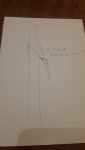
Meanwhile someone has suggested that I cut the existing stays down and replace them with this arrangement (see attached sketch) - meaning they wouldn't need to go over the top. Might this be an option or is it a bad idea?
IMG-20230205-WA0004.jpg
 
Thanks for the reply. We're at turf lock in the exeter canal and although they have a crane its not a boatyard and I'm not sure there is anywhere there where I'd be allowed to lay the mast down for more than a few hours. Crane is mostly for boats to get under the M5. I'll speak to them tomorrow.

Meanwhile someone has suggested that I cut the existing stays down and replace them with this arrangement (see attached sketch) - meaning they wouldn't need to go over the top. Might this be an option or is it a bad idea?
View attachment 150687

I'm no expert, but I don't think it would be advisable to have that tight bend in the wire, with a sideways load on it.

Better, I would think, to have the stay in two parts:
(a) A short length you could pass around the mast, with a hard eye or other fitting fixed on both ends;
(b) The main length of the stay, with a hard eye or other fitting fixed at the top end.

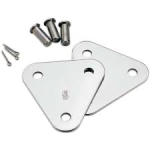
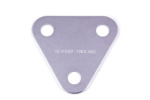
The two parts could be joined by a shackle of some sort, but better would be one of the triangular or Y shaped fittings (see below) that are made for boats with split backstays. The type bought would dictate whether you'd want fork or eye fittings on the ends.

1675632333676.png
1675632402012.png
1675632425863.png
 
Last edited:
Re "What's the significance of the 10 years? " that's a good question, I bought the boat this time last year and the previous owner said "the standing rigging is 9 years old and needs to be replaced after 10 years". It is showing no visible signs of wear but there seems to be a consensus that this is a universal insurance rule. I will check with my insurer before spending any money.

Re using a separate part to go around the mast, yes I like this idea. I think given that there are a pair of shrouds each side, I would be tempted to have a single loop around the mast for each side (8mm instead of 6mm), with both shrouds going into it. This would minimise the number of shackles or triangular fittings needed in the hounds area.
 
If you went aloft before you discovered how your standing rigging is secured on the mast, I'm guessing that you don't have much rigging experience. That is not a criticism or snide remark by the way, it just prompts me to make a suggestion which may provide an easy solution to your problem, or easier perhaps, and if you are going to get the rigging itself professionally made, fitting a Mast Clamp is not rocket science.
There is the possibility of fitting a hinged Mast Clamp that has lugs on to allow you to simply shackle your standing rigging to the mast.
This sort of fixing, although I'm not suggesting the Capt Watts Gucci model as illustrated, as you can get them in galvanised metal with a hinge built in. You could then go aloft with some bolt cutters, cut away the present rigging and put the hinged clamp on the mast. Even if it sits above the chocks which are on the mast at the moment it would not hurt. The Rigger could make the Stays to the correct length once the mast clamp was in position.
watts.jpg

Just a suggestion but if you are going to keep the boat being able to replace standing rigging by just undoing a shackle would make life easier. I used the mast clamp method on my Gaff Cutter and I have to say when varnishing the mast or doing any work aloft I found it was easier than the traditional rigging eyes over the mast system
 
Re "What's the significance of the 10 years? " that's a good question, I bought the boat this time last year and the previous owner said "the standing rigging is 9 years old and needs to be replaced after 10 years". It is showing no visible signs of wear but there seems to be a consensus that this is a universal insurance rule. I will check with my insurer before spending any money.

It's not a universal insurance rule. Some insurers demand replacement at 15 years, some 10 years, others have no such stipulation.

It is highly unlikely that 10years' non-racing use of a low stress rig on a boat such as the Tamarisk would be 'worn out'. (Of course problems can arise at any age. There's no guarantee that a boat rig under 10 years would be all fine, and there are many rigs much older than 10 years without problems, but with greater age there's gradually increasing risk of defects.)

Insurers would all probably require you to do any work a surveyor recommended. A boat surveyor probably wouldn't comment on your rigging beyond glaring issues observable at deck level - such as frayed wires, wrong sized cotter pins, etc.; saying it appears to have been replaced 9 years ago (if they were provided with the evidence); and might perhaps say should be inspected by a rigger.

A reputable rigger should be better placed to know what issues to look for, and to judge, than someone inexperienced . They might be willing to produce a report saying no defects were found, but wouldn't guarantee there were none. Some might wish to persuade you to have them replace the rigging and fittings.
 
The "hinged mast clamp" does seem like another worthwhile suggestion. Now I wish I'd measured the mast diameter while I was up there. The boom attaches with a hinged clamp so I can well imagine how it would work
 
  • Like
Reactions: srm
The "hinged mast clamp" does seem like another worthwhile suggestion. Now I wish I'd measured the mast diameter while I was up there. The boom attaches with a hinged clamp so I can well imagine how it would work
I was thinking of the mast clamp but @veshengro beat me to it. Buying (finding) an off the shelf version the correct size may be a problem. However, a small metal fabrication shop will probably be able to make one to your exact specification, with lugs positioned exactly where you need them. Rather than making it hinged two sections with flanges that bolt together might be easier. Marine grade stainless steel will probably be expensive but mild steel hot dip galvanised after fabrication should give a longish life. I have found agricultural engineers are often more flexible and can offer a realistic price with unusual jobs like this.

I don't think the sliding eye is a very good idea for attaching the rig. More a case of it is probably weaker than the existing eyes and does not look right. You will have to use a multistrand flexible wire to make the hard eye and the tight choke hold on the mast. With a mast band and fork terminals you can use 1x19 wire which is stronger for any given diameter.
 
Last edited:
To answer the original point it seems safer/better/easier to have the mast lifted out. It's two lots of crane hire, not one to dangle in a chair, but attaching the new rigging with the mast down will surely give you confidence you've done it properly.
 
The Tamarisk 29 was designed by David Cannell (who also designed the smaller Tamarisks; Samphire 23, 26 and 29; an Itchen Ferry version; and the North Sea 127).

You may be able to get advice from him, or his company - DMC naval architects at Wivenhoe (though likely for a fee). They probably hold the original drawings showing how and whether a mast clamp or some other arrangement was intended.

David Cannell took a great interest in traditional craft, but especially in applying modern thinking and techniques in their design and construction.
 
Thanks LittleSister. I've just had an exchange of emails with David Cannell, who informed me that the original design for the Tamarisk 29 did call for a mast band. The swaged loops are a deviation from the design.
 
There are several good riggers within easy travelling distance, including one at Totnes. In your position, I would seek guidance from one of them. Armed with that guidance, a conversation with your insurer would be most appropriate. Saving money by DIY is all well and good, but doing it wrong is much more expensive.
 
I spoke with the insurer and read the policy today. They say they have no rule about the age at which the standing rigging needs to be replaced. But they do have a rule that the recommendations in the surveyors report are carried out. And the surveyor - having been told that it was 9 years old - said it should be renewed once it was 10 years old.
 
Its unfortunate that your surveyor did not actually look at your rigging, or if he did failed to understand the properties of different forms of wire rope construction.

Have just looked at your video again. Your rigging wire is of flexible multistrand construction, something like 6x19 but can not see enough to be certain. This construction was needed to make the eyes around the mast.

The ten year rule of thumb applies to single strand 1x19 rigging, used on most bermudan rigs. This construction can not be bent in a tight radius and is subject to vibration hardening and failure without warning.

I had highly stressed multistrand forestays on a heavy 42 ft sloop that were probably original to the boat and around 25 years old. I replaced all the other standing rigging with new 1 x 19 but kept those forestays as there were no "fishooks" (broken wires, the first sign of failure) in them. Flexible wire construction has a far longer working life than 1x19. As the individual wires are thinner than 1x19 you usually get warning of potential failure when individual wires break.

Perhaps you could point this out to your surveyor and ask him to correct his report. (The last insurance survey I had done on a 35 ft boat came with around a dozen factual errors in it and went through three drafts before I accepted it).
 
Last edited:
I've also gone back to a surveyor and got his agreement to change several survey report recommendations to something more practicable but still consistent with his identification of issues..

(E.g. 'replace [something a bit worn] within a couple of years', rather than just saying 'replace' which would be interpreted by the insurers as needing doing before first launching; 'fix the teak cockpit seats down securely with screws' to 'fix down or remove the cockpit seats', as these were merely cosmetic/comfort toppings to GRP benches and could be simply lifted out and not used, and even if fixing them down, structurally and practically screws would not have been a good way to do it. )
 
  • Like
Reactions: srm
I would endorse post#14. Talk to a rigger familiar with traditional rigging. While a band is a neater solution the method used on your boat is perfectly satisfactory. A gaff rig is not highly stressed like a bermudian and that all looks pretty good in your video. You are in a rock and a hard spot if your insurer won't continue cover if you do not follow the surveyor recommendation and you might avoid that if you can get a positive report from a rigger.
 
  • Like
Reactions: srm
I've just had a conversation with my surveyor. He accepts the points about the wire itself being in good condition, less tension than a bermudan rig and so on, however the reason he thinks the rigging should be replaced after 10 years is that the stays are made with "Talurit Pattern" swagings. He thinks these are inferior to bucket style swagings and shouldn't be in service for more than 10 years.

He likes the mast band idea and pointed out that a two-part mast band is preferable to a single piece band because you can get it a lot tighter.

He was reluctant to amend his report because of his dim view of these swagings, but said that I could always get a further report by a different rigger and if they said it was ok the insurance company would accept this.
 
Top