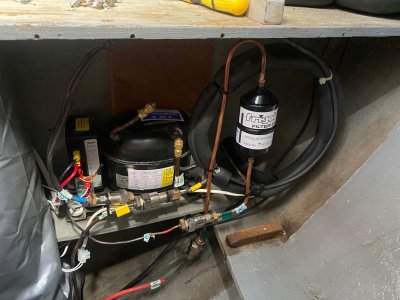
Refrigerant dryer

Driers are cheap about £10 but fitting one requires degas and recharge which costs, degass and deep evacuation before recharge would have same result as removing any moisture but inline driers are normal in systems other than the small systems have
 
My (very) built-in fridge has been performing erratically.
Can you elaborate on this?

There will be a difference between a system with a capillary tube and a thermostatic expansion valve.
gary
 
Our fridge (water cooled) and parts bought from Frigoboat started behaving erratically. There were two problems. Firstly the rather crude mechanical thermostat was misbehaving so it got replaced with one of these:


IMG_8690.jpeg
However it didn’t cure the faults 100%. It was still misbehaving occasionally so in answer to the OP I spoke to Frigoboa who were very helpful and I too was advised to fit a filter/dryer. Our system didn’t need degassing as the connectors self seal when undone. The filter/dryer came precharged with the correct amount of refrigerant and I carefully undid the couplings and added the filter/dryer to the circuit.

The fridge sprang into life immediately when turned back on and has worked perfectly ever since.

Here’s the filter as fitted.
IMG_3948.jpeg

The instructions said it had to be fitted vertically.
 
Last edited:
Here ya go Will.
A refrigeration system circulates a refrigerant.
A simple but overly long explanation.
The refrigerant is compressed into a high pressure gas.
The gas passes through a condenser (coil or heat exchanger) and the heat is removed as the gas becomes a liquid.
The high pressure liquid is fed through a restricting orifice (either a cheap copper capillary tube or a more controlling valve) to an evaporator.
This restriction and change of pressure forces the refrigerant to boil, there by drawing in heat and cooling a sealed area.

If there is any molecules of water inside the system they will accumulate right at the coldest point, the orifice. A tiny amount will partially block the orifice and a larger amount will completely block it.


When a a refrigeration system is first commissioned a vacuum is drawn internally.
There are three reasons for this.
1. To remove any air from the system.
2. To remove any moisture from the system (the moisture will boil under a vacuum and be drawn out)
3. To ensure that the system is leak proof.

In the high pressure liquid line there is usually a dryer/filter. Inside the dryer is a desiccant, usually silica gel (like in those little packets with some foods ).
The desiccant will remove any remaining moisture.


On a large commercial system the system is evacuated, charged and run for about 24 hours. Then the dryer is changed out like a diesel fuel filter. Never to be touched again.
Some small systems (like your kitchen fridge) have no dryer because the system was evacuated, tested and run in a controlled factory and there is zero moisture. Also dryers cost money, so if the manufacturers can reduce costs they will.
The key point here is how deep and how long the vacuum is drawn. If well done there will be zero moisture in the system.
Moisture will only be in the system from the initial commissioning. It cannot enter the system once it is closed up. So problems with moisture are apparent from the first day of operation.

The unit in the photo above has pre-charged lines. This means that the refrigerant is in the lines and when the lines are fitted they are bled like diesel fuel lines (basically), This type of system are sometimes not evacuated because AC power is not available to run the vacuum pump. That is why there is a dryer fitted to the system above. BTW Keep your eyes on those wire ties holding the dryer to the coil. Replace any that may break.

If a system springs a leak, the refrigerant will leak out and air will be drawn in on the suction side of the compressor. Air is not condensable. It will accumulate in the condenser creating a back pressure with with mean a high operating temperature, high operating pressure and no cooling.
Probably the most common serious fault in a small marine system.
That is why I asked the OP about his particular problem.

gary
 
Sounds like it going down on moisture, if capillary the moisture blocks a small line and stops the flow of refrigerant. Turning off for a few hours should allow it to work again until the moisture does the same again. I expect the compressor will keep running when it happens and get hotter and hotter until it cuts off as they need gas cooling while running on the motor windings. There is a couple of hours work to remove the old gas and fit the drier and reinstate under F gas regs. Assume it’s on r134a gas?
 
These self sealing couplings are not perfect and will allow small amounts of air in. All air contains moisture, which is the root of the problem, so fitting a drier on a small system that would not normally have such a device is a cure for the problem of self assembly systems, which encourages practices professionals would never condone (the worst IMHO is purging air out with a good blast of refrigerant - illegal and rarely effective !). As already said doing the job properly with permanently sealed pipelines, pressure tests with dry nitrogen via proper access fittings (not strap on pierce pipe style) and then deep evacuation means driers are not necessary. That said we routinely use driers on large commercial chillers, but then our refrigerant charges are typically 30 - 200 kg in each system.
 
These self sealing couplings are not perfect and will allow small amounts of air in. All air contains moisture, which is the root of the problem, so fitting a drier on a small system that would not normally have such a device is a cure for the problem of self assembly systems, which encourages practices professionals would never condone (the worst IMHO is purging air out with a good blast of refrigerant - illegal and rarely effective !). As already said doing the job properly with permanently sealed pipelines, pressure tests with dry nitrogen via proper access fittings (not strap on pierce pipe style) and then deep evacuation means driers are not necessary. That said we routinely use driers on large commercial chillers, but then our refrigerant charges are typically 30 - 200 kg in each system.
That may all be perfectly true. But when our fridge failed in Martinique I called the local Marine refrigerant engineer in. His suggested solution was to rip out my entire water cooled system and install an inferior one at the cost of several thousand euros. He refused to pump the old refrigerant out and flushed the system as he said it wouldn’t necessarily cure the problem.

I got a filter posted out to me and collected it in St Lucia and as noted in my post above the system has worked perfectly ever since.

I appreciate that the self seal systems may introduce a tiny little bit of air with the possibility of a tiny bit of moisture but for a DIY solution for someone without the means of evacuating and recharging the gas a filter/dryer on self seal connections is a simple straightforward and easy fit.
 
Top