Re-wiring a sailing boat - cable colours and standardised guage

sarabande

Well-Known Member
Joined
6 May 2005
Messages
36,182
Visit site
In the Grand Plan to sort out some historical wiring and reorganise panels and some controls round the chart table, I am wondering about adopting a wiring colour scheme for the job. The USA has the ABYC standard, but that seems complicated for a simple sailboat.

What suggestions of good UK practice would the panel (joke !) recommend please ? I did think of running a lorry-sized multi-wire trailer cable round the boat as a loom. One such cable has 12 separately coloured wires.

And rather than sizing each wire for the individual circuit, could I standardise on two qualities, one heavy duty, and one light ? It would make a bulk purchase easier, even though many circuits might be over-specified a bit.

Simplicity of installation as well as safety of operation and ease of trouble shooting are objectives. :)
 
Bundling wires reduces the current carrying capacity of the wire - so you'd need to over specify anyway.

TLC Electrical Supplies
This is really only a problem if the wires are carrying the maximum current which might be the case with a 230V system where a 5V volt drop is acceptable. On a 12V system the wires will be sized for volt drop which means they will be carrying much less than the maximum rated current.
For example 1mm2 cable has a current rating of 14A but a10m length would drop nearly 1V at 5A.
There are lots of nice tables and calculators at 12VoltPlanet.
I have also used some thin wall 7 core trailer cable to save some space in the conduit which was getting rather full. It is not tinned but is OK if terminated inside a waterproof box. 12Volt Planet also supply a trailer cable with one larger core that you could use as a common negative return.
 
I thought I was going to go along with the approved color coding system but quickly gave it away as I couln't buy pink, purple, orange colored cables.

Maybe these tags could help?

Screenshot 2022-03-30 at 18-35-39 4 150mm Easy Mark Ties markers Tag Labels Nylon Cable Ties P...png

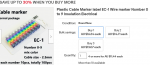
Maybe these? Number each cable?

Screenshot 2022-03-30 at 18-43-28 Plastic Cable Marker label EC-1 Wire marker Number 0 to 9 In...png
 
Oh goody ! I have just found tinned 7 core on the 12v Planet site. 1.5mm sq each wire; that seems to be a good size to carry e.g. a 12v deck floodlight of 50W , which would give a drop of 1.3v over 20m run.

Oceanflex 7 Core Tinned Marine Cable 7x21A 1.5mm² | 12 Volt Planet

Probably a separate negative return in larger cross-section to take accumulated load ?
I fitted a 5W MR16 LED spotlight to the deck floodlight which means I can get away with a smaller wire. This might be an easier and cheaper option than fitting a larger wire.
 
I am using the KISS principle with my rewire - all red and black. 1.5 and 2.5 mostly from the switch panel on 10 from the battery bus bars to the panel and 25 from the batteries to the bus bars and engine.. I am fortunate in that the batteries, engine, bus bars and isolators and switch panel are very close together and all runs are short. Have space to lay things out easily and use Dymo printed labels at terminals. The lighting and nav lights cabling is all in place and not planning on changing as it all seems sound. The windlass is powered by its own battery so the only long cable runs will be from the B2B charger to the battery.

I am actually working on it now (tea break) and will be fitting the fully wired switch panel and the battery box later today. hopefully will get some photos soon.
 
I based my rewire on the US standards as there didn't seem to be anything Euro or UK. For example, I have blue for cabin lighting, purple for nav equip and so on. Readily available from marine manufacturers such as Ancor. It does makie tracing wires easier when they are not just all red and black.
 
I've always used black and red, 1 and 1.5mm2 ( except starter and alternator) otherwise you end up with lots of waste. I'd like to label with a machine but have only white electricians tape with hand written lettering :(
I found self adhesive mini trunking good for a tidy installation but you should ideally de-rate the cable. BTW 1.4v drop on 12v is a lot IMH. 12%
 
Tim

Deciding how best to label and distinguish wiring is part of my day job. IMHO multi coloured wires work until you run out of primary colours, so in the case of a boat everything + is red and everything - is black. Then this leave brown and blue for the 240v stuff.

Then for each other conductor slide on numbers at each end, and my choice is these should be read from the left end where the standing part is in the right had (both ends of each cable) really is the best solution I have found. Each wire can be identified against the diagram i assume you would also create.

I do come across production machines with cable marks printed on each individual wire. I have also tried heat shrink printable shrink ferrules, but used the entire cartridge just carrying out some practice ferrules.
 
I just finished a major tidy up and mainly used red and black, but I did reuse the coloured feeds to the mast lighting.

One source for really good quality wire in many colours is an old radar cable...

I got most of my main supplies from Furneaux Riddal and Amazon..

The boat was originally wired with untinned twin gray or twin brown cable brought to Choco block connectors in the most obscure places....in theory this should have been bad but it worked for 40 years....
 
I fitted a 5W MR16 LED spotlight to the deck floodlight which means I can get away with a smaller wire. This might be an easier and cheaper option than fitting a larger wire.
It would be far better top use a decent sized wire if only for the robustness that results in longer life and reliabiolity. Fine wires are fine for inside electronics but are susceptible to corrosion and physical damage in a boat. ol'will
 
I am another who likes simple red and black. Hard for someone to get confused by it later.

However whatever you use, label label label both ends of every wire. Invest in a label maker (approx £30) and get some clear heat shrink to seal the labels to the cable.

What every colours you use, I am sure an electrician working on it in the future who prefer a clearly labelled system than one where he is not sure which colour standard was used.
I am another who likes simple red and black. Hard for someone to get confused by it later.

However whatever you use, label label label both ends of every wire. Invest in a label maker (approx £30) and get some clear heat shrink to seal the labels to the cable.

What every colours you use, I am sure an electrician working on it in the future who prefer a clearly labelled system than one where he is not sure which colour standard was used.
 
Be careful if using a dymo marker and then heatshrink, because the dymo is a heat process, and the hot heat shrink turns it black. I now use the small plastic numbers that just clip on.

And black and red single core everywhere for 12v and blue and brown for 240v.

Also leave a draw string in every run - you'll be grateful in the future :)
 
I did think of running a lorry-sized multi-wire trailer cable round the boat as a loom. One such cable has 12 separately coloured wires.

Colour coded wires can be very useful for some specific tasks, for instance when wiring shunts to A- and V- meters etc.
 
The PO used brown tape to designate the polarity of a battery wire...... live (+) or earth (-) would you reckon... brown is Uk mains live, but is also sort of earth/negative colour......
 
As well as a lot of the above, make a thorough schematic drawing of it to have as a permanent reference 'somewhere'. It takes minutes to do, and is such a useful starting point on any future fault finding.
 
It would be far better top use a decent sized wire if only for the robustness that results in longer life and reliabiolity. Fine wires are fine for inside electronics but are susceptible to corrosion and physical damage in a boat. ol'will
OP was going to use 1.5mm2 wire which he calculated to give a volt drop of 1.3V. That prompted my suggestion to reduce the demand from 50W to 5W for the same light output and only 0.13V drop. I wouldn't call 1.5mm2 wire fine and it should be robust enough. Going up to 2.5mm2 or 4mm2 wires has cost and installation issues as it is more difficult to route.
 
Top