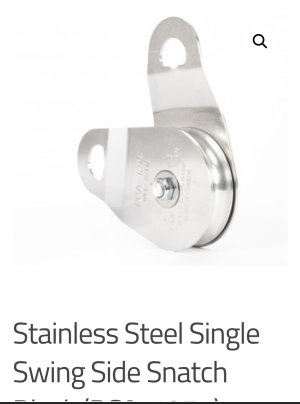
Pulley for Dinghy Mooring Ground Tackle.

Mark-1

Well-Known Member
Joined
22 Sep 2008
Messages
5,578
Visit site
I need a pulley for a simple dinghy‑hauling system using a continuous loop of 18mm rope. The rope runs out from land to over down to a seabed fairlead block, and back to shore. The dinghy’s painter clips to the moving loop so the boat can be pulled in and out from land to amd from it's mooring. (Does this arrangement have a name?)

I’m looking for a suitable fairlead block to live on muddy half tide seabed. It must be openable or bolt‑together because I'm not willing to re-splice the line.

Help!
 
18mm is very substantial for a dinghy running mooring. Most running moorings on The Dart use 10mm or 12mm. A marine snatch block that size will be very expensive. I would be tempted to pick up a large block at a boat jumble and drill out the top rivet and replace it with a nut and bolt. Alternatively get a suitable nylon sheave from Ebay and add a couple of stainless cheek plates and a couple of bolts and washers. Nobody is going to see it so it might as well be proper PBO style.
 
I need a pulley for a simple dinghy‑hauling system using a continuous loop of 18mm rope. The rope runs out from land to over down to a seabed fairlead block, and back to shore. The dinghy’s painter clips to the moving loop so the boat can be pulled in and out from land to amd from it's mooring. (Does this arrangement have a name?)

I’m looking for a suitable fairlead block to live on muddy half tide seabed. It must be openable or bolt‑together because I'm not willing to re-splice the line.

Help!
As in #3. Marine snatch blocks are super expensive but if you have a plastic sheave and are good at working stainless steel to make two cheeks.....
1000025170.jpg
 
18mm is very substantial for a dinghy running mooring. Most running moorings on The Dart use 10mm or 12mm. A marine snatch block that size will be very expensive. I would be tempted to pick up a large block at a boat jumble and drill out the top rivet and replace it with a nut and bolt. Alternatively get a suitable nylon sheave from Ebay and add a couple of stainless cheek plates and a couple of bolts and washers. Nobody is going to see it so it might as well be proper PBO style.

As it happens that's pretty much what I've done as a temporary repair. Looks like it's just been promoted to a permanant repair! Thanks.

Thanks everyone.
 
Does it have to be a block? Perhaps a low friction ring would be less likely to jamb.
Lying in the mud, it must be a better solution than a bearing of any kind.
I've never used a block for this. You can use a very large shackle or a stainless ring.
A friend used a big ceramic insulator from an overhead power line, it worked really well.
These days, you can buy large low friction rings for very little. £15 on ebay currently.
 
The low friction ring does fail on the ‘not having to splice’ requirement though?

When I had a wayfarer on this sort of mooring, I just used a big plain bearing Barton block. Worked OK for the couple of seasons I tried keeping a W on a mud berth.
 
Lying in the mud, it must be a better solution than a bearing of any kind.

Yes but, based on a sample of the two I've seen, the bearings disintegrate quickly so you soon end up with something that's exactly like a low friction ring on a shackle. :) The low friction ring is just the same thing achieved through intelligent design rather than evolution. 😁

If the problem falls to me again I'll put a low friction ring on a large stainless steel shackle.

The low friction ring does fail on the ‘not having to splice’ requirement though?

Not if it's put on a shackle.
 
Last edited:
The lakes here use this endless line system ..... and the end is passed through a large Bow Shackle which is fixed to the ring of the metal riser of the buoy .... the buoy of course anchored ..

No need for anything fancy ... they last for years .............. they have boats up to 25ft on such and most endless lines are ~12mm - more than enough .. but reasonable size for the hands.
 
I need a pulley for a simple dinghy‑hauling system using a continuous loop of 18mm rope. The rope runs out from land to over down to a seabed fairlead block, and back to shore. The dinghy’s painter clips to the moving loop so the boat can be pulled in and out from land to amd from it's mooring. (Does this arrangement have a name?)

I’m looking for a suitable fairlead block to live on muddy half tide seabed. It must be openable or bolt‑together because I'm not willing to re-splice the line.

Help!
It's called a running mooring and used to be very common here.
 
If your dinghy is always attached to the running mooring at the same point, why does the line have to be spliced?
When I had a running mooring, I had a pick-up buoy at the pennant, so obviously it didn't need to go through the block.
 
If your dinghy is always attached to the running mooring at the same point, why does the line have to be spliced?
When I had a running mooring, I had a pick-up buoy at the pennant, so obviously it didn't need to go through the block.

Exactly ... the line ends can be fixed to the ring or whatever used to attach to dinghy.

I think I prefer the method here though - where the endless line is above water and works via a buoy .....
 
+1 for just using a shackle. After a couple of months of lying in the mud the low friction ring won't be low friction and the pulley wheel won't turn.


What's currently on there is a surprisingly high-tech looking pulley, which, although destroyed early in it's undersea life, was turning fairly freely despite years in mud because the alarming amount of wear caused by sandy mud actually kept it free. So a pulley wheel will continue to turn for years. I must admit, that fact took me by surprise, I wasn't expecting to see a pulley, especially not one that was far from agricultural.

A shackle will certainly work but I'm not convinced it will work very smoothly because the land end is a shackle and that constantly gets stuck with a kink of rope. Not a problem if you can see it - a night mare if it's the other end. (Although bare shackle was plan B if I couldn't find the right bolt for a new sheave pin.)
 
Top