Princess V48

I got the post upgraded to 32 Amps, in fact the electrician said he upgraded to 42 on something. Even without splitting at the boat via a Y connector it seems to be much better. I'm going to load test this weekend with all the AC Units on etc, if it trips then I'll get the Y connector ordered and try that.
I don’t understand that at all. There seems to be total mix up/crossed purposes situation about what Y connection even means.

You’re meant to be feeding the whole boat from a single dock socket. The Y merely joins together 2 independent buses that the boat is built with. It doesn’t split anything. So if the dock post trips a “y connector ordered” won’t help.

Perhaps we are all at crossed purposes.
 
I’ll know more when I go down to the boat on Thursday. I have new upholstery for the cockpit being delivered. I’ll test everything then.

Can anyone explain the reason for a boat to have 2 separate shore power sockets (Bus 1 & 2 or as labelled Shore power 1 & Shore power 2)
 
I’ll know more when I go down to the boat on Thursday. I have new upholstery for the cockpit being delivered. I’ll test everything then.

Can anyone explain the reason for a boat to have 2 separate shore power sockets (Bus 1 & 2 or as labelled Shore power 1 & Shore power 2)
usually one socket is for all the 240v mains sockets, battery chargers, immersion heater, fridges etc. The other socket usually just supplies the aircon systems.
It is easy enough to find out which is which. Just plug in one socket and see what works and what doesn't.
 
Everything works from Shore power Bus 1 being plugged on to the marina post. Shore power 2 is disconnected. I'll get a wiring diagram from Princess
You need to ask the question , about 42 Amp , I hope he means the cable will take 42 amp. I don’t recollect there being a 42 amp breaker so I hope it’s the cable. The largest breaker to use on a 32 amp socket is a 32 amp Type D. So ask as insurance could be compromised .
 
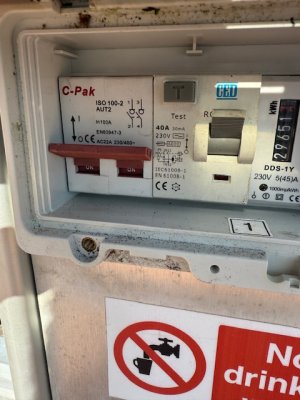
Here is a pic of the breaker. Is this wrong or dangerous if I’m using a 32 amp rated plug into the marina post?
It's fine. A purist might want it changed to a 32Amp RCD but I wouldn't bother. When aircon units start up they can pull a high peak current. I suspect the marina have fitted 40amp jobbies to reduce spurious tripping.
A 32amp connector can take a lot more than 32amps for a short period - minutes possibly hours depending on what is happening.
It will however be perfectly happy conducting 32amps all day long anywhere.
In the event of a fault big enough to trip a 32amp RCD, it will be big almost certainly be big enough to trip a 40amp one too. Plus you have your onboard breakers doing their thing too.
 
Can anyone explain the reason for a boat to have 2 separate shore power sockets (Bus 1 & 2 or as labelled Shore power 1 & Shore power 2)

You would blow the fuse of the dockside outlet if you use goodies like airconditioning , electric oven , maybe washing machine etc simultany on a single socket so there are two for loadsharing . On board both connect to a common ac bus .
 
Here is a pic of the breaker. Is this wrong or dangerous if I’m using a 32 amp rated plug into the marina post?
The 40 amp is the max current it can take it is not a breaker , the unit is RCD ie a Residual Current Device , it measures the current between live and neutral if does not match, it trips meaning you have a earth leakage.
 
Ok , can you explain what ?
Ok ok if the 2 bus units was joined on board , and you put power from two shoreside sockets via two trailing leads, to two fixed surface plugs on the boat , so say you disconnect one of the trailing sockets the pins on the fixed plug on the boat would have 230 volts on the pins, which could be DEADLY. I think you will find there could be two buses with Chang over switches . But would need to see CD.
 
Everything works from Shore power Bus 1 being plugged on to the marina post. Shore power 2 is disconnected. I'll get a wiring diagram from Princess
The information being given is sparse and not 100% clear.

Guessing a bit as to what precisely is happening, it sounds like you have a VSR on board, which joins the two on-board buses (and disconnects the unused boat shore connector socket) if only one shore connector on the boat is connected to the dock post 230v. The two buses then function as one and the unused shore connector is automatically safe.
 
When you connect the primary shore power on the boat it feeds both the air conditioning / heating system and the boat - chargers, sockets, water heater, refrigeration etc.

When you connect the second shore power to the boat this just feeds the heating / air conditioning removing it from the primary supply.

When you have a 32 amp supply there is no need to use the secondary shore power connection. However when there are only 16 amp feeds available you need to use both shore power inputs on the boat ( you will need 32amp to 16 amp adaptors). This allows you to run a limited air conditioning / heating service and also selective items on the boat.

Your air conditioning / heating is zoned, so you might just turn the master cabin heating on and see how many amps that draws. Then maybe see if you can turn the saloon on and still remain under 16 amps.

On the boat side of things don’t use a toaster at the same time as a kettle or hair dryer and be mindful of background items like the chargers and refrigeration. Watch out for the water heater, this uses quite a lot of power and you can forget it’s running. Your electrical panel will allow you to monitor current usage on each of the two circuits.

I hope that makes sense. In the UK there are only limited 32 amp supplies so you often need to use a pair of 16 amp supplies. We can actually take 64 amps into our primary feed but I’ve only once come across a 64 amp supply.

Henry
 
Ok ok if the 2 bus units was joined on board , and you put power from two shoreside sockets via two trailing leads, to two fixed surface plugs on the boat , so say you disconnect one of the trailing sockets the pins on the fixed plug on the boat would have 230 volts on the pins, which could be DEADLY. I think you will find there could be two buses with Chang over switches . But would need to see CD.

Of course the installation is designed to prevent reverse flow in such a scenario , basicly there is a diode on each line which allows flow in only one direction . The same we find in every battery charger where 230v input is transformed to 12output . There is a protection should somebody connect the charger to a battery with the cord plugged off to prevent we then have reverse flow with 12v input and transforming it to 230v output on the pins .

A buddy has a big fly with two lines and everything works from every line , just limited to the fuse on the dockside socket so its about load sharing on a big boat and not you have different things connected to different lines imho .
 
Of course the installation is designed to prevent reverse flow in such a scenario , basicly there is a diode on each line which allows flow in only one direction . The same we find in every battery charger where 230v input is transformed to 12output . There is a protection should somebody connect the charger to a battery with the cord plugged off to prevent we then have reverse flow with 12v input and transforming it to 230v output on the pins .

A buddy has a big fly with two lines and everything works from every line , just limited to the fuse on the dockside socket so its about load sharing on a big boat and not you have different things connected to different lines imho .
Sorry that is wrong. The current involved in these circuit is alternating. Diode(s) would not stop all the voltage. If a full bridge rectifier was fitted inline then much of the AC powered devices plugged in would not then work.

Load sharing across two connectors is generally a bad idea because one connector could end up with more current flowing through it than the other and could overheat. If say the boat has a max input current of 32 amps and both connectors where 32 amp rated that would be OK. But it would need isolation relays to make it safe as per Henryf's post.
If the boats max consumption was 64amps and that was split over two 32amp connectors just wired together internally there is a good chance one of the connectors would over heat.

Without some sort of relay mechanism to share/split the power, one connector would be exposed as live and as seastoke posted dangerous.
 
Last edited:
Just to clarify my previous post: when using a pair of 16 amp shore power feeds each feed goes into one of the boat inputs via a dedicated shore power lead. There are no 2 into 1 connectors. One of the shore power feeds supplies the heating, the other supplies the rest of the boat and there is no connection between the two. If you trip the heating feed the rest of the boat will still be powered and visa-versa.
 
Of course the installation is designed to prevent reverse flow in such a scenario , basicly there is a diode on each line which allows flow in only one direction . The same we find in every battery charger where 230v input is transformed to 12output . There is a protection should somebody connect the charger to a battery with the cord plugged off to prevent we then have reverse flow with 12v input and transforming it to 230v output on the pins .

A buddy has a big fly with two lines and everything works from every line , just limited to the fuse on the dockside socket so its about load sharing on a big boat and not you have different things connected to different lines imho .
Oh dear.
 
When you connect the primary shore power on the boat it feeds both the air conditioning / heating system and the boat - chargers, sockets, water heater, refrigeration etc.

When you connect the second shore power to the boat this just feeds the heating / air conditioning removing it from the primary supply.

When you have a 32 amp supply there is no need to use the secondary shore power connection. However when there are only 16 amp feeds available you need to use both shore power inputs on the boat ( you will need 32amp to 16 amp adaptors). This allows you to run a limited air conditioning / heating service and also selective items on the boat.

Your air conditioning / heating is zoned, so you might just turn the master cabin heating on and see how many amps that draws. Then maybe see if you can turn the saloon on and still remain under 16 amps.

On the boat side of things don’t use a toaster at the same time as a kettle or hair dryer and be mindful of background items like the chargers and refrigeration. Watch out for the water heater, this uses quite a lot of power and you can forget it’s running. Your electrical panel will allow you to monitor current usage on each of the two circuits.

I hope that makes sense. In the UK there are only limited 32 amp supplies so you often need to use a pair of 16 amp supplies. We can actually take 64 amps into our primary feed but I’ve only once come across a 64 amp supply.

Henry
Thank you. Okay I’m all good now. Understand this fully. I’m running all zones AC on shore power 1 with 32 amps. So all good. Thanks all.
 
Top