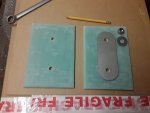
Plastic chopping board for backing plate!

Zagato

Well-Known Member
Joined
2 Sep 2010
Messages
2,813
Location
Chichester Harbour
Visit site
Apart from wood, what do people use as a backing spreader plate for some deck fittings... my wife's plastic chopping board looks just right for the job! Just needs chopping up!

 
Apart from wood, what do people use as a backing spreader plate for some deck fittings... my wife's plastic chopping board looks just right for the job! Just needs chopping up!
My aluminium mast has been standing on a piece of plastic chopping board for many years to insulate it from the galvanised steel mast-step.
 
Apart from wood, what do people use as a backing spreader plate for some deck fittings... my wife's plastic chopping board looks just right for the job! Just needs chopping up!
I find that polyethylene chopping boards are a very good source of material for use as backing plates. Keep an eye open for bargains from pound shops etc.
Mike
 
They are very good for isolation of dissimilar metals, but not in my view good as a load bearing under deck backing for deck fittings (if this is the application you had in mind).

The material is not strong and bolts heads tend creep to pull through the plastic even with large washers.

Better is to use, aluminium, stainless steel, fibreglass, or fibreglass /ply.
 
I'm sorry to be such a killjoy - and people do complain about me

I am sure someone will pop up and tell you why you should not use chopping boards (but it will not be me).

I had the same quandary and having used offcuts of marine ply I made my own by simply laying up glass and resin. It depends what you need the backing plates for but you can lay up multiple or single layers of glass, I use 750gm glasss. Lay up on a sheet of polythene, as a peel coat, and then as many layers as you want. You can chop them up to whatever size you need bond them with Sika or with resin - so they become structural. Thin sheets flex so the match hull curves. You can cut with a hole saw or angle grinder.

If you make big enough pieces one batch will last for years.

If you wanted to be fancy you could make them from foam and glass.

Depending on the application I have also used 3mm stainless plate and 5mm aluminium plate.

Jonathan
 
They are very good for isolation of dissimilar metals, but not in my view good as a load bearing under deck backing for deck fittings (if this is the application you had in mind).

The material is not strong and bolts heads tend creep to pull through the plastic even with large washers.

Better is to use, aluminium, stainless steel, fibreglass, or fibreglass /ply.

As noelex says above: chopping boards are usually HDPE which creeps under load and is unsuitable for backing plates
 
As noelex says above: chopping boards are usually HDPE which creeps under load and is unsuitable for backing plates
If you visit a Plastic fabrication place or stockist, you can buy half inch thick nylon sheet, they make spatulas for the food industry out of this, you can buy off cuts that work well as backing plates.
 
I agree with Noelex and DavyS. Don't use HDPE where you want dimensional stability for a critical application.
 
I recently asked a club member about using HDPE for backing pads on my Sea Feather and he said he had it for an outboard mount. The HDPE ended up slipping slightly against the glass with vibration causing the holes in the glass to oval giving him a bigger job.

I opted for 10mm G10 which I've rounded the edges, this will be stuck in with thickened epoxy, a fillet edge and then glassed over whilse I'm at it. I'll be replacing all the soft ply the same way in due course.
120471996_3266327576749074_308274549473442328_n.jpg
 
I don't know what my 30' aluminium mast and ancillaries weighs but the piece of domestic chopping board on which it has stands has not crept anywhere since I fitted it in 1998.
 
Warning : they won't be around for long !

Those who count themselves as aficionados of 'Saturday Morning Kitchen' or 'Master Chef' will have picked up that plastic boards are riddled with germs, chefs are now running scared and embracing wooden boards, far more healthy .
 
Warning : they won't be around for long !

Those who count themselves as aficionados of 'Saturday Morning Kitchen' or 'Master Chef' will have picked up that plastic boards are riddled with germs, chefs are now running scared and embracing wooden boards, far more healthy .

Surely wooden boards are absolutely teeming with germs?
 
I recently made spacer pads for a mainsheet track from nylon blocks. Loads of suppliers on ebay who will cut to size. Same sources will provide you with HDPE also.
 
I'm sorry to be such a killjoy - and people do complain about me

I am sure someone will pop up and tell you why you should not use chopping boards (but it will not be me).

I had the same quandary and having used offcuts of marine ply I made my own by simply laying up glass and resin. It depends what you need the backing plates for but you can lay up multiple or single layers of glass, I use 750gm glasss. Lay up on a sheet of polythene, as a peel coat, and then as many layers as you want. You can chop them up to whatever size you need bond them with Sika or with resin - so they become structural. Thin sheets flex so the match hull curves. You can cut with a hole saw or angle grinder.

If you make big enough pieces one batch will last for years.

If you wanted to be fancy you could make them from foam and glass.

Depending on the application I have also used 3mm stainless plate and 5mm aluminium plate.

Jonathan
I used some bits of GRP from the boatyard skip. Some nice thick bits where someone had cut out an extra portlight, and some others. Cut to shape add a few layers of matt and resin. Bond in place with chopped matt and resin 'mash'.
 
Another gotcha from my experiences with using chopping board - sealant won't stick to it so that has disadvantages if you were thinking of gluing in place, or if it is over something that you want to remain watertight.
 
Top