Plastic chopping board for backing plate!

They are very good for isolation of dissimilar metals, but not in my view good as a load bearing under deck backing for deck fittings (if this is the application you had in mind).

The material is not strong and bolts heads tend creep to pull through the plastic even with large washers.

Better is to use, aluminium, stainless steel, fibreglass, or fibreglass /ply.

+1

I'd use aluminum plate - in fact did when I had to mount a boarding ladder... plenty of it pretty cheap on eBay.. the plastic choping board is the business for non-heavy use though...
 
A problem with plastic boards is that nano sized particles are removed whenever you scour the surface clean. This is not a Good Thing.

Wood is much better, and can be sterilised by bleach or hot water.. IIRC There's a report by the University of Wisconsin somewhere.
 
Warning : they won't be around for long !

Those who count themselves as aficionados of 'Saturday Morning Kitchen' or 'Master Chef' will have picked up that plastic boards are riddled with germs, chefs are now running scared and embracing wooden boards, far more healthy .
I now have visions of Chefs running round on deck screaming, "We're" doomed", in a Private Fazer voice.
 
Another vote for G10.
Its pretty much the perfect material for backing plates, bed it on some thickened epoxy to stop the plate bridging any unevenness in the GRP.
 
I cut out rings and use these to make a flat base from epoxy and filler. Seacocks etc are then being fitted to a flat surface.
 
My favourite shipwright, Louis Sauzede, RIP, showed a vid putting sister frames of HDPE in a FV, he said they were also building a new boat with HDPE frames. You can't pull a screw out of it, and I have drilled and tapped it, then inserted a bolt. Then I hauled the bolt out with a nut, then wound it back in, the threads had folded and not stripped. Good enough for non critical stuff.
Used it for a couple of frames in my wooden punt, it can be heated with a gun and turned very tight.
 
From an engineer's perspective, polyethylene (cutting board ) is perhaps the structurally most useless material you could chose. It is weak, creeps over time, cracks under sustained high load. It does not actually distribut e the load in the long term because it bends over time. It only looks like it is working. It is not a structural material.

Place a 50 pound weight on the cutting board, suspended across two sticks. See how it takes a set in a few weeks. Then remember that the preload on the bolts is probably 1000 pounds. Just silly.

FRP and aluminum or SS are good choices. Extra thick (not standard) fender washers can work, as can laying up a few layers of 1708.

---

Sorry if that was harsh. Just the truth as known by all engineers.
 
Contrary to popular belief, plastic cutting boards are not automatically more food-safe than wood. It’s assumed that because wood is a porous surface and plastic isn’t, plastic boards are more resistant to bacteria. However, this doesn’t take into account the scars a plastic cutting board will get from daily use letting harmful toxins and bacteria in. So, in essence, wooden boards are actually a lot more sanitary in the long run.
Plastic Vs Wooden Chopping Boards: Which is better? - Eco Food Boards
 
I'd be very wary about using an aluminium backing plate, if there is any chance of getting a saltwater leak.
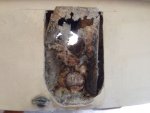
corroded Al backing plate.JPG
What remains of an aluminium backing plate

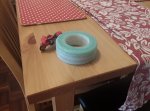
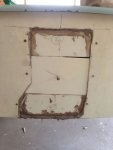
I repaired using chopping boards as a backing,
Plastic chopping boards.JPG
The screws are just temporary, to hold the board in place while the epoxy thickened with micro fibres cured.
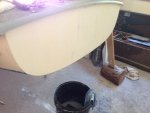
After epoxy glass and fairing.JPG
After covering with multiple layers of epoxy glass and fairing

The choice of chopping boards was driven by what was available, I was in NSW, Australia, I'd have prefered to use a GRP sheet.
It's a 16ft Corsair dinghy, still going strong many years after the repair. The boat is about 50 years old and was still using the original sails until we replaced them last year.

I've also had an Aluminium backing plate fail on my Southerly 46RS. The plate was reinforcing the turning block on the lifting keel (2.5tons), and failed because the aluminium corroded and split open the GRP it was encapsulated in.
 
Top