PLANING BOAT PECULIAR USE QUESTION

kolyo

Well-Known Member
Joined
5 Jul 2020
Messages
155
Visit site
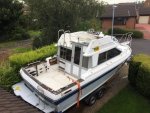
Yes, I know that the idea of considerably downsizing in power "Alex", our Bayliner 2556 Command bridge, is unwise, to say the least, in regard to her resale value. BUT at 75 I think she may well be the LAST boat I will be driving. So any arguments about a substantial loss of money at some future point are immaterial to me.

Unfortunately my boating habits have altered quite a bit in the last few years due to the knee and vertebrae problems my better ;) half is having lately. We even reached to the point when she refused point blank to limp on board unless I solemnly swore that we'll be plodding along gently in absolutely no more than force 3 winds. So it looks like I've received a life sentence to sail exclusively in calm to slightly rough conditions at a hull speed. Which in my case is about 6-7 knots. But since our "Älex" is a 25-35 knot planing boat I obviously have a problem. Luckily my usual boating grounds are quite sheltered, with virtually no tides or strong currents with no more than 10 N.m. of open water to cover. Ironically, the derogatory "Bay-Liner" has turned out to be quite apt in the circumstances.

But the point. I have the crazy intention to sell the existing and quite long in the tooth Mercruiser 7.4L along with the Bravo 2 drive for as much cash as I can and then install an outboard of appropriate hp on an appropriate bracket attached to the appropriate place of the transom. I got the courage to do this after bumping into an amazing thread about I/O to O/B conversion:

Inboard To Outboard Conversion Project Wellcraft St. Tropez - The Hull Truth - Boating and Fishing Forum.

The guy successfully replaced his two fuel sucking inboard monsters on his 1988 Wellcraft St. Tropez with a couple of much more efficient, easy to service and maintain outboards. The only, if quite significant, difference is that he went up in power whereas I'm planning to decrease it. What I can't decide is by how much. My gut feeling is that 50 to 60 hp will be plenty to push the boat at a displacement or close to "hump" speed no matter if the conditions suddenly got nasty.

The other thing that is bothering me is how uncomfortable will the ride become at such low speeds in case we are faced with unpredictable choppy seas???
 
Last edited:
First question, is the Mercruiser nigh unto death. Constant repairs needed or worried about breaking down?

If no to all the all the above and the engine is just aging but if aging gracefully (don't we all? ;) ) then why not keep it? Just because the power is there you don't have to use it and running a slow or displacement speed the fuel burn will improve dramatically. Probably won't burn a huge amount more than a new outboard and the money you save on keeping the old engine vs what you save on fuel would take 20 years to make up the difference.

A couple of benefits if you keep the old motor.

1. If you need the speed for any reason you'll still have it.

2. Comfort. Occasionally I've found that in certain choppy conditions the most comfortable ride is to run at that in between speed, well below planing speed but a bit more than displacement hull speed; basically squat the stern and raise the bow. Very inefficient but it can avoid the rolling and wallowing you get a lower speeds and uses the V of the bow to plow through the waves and minimize the bounce.
 
Either change the way you use the boat and put up with the imperfections or change the boat for a semi or displacement boat
As has been said you can run the boat at less speed although the temptation to do otherwise remains
 
I grew up on semi displacement and deep vee hulls, of which the vee can have an uncomfortable or even dangerous snap roll.

running a Duffy 35 and a Young brothers 45 now, which take heavy seas with grace and comfort.

For a guy with two back surgeries and approaching 60, it lets me fish far offshore in some very lumpy seas.

It may be worth looking into a comparably sized down east style craft.
 
First of all -- thanks for the input to all who took the time to reply, it's really appreciated!

First question, is the Mercruiser nigh unto death. Constant repairs needed or worried about breaking down?

If no to all the all the above and the engine is just aging but if aging gracefully (don't we all? ;) ) then why not keep it? Just because the power is there you don't have to use it and running a slow or displacement speed the fuel burn will improve dramatically. Probably won't burn a huge amount more than a new outboard and the money you save on keeping the old engine vs what you save on fuel would take 20 years to make up the difference.

A couple of benefits if you keep the old motor.

1. If you need the speed for any reason you'll still have it.

2. Comfort. Occasionally I've found that in certain choppy conditions the most comfortable ride is to run at that in between speed, well below planing speed but a bit more than displacement hull speed; basically squat the stern and raise the bow. Very inefficient but it can avoid the rolling and wallowing you get a lower speeds and uses the V of the bow to plow through the waves and minimize the bounce.

1. No, my 454 is far from being high unto death with only 450 hours on the clock. But nevertheless'the engine is over 30 years old. Also it has several parts replaced with non-OEM ones by the previous owners, e.g. a cheaper Chinese exhaust manifold, starter, etc, On top of that there are some quite rusty areas, the most worrying of them being on the oil sump. Apart from that the over 3 decades old fuel tank is highly hazardous unless I don't replace it soon enough at quite a hefty price. Plus the rather unappealing cost of servicing an 8 cyl. inboard engine and a Bravo out-drive being about a grand p.a. Without making use of their full potential it seems a pretty extravagant expense to me.

2. I have fount too that a semi displacement speed is best for comfort in choppy condition. This is why I plan for a 50 or 60 hp high thrust outboard which (hopefully) will be able to push my not so heavily loaded 25-footer with a nearly 10 ft beam at about 9-10 knots.

3. Saving on fuel is the least of my worries. But the time wasted for frequent repairs or replacements is of HUGE concern. At my age every hour of boating I am allowed becomes equal to a week or even a month in the life of a much younger person.
 
Last edited:
IMHO you should sell that boat and buy something more appropriate to your needs.

Oh, I wish it was that simple?

I spent quite some time looking to find exactly this type of boat -- one with a very spacious and unobstructed by an engine room "hump" aft deck, and, ABOVE ALL, one equipped with a flybridge!! To me these are two indispensable advantages of the Bayliner 2556 that are found only in boats costing four to five times as much. My boating is done in the often stuffy, stifling long summer months of Halkidiki, Greece and the feeling when having a sip of beer in the upper station seat or helming from there is simply incomparable. Not to speak of the view from up there when cruising or docking.

You see, I reverted to driving cars with a high steering positions some years ago and since then every time I sit in SWIMBO's "normal" one I feel quite nervous. Behind the wheel of my Land Cruiser 100 with a 2" lift I feel exactly as if I'm in a flybridge. And I'll never go back on that.
 

Attachments

  • 86787-78106.jpg
    86787-78106.jpg
    93 KB · Views: 44
Last edited:
I grew up on semi displacement and deep vee hulls, of which the vee can have an uncomfortable or even dangerous snap roll.

running a Duffy 35 and a Young brothers 45 now, which take heavy seas with grace and comfort.

For a guy with two back surgeries and approaching 60, it lets me fish far offshore in some very lumpy seas.

It may be worth looking into a comparably sized down east style craft.

Thanks for sharing about your two back surgeries. That's quite reassuring in view of my wife's condition.

The difference in my case is that I NEVER go out fishing or cruising when there is even the slightest chance of encountering anything close to heavy seas. As I said in my original post my fishing/leisurely cruising grounds are pretty safe, with no more than 5 to 6 N.m, away from a shore at any given time.
 
2. I have fount too that a semi displacement speed is best for comfort in choppy condition. This is why I plan for a 50 or 60 hp high thrust outboard which (hopefully) will be able to push my not so heavily loaded 25-footer with a nearly 10 ft beam at about 9-10 knots.


The problem is that the hull speed of your boat is, in reality, more like 5-6 knots. The waterline length on these are only around 22ft. You will achieve hull speed with around 10hp. To go beyond, particularly into the realms of 10 knots will take a lot more power and use considerably more fuel. After 6 knots, the next most efficient speed is around 18 knots. 50-60hp won't, IMHO. be enough. Then there is the fact that a planing hulled boat is designed to plane. It will be pretty awful at displacement speeds in any sort of chop. I know you said you won't go out in chop, but in reality it is nearly always there to some extent.

I would sell the boat and buy something more suitable, failing that continue with your plan but settle on a 6 knots cruise rather than 10 knots and put a 25hp or similar on the back.

In fact, save yourself the hassle and just buy this one (no connection) Bayliner 2556 Flybridge 25hp outboard 4 stoke | eBay
 
It’s a big project. Also consider that when you replace a heavy engine with a light one your boat will drive different. I had this problem once and had to get all my passengers and my late big dog to the back of the boat so that I could manœuvre in port. Of course with the outboard you can fit it lower in the water
 
I take your point regarding servicing and maintenance time/costs.

I have an outboard powered boat for the reason that I do about an hours servicing each year then go boating....

I can't be bothered with all the faffing around with outdrives/belts/risers/manifolds etc. Bugger the fuel cost comparision of petrol/vs white diesel (stand by boys!!)

My sums:-

500 NM annually @ 3mpg average (mix of displacement and planing). 167 gallons (758 litres @ say £1.30 - mix of own fuelling and waterside) = £985
Diesel outdrive similar HP say 5 MPG so 100 gall - 455 litres at say 70p/litre £318.50.

A difference of £666 - I'll go boating I think!!
 
I take your point regarding servicing and maintenance time/costs.

I have an outboard powered boat for the reason that I do about an hours servicing each year then go boating....

I can't be bothered with all the faffing around with outdrives/belts/risers/manifolds etc. Bugger the fuel cost comparision of petrol/vs white diesel (stand by boys!!)

My sums:-

500 NM annually @ 3mpg average (mix of displacement and planing). 167 gallons (758 litres @ say £1.30 - mix of own fuelling and waterside) = £985
Diesel outdrive similar HP say 5 MPG so 100 gall - 455 litres at say 70p/litre £318.50.

A difference of £666 - I'll go boating I think!!


Horses for course though innit. Bigger boat that requires two engines, doing a decent mileage per year, (I tend to do about 1000). Cruising where petrol isn't widely available (ie anywhere that isn't South coast/Solent)

I would never say that petrol, or outboards, are always the wrong choice. In many instances they can be exactly the right choice, but equally you have to accept that in many other cases, diesel is the only sensible choice.

(BTW I'd like to see you do a full service on a 4 stroke outboard, that has the impeller in the leg in about an hour)
 
Horses for course though innit. Bigger boat that requires two engines, doing a decent mileage per year, (I tend to do about 1000). Cruising where petrol isn't widely available (ie anywhere that isn't South coast/Solent)

I would never say that petrol, or outboards, are always the wrong choice. In many instances they can be exactly the right choice, but equally you have to accept that in many other cases, diesel is the only sensible choice.

(BTW I'd like to see you do a full service on a 4 stroke outboard, that has the impeller in the leg in about an hour)

You just need to be organised with all the tools ready - I do it on a lift and hold including the leg oil change, main oil and filter plus replace impeller... Boatyard charge £125, compared to lift, chock off, lift and relaunch @ £235

Remote boating away from the south coast would mean diesel is the best option, but as a huge number of people are on the South coast its not nearly so much of an issue.
 
Remote boating away from the south coast would mean diesel is the best option, but as a huge number of people are on the South coast its not nearly so much of an issue.

Well speak for yourself, but I wouldn't be doing the boating that I do if I had two big outboards on my transom.
 
Top