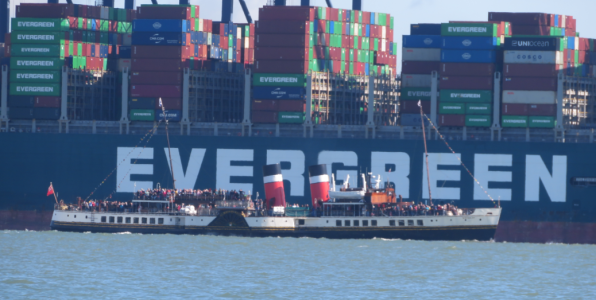
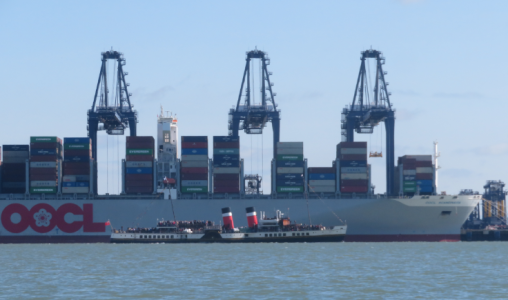
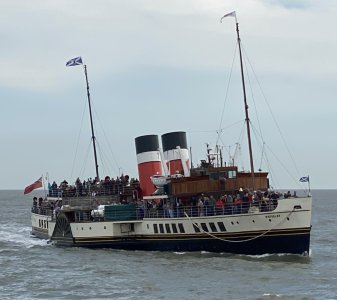
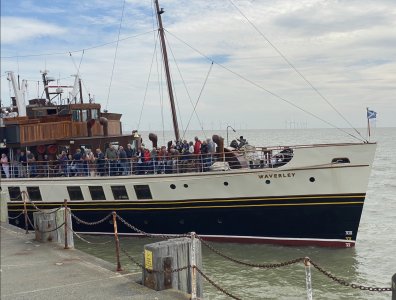
Paddle steamer heading down the Orwell.

We had an outing on the Waverley a few years back and always wondered myself why she didn't have independent paddles and assumed that it could be done with one engine and a clever arrangement of valves, but I guess not. Thanks for the info(y)😁
Her engine is a triple expansion steam engine, so the exhaust steam from one cylinder is used to operate the next, larger diameter cylinder. So all the pistons and cranks you see when you watch her engine are in a sort of cascade from high pressure to low. To drive two independent shafts you'd need to have a separate crankshaft, and then gearing from it to two independent paddle shafts. The increase in complexity would be substantial, the space requirements much greater and there are safety reasons why it isn't usually done.
 
Her engine is a triple expansion steam engine, so the exhaust steam from one cylinder is used to operate the next, larger diameter cylinder. So all the pistons and cranks you see when you watch her engine are in a sort of cascade from high pressure to low. To drive two independent shafts you'd need to have a separate crankshaft, and then gearing from it to two independent paddle shafts. The increase in complexity would be substantial, the space requirements much greater and there are safety reasons why it isn't usually done.
It used to be entertaining as a child watching the RN PAS diesel tugs in Portsmouth harbour, they had independently controlled paddles. But more easily done with diesel than steam as AP states.
 
It used to be entertaining as a child watching the RN PAS diesel tugs in Portsmouth harbour, they had independently controlled paddles. But more easily done with diesel than steam as AP states.
I understand that while independent paddles are ok on tugs, they are regarded as too hazardous for passenger carrying vessels; if operated incorrectly they can result in a capsize.
 
19.45 Friday. If anyone is interested there is a paddle steamer heading down the Orwell from Harwich.
My wife and I did the trip a few year's back. Just magical.
Drove to Ipswich to board coach to Harwich. Then Waverley to under Tower Bridge. Great commentary during London River. We only managed to get tickets as someone dropped out.
 
A few years ago now, coming south through the Caledonian canal tied up for the night on a pontoon next to a rather nice motor cruiser.

Engaged in chat with the skipper who turned out to a master mariner who had been an occasional skipper on the Waverley.

He said it was always amusing to see the look of horror on the faces of passengers on a pier she was approaching due to the speed of approach till at the last (appropriate) moment full astern was applied to bring her to a stop.

She wasn't all that easy to handle without the appropriate experience apparently.
 
I saw her the Kyles too. Often around here, using Southend Pier. Not going to be much turning space in the revised plan for Ipswich is there? Might need a little tug.
Hi Roger,

I dida short local passage on her from Halfpenny Pier in 2017 and we needed a tug to turn her without contemplating entering the Wet Dock. My dodgy memory seems to recall we turned just below the Orwell Bridge, but it may have been higher up off Cliff Quay. He did manage the turn off the Blackwater estuary to head back to Halfpenny pier without a tug, and that was masterful for such a large paddler and the coordination between line handlers and the helm for getting both off and back onto Halfpenny pier was a treat to watch.

Even longer ago, I did a trip on the smaller Kingswear Castle just after Babcocks had retubed her boiler. Setting off from London Bridge pier we headed first down river under Tower Bridge and on to just above the Thames Barrier where she did an impressive10 point turn to return upriver. Having passed again under Tower Bridge, we carried on almost up to London Bridge where the helm performed what felt like a 20 point turn before coming alongside London Bridge pier. The helmsman's patience and skill with this cumbersome vessel in 25 knots or more of breeze was an education for any seaman paying attention.

There is good reason the paddles cannot be rotated independently. The crankshaft is as long as the beam of the ship and runs transversely so the "transmission" is a simple matter of bolting a paddle on each end of the crankshaft. Reversing involves no gearbox but is achieved simply by changing the valve timing. just as on a railway loco. These ships have a narrow beam for their length and so when folk did try independent paddle wheels to aid manouvering, contra rotating the paddles led to capsize. As far as I'm aware, the only successful paddlers with contra rotating wheels were the RN Director class paddle tugs built in the 1950's to handle aircraft carriers, but others may know better. The Director class had two diesel engines, one for each paddle, with electric transmission. They were 60 ft beam to reduce the capsize risk but, I believe, still had an interlock to prevent applying too much power when contra rotating.

Peter.
 
It used to be entertaining as a child watching the RN PAS diesel tugs in Portsmouth harbour, they had independently controlled paddles. But more easily done with diesel than steam as AP states.
One of pair of MOD paddle tugs launched long after the screw had taken over.
Originally designed as harbour tugs they proved woefully underpowered and difficult to use, were soon demoted to provisioning duties, then laid off and supposed to be scrapped.
One of them was rescued and went off to the USA for restoration ?????. believe this was its twin?
Bought with a view to restoring it, failing to find any funding what so ever was dumped on this floating barge around 30 + years ago and left to rust, the hull has deteriorated considerably since this photo was taken with some gaping holes now in the hull plating.
It can be viewed anytime in Short Reach on The Mudway.


John H Amos History

"Unlike all passenger carrying paddle steamers, the John H. Amos was able to work each engine independently. This gave the manoeuvrability necessary for a tug. It was found that on passenger vessels, when approaching port, the passengers went to one side of the boat to disembark. If the engines were then worked independently the uneven distribution of weight could capsize the vessel. The John H Amos invariably worked with the clutch disengaged."
Wikipedia.

"European side-wheelers, such as PS Waverley, connect the wheels with solid drive shafts that limit maneuverability and give the craft a wide turning radius. Some were built with paddle clutches that disengage one or both paddles so they can turn independently. However, wisdom gained from early experience with side-wheelers deemed that they be operated with clutches out, or as solid-shaft vessels. Crews noticed that as ships approached the dock, passengers moved to the side of the ship ready to disembark. The shift in weight, added to independent movements of the paddles, could lead to imbalance and potential capsizing. Paddle tugs were frequently operated with clutches in, as the lack of passengers aboard meant that independent paddle movement could be used safely and the added maneuverability"
 
Last edited:
My only trip on a paddle steamer was on the Rhine in 1975, which was delightful. The young men on board continued to sing in tune even when absolutely plastered. There is also one that does excursions on the Kiel canal that I have photos of somewhere.
 
One of pair of MOD paddle tugs launched long after the screw had taken over.
Originally designed as harbour tugs they proved woefully underpowered and difficult to use, were soon demoted to provisioning duties, then laid off and supposed to be scrapped.
One of them was rescued and went off to the USA for restoration ?????. believe this was its twin?
Bought with a view to restoring it, failing to find any funding what so ever was dumped on this floating barge around 30 + years ago and left to rust, the hull has deteriorated considerably since this photo was taken with some gaping holes now in the hull plating.
It can be viewed anytime in Short Reach on The Mudway.


John H Amos History

"Unlike all passenger carrying paddle steamers, the John H. Amos was able to work each engine independently. This gave the manoeuvrability necessary for a tug. It was found that on passenger vessels, when approaching port, the passengers went to one side of the boat to disembark. If the engines were then worked independently the uneven distribution of weight could capsize the vessel. The John H Amos invariably worked with the clutch disengaged."
Wikipedia.

"European side-wheelers, such as PS Waverley, connect the wheels with solid drive shafts that limit maneuverability and give the craft a wide turning radius. Some were built with paddle clutches that disengage one or both paddles so they can turn independently. However, wisdom gained from early experience with side-wheelers deemed that they be operated with clutches out, or as solid-shaft vessels. Crews noticed that as ships approached the dock, passengers moved to the side of the ship ready to disembark. The shift in weight, added to independent movements of the paddles, could lead to imbalance and potential capsizing. Paddle tugs were frequently operated with clutches in, as the lack of passengers aboard meant that independent paddle movement could be used safely and the added maneuverability"
Looks like an older tug? This is the type I remember....

 
Out of interest, I was looking at the Wikipedia pages on them, and it seems that they are an important route for HGVs, avoiding tolls on the Dartford crossing - the ferries are free. Apparently, there is a long-term requirement for them to be run by TfL (I think), who outsource them to whoever actually runs them. Not sure, but I think it's a legislative requirement that would require parliamentary time to overthrow,
 
Top